
Best Cardio for Fat Loss at Home: Easy Workouts That Burn More Calories
This blog explains how cardio for fat loss works by combining science-backed strategies, high-intensity workouts, and smart nutrition. It highlights the critical difference between fat loss and weight loss, emphasizing the importance of preserving muscle to maintain a healthy metabolic rate. The guide showcases effective cardio for fat loss exercises such as HIIT, skipping, burpees, and stair climbing, all designed to maximise calorie burn and trigger the powerful afterburn effect (EPOC). It also outlines a practical weekly workout plan, ideal durations for different fitness levels, and the role of protein-rich foods in sustaining muscle and boosting metabolism. By blending structured cardio for fat loss routines with strength training and a consistent calorie deficit, the blog presents a sustainable, results-driven approach to achieving a leaner, stronger physique.
Neha Shukla
6/1/20267 min read
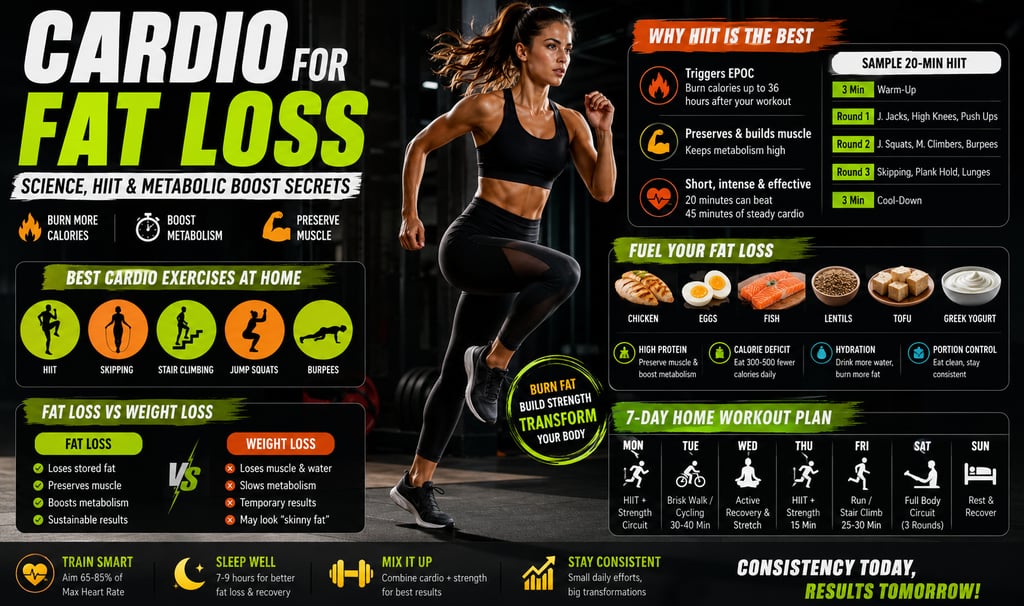
How Cardio for Fat Loss Works: Science, HIIT & Metabolic Boost Secrets
You follow a disciplined routine, avoid indulgences, and still the mirror offers little reassurance. It feels as though your efforts are vanishing into thin air. The truth is, transformation demands more than mere movement. It calls for intention. The right cardio for fat loss is not about endless hours of exercise, but about choosing movements that awaken your metabolism and sustain calorie burn long after you have finished.
Many people unknowingly rely on routines that promote fatigue rather than results. This is where cardio for fat loss becomes a quiet game changer. When done correctly, it refines your physique, preserves lean muscle, and enhances your metabolic rhythm. Instead of chasing the scale, it helps you sculpt a stronger, more defined body.
If you have been searching for a method that truly works, understanding cardio for fat loss may finally shift your journey from effort to visible, lasting results.
What is the Difference Between Fat Loss and Weight Loss?
Weight loss reduces total body mass, which could be water, muscle, or fat. Fat loss deliberately trims stored adipose tissue whilst preserving lean muscle. A neighbour once lost 8 kg in two months through crash dieting and relentless cardio. She looked thinner, felt weaker, and regained everything within six weeks.
Losing muscle slows the metabolic rate, making future fat reduction progressively harder. This is precisely why targeted cardio for fat loss matters more than sheer volume of exercise.
Fat loss preserves muscle; weight loss does not discriminate between muscle and adipose tissue.
Slowing metabolic rate after muscle loss makes burning fat considerably harder over time.
Best cardio to burn belly fat combines moderate-to-high intensity movement with consistent nutritional discipline.
Losing weight without resistance work often produces a "skinny fat" physique
Understanding this distinction is the foundational step before any workout routine begins. And with that clarity established, the next question is: which cardio exercises actually deliver maximum fat results?
What are the Best Cardio for Fat Loss That Burns Maximum Fat?
The finest cardio for fat loss at home recruits multiple muscle groups, elevates heart rate meaningfully, and requires nothing but floor space and resolve.
Top Cardio Exercises at Home
HIIT: Alternating explosive effort with brief rest forces extraordinary oxygen consumption. A 20-minute session can match the calories burn of a 45-minute steady jog.
Skipping: At moderate intensity, skipping burns upwards of 10 calories per minute, engaging the calves, shoulders, and core simultaneously.
Stair Climbing: Targets glutes, quads, and hamstrings whilst spiking the heart rate considerably. Available in virtually any home.
Jump Squats: Squats elevated with a plyometric leap transform a strength movement into a calorie-torching cardio drill demanding tremendous power from the lower body.
Burpees: Combining push ups, a squat, and a jump into one fluid motion, burpees recruit nearly every major muscle group and rank among the most efficient home workouts for fat reduction.
Beginner tip: Begin with 30 seconds of work, 30 seconds of rest. Progress to 40/20 splits after two weeks.
Hidden Strategy Most Blogs Miss
Intensity cycling, deliberately varying effort levels within a session, prevents the body from adapting too quickly. Pair high-burst intervals with slower recovery phases rather than maintaining a flat pace. Fasted cardio increases fat oxidation momentarily, but total daily calories burned remain comparable to fed-state training.
Maintaining a consistent calorie deficit diet throughout the week matters far more. With the best exercises identified, the science behind the most powerful of them all deserves a closer look.
How do HIIT Workouts Help in Fat Loss?
Of all cardio for weight loss methods, HIIT occupies a category entirely its own.
Why HIIT is the Best Cardio for Fat Loss
HIIT workouts trigger Excess Post-Exercise Oxygen Consumption, known as EPOC. After an intense session, the body continues burning calories at an elevated rate for up to 36 hours as it restores oxygen levels and repairs muscle fibres.
This afterburn effect separates HIIT from leisurely cycling or a gentle stroll. Crucially, HIIT also preserves and stimulates muscle growth, which prolonged low-intensity cardio often undermines.
Sample 20-Minute HIIT Routine
Warm-Up (3 minutes): March in place, arm circles, gentle hip rotations.
Round 1 (40 sec on / 20 sec rest): Jumping jacks, high knees, push ups.
Round 2 (40 sec on / 20 sec rest): Jump squats, mountain climbers, burpees
Round 3 (40 sec on / 20 sec rest): Skipping motion, planks (hold), alternating reverse lunges
Cool-Down (3 minutes): Deep breathing, quad stretch, hamstring stretch.
Performed four times weekly, this is among the finest structured home workouts for fat reduction.
But knowing the best exercises is only half the picture, because fat loss and weight loss require different training approaches entirely.
Do We Need to Follow the Same Workout Routine for Fat and Weight Loss?
The approach that shifts total body weight is not the same approach that sculpts a leaner physique.
Fat Loss vs Weight Loss Training
Intensity: Fat loss demands higher intensity to stimulate EPOC; weight loss sustains lower intensity.
Resistance: Strength training and weightlifting are essential for fat loss, secondary for pure weight reduction.
Duration: Fat loss thrives on shorter intense efforts with bodyweight exercises rather than long moderate sessions.
Squats, planks, and push ups are particularly vital within a fat loss protocol.
Customising Your Workout Routine
Monday: HIIT (20 minutes) plus bodyweight strength circuit.
Tuesday: Brisk walking or indoor cycling (30 to 40 minutes).
Wednesday: Active recovery and stretching.
Thursday: HIIT (20 minutes) plus strength training (15 minutes).
Friday: Running or stair climbing (25 to 30 minutes).
Saturday: Full-body bodyweight exercises circuit.
Sunday: Complete rest
This structure supports muscle growth and keeps the metabolic rate elevated all week. Yet without the right nutrition strategy, even this plan will only take things so far.
What are the top calorie deficient diet for Fat Loss?
A calorie deficit of 300 to 500 calories daily is sustainable without triggering excessive hunger. Eating the majority of calories earlier in the day aligns with the body's circadian rhythm.
Portion control and eliminating mindless snacking reinforce the calorie deficit diet without stripping away enjoyment.
Foods That Boost Fat Loss
Turkey and chicken: Lean, satiating, and protein-rich.
Fish: Packed with omega-3 fatty acids supporting fat metabolism.
Boiled eggs: A complete protein source with remarkable satiety.
Yogurt and cottage cheese: Support gut health and provide slow-releasing energy.
Chickpeas and lentils: Fibre-rich, deeply filling, metabolically supportive.
Tofu: An excellent plant-based anchor for any solid fat loss diet.
Speaking of nutrition, one macronutrient above all others transforms fat loss results at the cellular level.
How Protein Rich Foods Helps in Fat Loss?
Protein preserves lean muscle during a calorie deficit, keeping the metabolic rate from declining. It also carries the highest thermic effect of any macronutrient, meaning the body burns 20 to 30 percent of protein's own calories simply digesting it.
Best High Protein Foods for Fat Loss
High protein foods vegetarian options: tofu, lentils, chickpeas, Greek yogurt, cottage cheese.
Kidney beans: A formidable plant protein promoting lasting fullness.
Natural peanut butter: Protein-rich and satisfying in controlled portions.
Chicken and fish remain the gold standard animal proteins for fat reduction
Protein Timing Strategy
Before workout: A protein snack 45 minutes prior, such as a boiled egg or natural peanut butter with a banana, fuels performance and reduces muscle breakdown.
After workout: Consuming high protein foods within 30 to 45 minutes post-exercise accelerates muscle repair and sustains muscle growth.
Best Cardio for Fat Loss at Home (Actionable Weekly Plan)
7-Day Home Workout Plan
Day 1: 20-minute HIIT plus bodyweight exercises circuit (push ups, squats, planks).
Day 2: 30-minute brisk walking or indoor cycling at moderate intensity.
Day 3: Active recovery, light swimming if accessible or full-body stretching.
Day 4: 20-minute HIIT plus strength training using bodyweight resistance.
Day 5: 25-minute running at a steady pace.
Day 6: Full-body circuit of jump squats, burpees, mountain climbers, and planks (3 rounds).
Day 7: Complete rest for recovery and rebuilding.
This structure weaves cardio exercises, bodyweight exercises, and strength training into a balanced plan that prevents adaptation.
But knowing precisely how long to exercise daily seals the entire strategy together.
How Long Should I Do Cardio to Burn Fat Daily?
Ideal Duration Based on Goals
Beginners: 20 to 25 minutes, four to five days weekly. How long should I do cardio to burn fat a day? For newcomers, consistency outweighs duration every time.
Intermediate: 30 to 40 minutes of varied intensity, five days weekly.
Advanced: 40 to 60 minutes with structured intervals; 1 hour of cardio a day to lose weight suits well-conditioned individuals with adequate nutrition in place.
Quality of effort across weeks always outperforms raw duration alone.
Common Mistakes That Slow Down Fat Loss
Mistakes to Avoid
Overtraining: Excessive cardio without recovery elevates cortisol, promoting fat storage around the abdomen. Rest is an essential strategy, not laziness.
No protein intake: Following a calorie deficit whilst neglecting protein forces muscle breakdown, reducing metabolic rate and sabotaging long-term results.
Same workout routine every week: Cycling between best cardio for fat loss and muscle gain styles, HIIT, steady-state running, and resistance circuits, keeps the body perpetually challenged.
Expert Tips to Maximise Fat Loss Faster
Pro Tips
Mix cardio and strength: Combining cardio exercises with weightlifting or bodyweight exercises produces superior fat loss compared to either discipline alone.
Track intensity: Aim for 65 to 85% of maximum heart rate during every cardio for fat loss session.
Sleep optimisation: Seven to nine hours nightly is a biological requirement. Sleep deprivation suppresses leptin and elevates ghrelin, making any fat loss diet exponentially harder to sustain.
Conclusion
Sustained fat loss emerges from the intelligent union of targeted cardio for fat loss, consistent resistance work, and a nourishing calorie deficit. There is no shortcut worth taking, but there is absolutely a smarter path. Start today, honour the process with patience, and trust that every effort compounds into something genuinely extraordinary.
FAQs
What cardio burns the most fat?
Ans: HIIT workouts rank highest due to the EPOC afterburn effect, elevating calorie burning for up to 36 hours post-session. Best cardio for weight loss at home also includes brisk walking and cycling for lower-impact options. Combining both approaches produces the most sustainable long-term fat loss results.
How to burn 800 calories a day?
Ans: Burning 800 calories requires structured cardio for fat loss sessions combined with a calorie deficit diet. A 45-minute HIIT session paired with a 30-minute brisk walk, alongside reduced sedentary time, can realistically achieve this for most moderately fit individuals.
Does 30 minutes of cardio burn fat?
Ans: Yes, but intensity governs outcome far more than duration. Thirty minutes of vigorous HIIT or running burns significantly more fat than 60 minutes of gentle walking. Aim for a heart rate of at least 65 percent of maximum for meaningful calories burn.
Does the 12/3/30 really work?
Ans: The 12/3/30 method, walking at 12 percent incline at speed 3 for 30 minutes, is legitimately effective low-impact cardio for fat loss. It burns meaningful calories, strengthens the lower body, and suits most fitness levels. Consistency over months is where its true power emerges.
How to burn 1000 calories in 1 hour?
Ans: Advanced HIIT circuits, competitive cycling, or elite-pace rowing can achieve this. This target suits highly conditioned individuals only; beginners should always prioritise safety and gradual progression over dramatic hourly calorie targets.
How to lose 10 kg on a treadmill?
Ans: Combining near-daily treadmill sessions, alternating running with incline walking, alongside a calorie deficit diet and adequate protein intake, builds the sustained deficit required. A realistic timeline with diligent, consistent effort is three to six months.
About The Author
Mandeep Rawat is a writer and LinkedIn creator who demystifies wellness for modern lives. He writes about nutrition, mindfulness, and sustainable habits, grounded in research, infused with real-world wisdom. His mission is to help you feel better without feeling overwhelmed.



Contact
Don't Let Your Wellness Journey Feel Boring! Get connected with us today to know your health better.
Phone
hello@nehashuklaa@gmail.com
+91 92110 33284
© 2026. All rights reserved.