
How Treatment for Unbalanced Hormones Addresses Weight and Hormone Problems?
Discover how the treatment for unbalanced hormones is making you feel better, confident and changing your lifestyle. Check how habits adaptibility enhances your life.
Neha Shukla
5/8/20249 min read
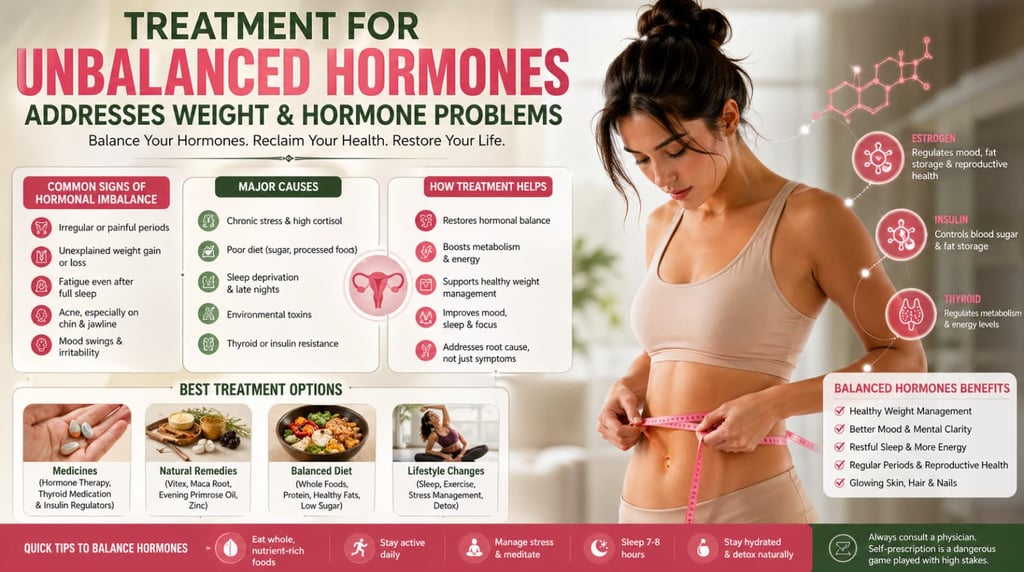

You just woke up, having your morning chai, looking at the mirror, and thinking, “What’s happening with my body?” You might feel depressed and anxious, becoming more insecure with yourself and your body. We understand how it feels when you think like that. It could be the reason for having signs of hormonal imbalance, hormonal changes, estrogen imbalance, and may include something else. Through this, the treatment for unbalanced hormones becomes so necessary.
Honestly speaking, you should require a hormone balance doctor, but not to mention, you also need some activity in your daily diet as well. And with the right treatment for unbalanced hormones, your journey becomes easier. So, let’s start and check out what hormonal problems are and why they disrupt your body.
What Are Hormone Problems and Why Do They Disrupt Your Body?
The hormones are like your body’s internal mail system. Millions of chemical messages are travelling to a specific location. And, if any one of those emails doesn’t get delivered, that’s the time when the whole hormone system can fall apart, and you will encounter yourself with hormone problems with thousands of little rejections.
Not to mention, this can also disrupt the uterus and womb in the female body. Multiple factors are interlinked with your hormone problems, and you will better understand the treatment for unbalanced hormones:
Your thyroid controls the body's temperature.
The insulin is responsible for storing energy.
Estrogen determines both your uterine cycles and your hours of wakefulness.
Now, when any one of these hormones goes astray, the resulting hormonal imbalance affects, speaking of which, it accumulates your fat in the body and results in mental fuzziness. Hence, it becomes necessary for you to look for treatment for unbalanced hormones.
As you got a bit about the hormone problems and how they can affect a female's uterus and womb. Now, let’s check out the common signs your hormones are out of balance, so that you can check out how you can address the treatment for unbalanced hormones easily.
Common Signs Your Hormones Are Out of Balance
Females can analyse unbalanced hormones periods that usually come out of nowhere without any clear rhythm.
You may encounter either high weight gain or low weight changes.
Even after 8 hours of sleep, you feel fatigued.
You get chin acne a lot.
Sudden mood changes.
Now, digging deeper, let’s check out the causes of unbalanced hormones
What are the Causes of unbalanced hormones?
The occurrence of unbalanced hormones may include various factors, which lead to a diagnosis of a modern-day mess rather than listing medical causes. There is not a single culprit that dominates this situation, but a whole bunch of everyday decisions that come together and work in secret to disturb your balance.
To understand better, check out the section below.
Causes of unbalanced hormones
Chronic stress without a single hour of true rest.
A diet rich in ultra-processed foods and hidden sugars.
Sleep deprivation treated as a badge of honour.
Environmental toxins lurking in plastics and perfumes.
Moving ahead, let’s check out the query if the unbalanced hormones can cause weight gain.
Can unbalanced hormones cause weight gain?
Yes. The unbalanced hormones cause weight gain. This question haunts millions of people, and the answer to that, too. But there’s no two ways of saying that unbalanced hormones cause weight gain. See, the hormone problems do not merely encourage weight gain, but they rephrase the entire metabolic rate from scratch.
The time when oestrogen declines or insulin increases, the body gets a primitive instruction etched in survival, which is to store everything in the viscera.
Thus, the belly becomes a fortress of fat that dieting alone cannot breach. Now, let’s check out the detailed process of how it determines weight gain.
How can unbalanced hormones cause weight gain?
By slowing the basal metabolic rate by up to 400 calories each day.
By converting lean muscle into glucose rather than preserving it.
By instructing fat cells to multiply rather than shrink.
By silencing the hormone that tells your brain, "I am full."
And that’s how the unbalanced hormones cause weight gain. But the story doesn’t end here. There is also a connection between hormones and fat.
The estrogen imbalances tell the adipose tissue to expand.
Cortisol converts the muscle into fuel. And, then, it parks the surplus abdominal fat.
Then, next, leptin resistance, which means your brain never gets the satiety signal.
Hence, the ghrelin overproduction, which means your stomach always feels hungry.
But even after tons of dieting, the plans fail. Why? Because you just fight with a locked door while the key gets rusty in ignorance.
The treatment for unbalanced hormones is the locksmith you never knew you needed, and the process includes little hard work. To understand better, check out the next section.
How Treatment for Unbalanced Hormones Helps in Weight Management?
That is when the tide begins to turn. Hormonal therapy does not suppress the tune of dysfunction; it rebalances the entire symphony. When you take your medication from an endocrinologist or hormone balance doctor, there are three major changes that will happen.
The first one is that your basal metabolic rate will ignite like an ember from a hearth in winter.
The second change is that your hunger cues will calm down from a cry to a polite request.
The third change is that the authentic energy returns, transforming movement from punishment into quiet privilege.
Treatment for unbalanced hormones
When you opt for the treatment for unbalanced hormones, you recover and restore.
You restore your metabolism even after the suffering of insulin resistance.
You recalibrate your appetite hormones. So, you eat when hungry and stop when satisfied.
You repair your thyroid problems, so your cells receive whatever energy it requires.
You lower your cortisol, and your body stops the hoarding of belly fat for a famine that never arrives.
And now your weight loss becomes easier even without extreme dieting. Why? Because the treatment for unbalanced hormones transforms your body, and you stop fighting biology but collaborate with it.
Considering this, let’s check out the best medicines to treat hormonal imbalance.
What is the best medicine to treat hormonal imbalance?
The micronised progesterone or oestradiol patches, the levothyroxine, or the metformin are considered the best medicines to treat hormonal imbalance.
But still, if you are searching for the “best medicine to treat hormonal imbalance”, then there is no universal answer.
Because medicines are generally given according to your body’s requirements and multiple factors.
For oestrogen deficiency, the micronised progesterone or oestradiol patches restore the monthly rhythm.
For thyroid sluggishness, the levothyroxine regulates the metabolism.
For insulin resistance, which is common in PCOD conditions, metformin lowers the drawbridge that traps the glucose outside your cells.
When Medication Becomes Necessary?
When you examine the PCOD case with irregular cycle and dysfunctional uterine bleeding, the medication becomes necessary. But there are more factors than PCOD.
When you encounter thyroid disorders, the gland refuses to perform its duties.
When you encounter a severe imbalance causing large fibroids or an enlarged uterus.
When you encounter adenomyosis, the uterine lining invades the muscle wall without invitation.
Now, let’s move further and check out which pill is best for hormonal imbalance.
Disclaimer: Always consult a physician. Self-prescription is a dangerous game played with high stakes.
Which pill is best for hormonal imbalance?
The birth control pills, thyroid medication T4, and insulin regulators like Metformin act as the best pills for the treatment of unbalanced hormones.
Causes and impact of pills
The birth control pills help in regulating period cycles, diagnosing the unbalanced hormones periods and clearing the acne, while managing the symptoms rather than the roots.
The Thyroid medication - T4: It is considered the gold standard for hypothyroidism.
Insulin regulators like Metformin works excellent for PCOD patients and help prevent metabolic syndrome.
Along with this, a PCOD diet with the correct pill will perform better. Speaking of which, you should always remember that a pill manages the hormonal changes, but a comprehensive protocol reverses them.
One offers a crutch, but the other offers a cure. For that, let’s check out the way to check hormone balance at home.
How to check hormone balance at home?
To check the hormone balance at home, you should always track your waking temperature in 3 cycles (low suggests thyroid dysfunction).
Chart your unbalanced hormones periods by parallel checking the length, flow, pain, regularity, colour, texture, and pain in the uterus and womb.
Monitor your sleep quality and an afternoon energy crash with precision. Home saliva kits offer glimpses, but never replace a venous draw.
The Detailed process of how to check hormone balance at home
Take your basal temperature with a thermometer each day, first thing in the morning, before getting out of bed.
Keep a record of symptoms for two full menstrual cycles.
Pay attention to how well you sleep and the dreams you remember when you get up.
Be aware of your afternoon tiredness and cravings for sweets.
Early Warning Signs You Should Not Ignore
Irregular bleeding between cycles without explanation or apology, which affects the uterus and womb.
Unexplained fatigue that naps cannot remedy or touch.
Hair thinning on the scalp paired with growth on the chin.
Dysfunctional uterine bleeding that soaks a pad hourly.
Natural remedies for hormonal imbalance in females
Ingredients for the cycle-specific and general health of women: Vitex (chasteberry) to increase progesterone and extend the luteal phase.
Maca root to support the endocrine system energetically without imposing a specific answer.
Evening primrose oil for breast tenderness and general inflammation-related discomforts.
Zinc supplementation for acne, hair health, and thyroid conversion.
Adding to that, if you consider a balanced diet, strength training, stress management, and optimise your sleep cycle, you will rectify your treatment for unbalanced hormones better.
Talking about females’ uterus health, the hormonal imbalance affects it the most and worsens the situation. How? Let’s check it out.
How Hormonal Imbalance Affects Uterus Health?
The uterus (or womb) is highly sensitive to hormonal fluctuations. If there is a constant presence of high levels of estrogen without a blood supply from progesterone.
It will most likely cause an enlarged uterus, leading to the formation of large fibroids. And result in suffering from the relentless and severe pain of adenomyosis.
When women suffer from fibroids after menopause, they generally shrink and stop causing problems. On the other hand, if they grow, it is a sign that should not be ignored at any cost.
Besides, hormonal imbalances that are not treated in time can cause the signs of uterine cancer to appear, such as:
Bleeding after menopause.
Pressure in the pelvic region, and
Changes in urination that should always be checked.
So, a hysterectomy is a last resort and not a first step. The structure of the womb remains intact when the hormones are balanced.
How to balance your hormones in a week?
If you are looking to balance it out, your approach should be strategised, and here you go.
Remove all ultra-processed foods from your kitchen on Sunday evening.
Shift breakfast from carbohydrates to protein and healthy fats.
Walk for twenty minutes within one hour of waking each morning.
Dim all lights by 8 p.m. and sleep in
complete darkness.
You will not cure a year of imbalance in a week. That would be a lie dressed as hope. But you will feel the first quiet notes of return.
And that feeling? That feeling is everything.
And if you are menstruating. Change the approach and try the method shared.
How to cure hormonal imbalance in menstruation
To understand how to cure hormonal imbalance in menstruation is to honour the cycle itself. A healthy period arrives every twenty-four to thirty-five days. It flows for four or five days.
It causes manageable discomfort, not collapse. It ceases cleanly without prolonged spotting or drama.
Track your cycle for three months before seeking medical intervention.
Address thyroid function first, as it governs every other hormonal system.
Stabilise blood glucose through protein at every meal without exception.
Lower evening cortisol through deliberate rest and digital boundaries.
Restoration requires three pillars standing together. Cycle regulation via thyroid and ovarian support.
A diet that stabilises blood glucose from dawn to dusk without exception. Stress reduction that lowers cortisol to baseline human levels.
When these align, unbalanced hormones periods become a whisper instead of a scream. The monthly ordeal becomes a rhythm.
Conclusion
The treatment for unbalanced hormones reclaims more than a number on a scale. It retrieves your sleep, your mood, your womb, your patience, and your quiet confidence. The link between hormones and weight is not a mystery written in ancient script. It is a map drawn in plain ink. Follow it home.
Disclaimer: Always consult a physician. Self-prescription is a dangerous game played with high stakes.
FAQs
What is the best medicine to treat hormonal imbalance?
Ans: No universal pill exists. The treatment for unbalanced hormones depends entirely on your specific deficiency - thyroid, progesterone, oestrogen, or insulin. A hormone balance doctor prescribes based on blood work. Never borrow another person's prescription. Your body is not a copy.
How do I fix my unbalanced hormones?
Ans: Begin with a minimum of seven hours of sleep. Remove industrial sugar completely. Manage stress through morning light and evening boundaries. Test your blood before guessing. A treatment for unbalanced hormones may include medication, natural remedies, or both. Address the root cause, not the symptom that shouts loudest.
What are the 5 signs of hormonal imbalance?
Ans: Unexplained weight gain concentrated at the belly. Severe fatigue that sleep cannot cure. Erratic or painful periods. Adult acne along the jawline. Mood swings that arrive without warning or provocation. If these sound familiar, a treatment for unbalanced hormones could restore your equilibrium.
How do I check if my hormones are unbalanced?
Ans: Track your cycle length, basal temperature, and daily symptoms for two full months. Then request a full panel: oestrogen, progesterone, testosterone, cortisol, TSH, and fasting insulin. A treatment for unbalanced hormones begins with accurate data, not intuition dressed as certainty.
What are common causes of hormonal imbalance?
Ans: Chronic stress without recovery. Poor sleep night after night. A diet rich in sugar and industrial seed oils. Gut inflammation from processed foods. Environmental toxins in plastics and perfumes. Addressing these alongside a treatment for unbalanced hormones yields the deepest, longest-lasting results.


Neha Shukla
Is a writer and LinkedIn creator who demystifies wellness for modern lives. She writes about nutrition, mindfulness, and sustainable habits, grounded in research, infused with real-world wisdom. Her mission is to help you feel better without feeling overwhelmed.
About The Author

Contact
Don't Let Your Wellness Journey Feel Boring!
Phone
hello@nehashuklaa@gmail.com
+91 92110 33284
© 2026. All rights reserved.