
What Is Women White Discharge? Meaning, Types & Health Insights
This blog explores women white discharge, explaining it as a natural vaginal fluid known medically as leucorrhoea that helps maintain vaginal hygiene by removing dead cells and bacteria. It discusses how discharge varies across the menstrual cycle due to hormonal changes, often becoming clear and stretchy during ovulation and thicker before periods. The article also highlights common causes such as infections like yeast overgrowth, stress, diet, and lifestyle factors, helping readers distinguish between normal and abnormal signs. It further explains women white discharge during pregnancy, where increased fluid is usually protective but should be monitored for unusual colour, smell, or discomfort. Additional sections cover types of discharge, including yellow, grey, or clumpy variations, and when medical attention is necessary. Finally, it provides practical tips on hygiene, diet, and treatment options to support healthy vaginal function and overall reproductive well-being.
Neha Shukla
5/31/20269 min read

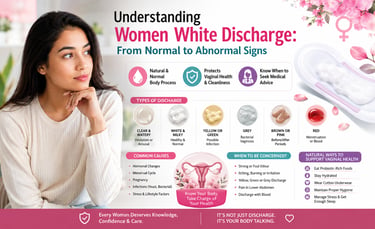
Understanding Women White Discharge: From Normal to Abnormal Signs
There are conversations that women have been whispering amongst themselves for centuries, conversations that deserve to be spoken aloud with clarity, confidence, and compassion. Women white discharge is one of them. For generations, this utterly natural phenomenon has been shrouded in silence, misunderstanding, and unnecessary shame. Yet every single day, millions of women across the world quietly wonder whether what they are experiencing is perfectly ordinary or a quiet signal from their body asking for attention.
Women white discharge, known medically as leucorrhoea, is a fluid produced by the glands inside the vagina and cervix. It carries away dead cells and bacteria, keeping the vaginal environment clean and balanced. In its healthiest form, it is odourless or mildly scented, clear to milky white in appearance, and entirely harmless.
However, this vaginal discharge in its altered states, whether coloured, clumpy, foul-smelling, or unusually heavy, can sometimes indicate that something beneath the surface requires care. This is not merely a biological topic. It is a lived experience. It is the quiet anxiety of a young woman noticing a stain for the first time. It is the confusion of a pregnant woman wondering whether her body is behaving as it should. It is the relief of finally understanding that what she experiences is not shameful; it is simply human.
This blog untangles every layer of women white discharge or vaginal discharge from its origins and types to when it demands medical attention, with warmth, precision, and the kind of insight that transforms confusion into confidence.
What Is the Cause of Women White Discharge?
During ovulation, oestrogen levels rise considerably, and the cervix responds by producing more fluid. You might notice that around the middle of your cycle, white discharge for women becomes more abundant and stretches almost like raw egg white. This is your body signalling peak fertility. It is elegant in its design, even if it feels inconvenient in the moment.
Role of the Menstrual Cycle
The menstrual cycle governs this vaginal discharge patterns in a remarkably predictable rhythm. Just before menstruation, discharge tends to thicken and may appear more cream-coloured. After your period, it often lightens and diminishes. This cyclical nature is completely normal, and tracking it can actually offer profound insight into your overall reproductive health.
Infections Such as Yeast Infection
Not all causes of women white discharge are benign. A yeast infection, caused by the overgrowth of Candida fungus, is one of the most common culprits behind abnormal discharge. It typically presents as a white clumpy discharge, resembling cottage cheese, accompanied by intense itching and irritation. Antibiotics, high sugar intake, and a compromised immune system can all tip the vaginal flora off balance.
Stress, Diet, and Lifestyle Factors
Chronic stress elevates cortisol, which disrupts hormonal balance and can alter both the volume and consistency of women white discharge or vaginal discharge. Poor dietary habits, particularly diets heavy in sugar and refined carbohydrates, feed unfriendly bacteria. Dehydration concentrates vaginal secretions, while poor sleep weakens the immune defences that keep infections at bay.
Women white discharge medicine may be prescribed when infections such as bacterial vaginosis or trichomoniasis are confirmed through testing.
Women white discharge home remedies such as probiotic-rich foods, unsweetened yoghurt, and staying well-hydrated can support vaginal health naturally.
What Is Meant by Women White Discharge During Pregnancy?
White discharge or vaginal discharge during pregnancy is one of the most common concerns expectant mothers bring to their midwives and doctors. Reassuringly, in most cases, it is entirely normal and even protective.
Why Discharge Increases During Pregnancy?
During pregnancy, blood flow to the pelvic region increases dramatically, and the cervix softens, producing more mucus. This is the body's way of creating a barrier against infection. White discharge during pregnancy, called leukorrhoea, is typically thin, mild-smelling, and milky white. It often increases as the pregnancy progresses.
Difference Between Normal Discharge and Infection?
The line between normal and abnormal vaginal discharge during pregnancy deserves careful attention. Normal vaginal discharge is odourless or faintly musky. Discharge that turns yellow, green, or grey, that carries a strong fishy or sour odour, or is accompanied by itching and burning may indicate a yeast infection or bacterial vaginosis, both of which require prompt treatment during pregnancy.
Seek medical advice immediately if you notice large amounts of watery fluid before 37 weeks, which could indicate early rupture of membranes. Any blood-tinged discharge, particularly in the first trimester, also warrants an urgent conversation with your healthcare provider.
What Does Thick White Discharge Mean?
Thick white vaginal discharge is perhaps the variation that causes the most anxiety, yet it spans an entire spectrum from the perfectly ordinary to the clinically noteworthy.
Normal Thick Discharge
Creamy white discharge that appears thick, smooth, and without any accompanying irritation is typically normal, particularly in the days just before your period or just after ovulation. The body's hormonal fluctuations during these phases thicken the cervical mucus considerably.
Thick Discharge Without Smell
Thick white vaginal discharge no smell is generally a sign of healthy cervical activity. If the texture is uniform, the colour is white or off-white, and there is no discomfort, there is usually nothing to be concerned about. It is simply your body doing its quiet, diligent work.
Thick Discharge With Smell and Irritation
Thick white smelly discharge, however, is a different matter entirely. When discharge becomes dense, carries a sharp or unpleasant odour, and is paired with redness, swelling, or a burning sensation during urination, it frequently points to a yeast infection or bacterial vaginosis. This combination deserves professional evaluation rather than self-treatment.
Does Women White Discharge Affect Menstrual Cycle?
Women white discharge or vaginal discharge and the menstrual cycle are deeply entwined, each mirroring the other's rhythms in a dance governed by hormones.
Discharge Patterns Before Periods
In the days leading up to menstruation, progesterone dominates, producing a thicker, creamier discharge. This is often when women notice a heaviness or increased moisture that feels different from the rest of the month.
During Ovulation
Mid-cycle, as oestrogen surges, discharge becomes clear, slippery, and abundant. This fertile-quality mucus is a hallmark of ovulation and is the body's invitation for conception.
After Menstruation
Immediately after menstruation, discharge is minimal. As the cycle progresses and oestrogen begins to rise again, it gradually increases in volume and shifts from dry to moist to the familiar white milky consistency.
Does Hormonal Changes Affect Women White Discharge?
Hormonal changes are perhaps the single most powerful force governing the character of women white discharge or vaginal discharge across a lifetime.
Oestrogen and Progesterone Roles
Oestrogen stimulates the production of cervical fluid, making discharge more abundant and fluid-like. Progesterone thickens it. The interplay between these two hormones throughout the menstrual cycle explains why women white discharge changes in texture and volume so markedly from week to week.
Puberty and Menopause Changes
At puberty, the first appearance of women white discharge is often a bewildering experience. It typically begins six to twelve months before the first period and signals the awakening of the reproductive system. At menopause, oestrogen declines, and discharge diminishes or disappears entirely, sometimes replaced by vaginal dryness.
Birth Control Impact
Hormonal contraceptives alter the body's natural hormonal landscape. Some women notice thicker, scantier discharge on the pill, while others experience the opposite. Intrauterine devices, particularly the hormonal variety, can also modify discharge patterns significantly.
Types of Vaginal Discharge You Should Know
Understanding types of vaginal discharge empowers you to read your body's signals with greater sophistication. The colour, texture, and odour of discharge together paint a detailed picture of your reproductive and vaginal health.
White milky discharge no odor is the hallmark of healthy, normal discharge. Clear and watery discharge often accompanies arousal or ovulation.
Yellow or green discharge with odour frequently signals infection. Brown or pink discharge is commonly associated with the beginning or end of menstruation or, in some cases, implantation bleeding.
Grey discharge with a strong fishy smell is a classic indicator of bacterial vaginosis and should not be ignored.
What Does Yellow Discharge Mean?
Yellow vaginal discharge occupies a curious territory where the distinction between mild variation and genuine infection matters enormously.
Mild Yellow Discharge
A very pale yellow or yellowish-white vaginal discharge, particularly in small amounts and without odour or discomfort, is often simply normal discharge that has oxidised slightly upon contact with air or fabric. Many women experience this at various points in their cycle without any underlying issue.
Dark Yellow or Green Discharge
Dark yellow or green vaginal discharge, however, is a different story entirely. This colouration almost always indicates the presence of bacteria or, in some cases, a sexually transmitted infection such as gonorrhoea or chlamydia. The urgency here is not to panic, but to seek a professional diagnosis promptly.
When yellow vaginal discharge is accompanied by pelvic pain, a burning sensation during urination, swelling, or an unusual odour, these symptoms together form a constellation that warrants immediate medical evaluation.
Do not delay, as untreated infections can ascend to the reproductive organs.
How to Control Women White Discharge Naturally and Medically
Gentle, unscented soap used only on the external vulva, breathable cotton underwear, and the avoidance of douching are the foundational pillars of vaginal hygiene. The vagina is a self-cleaning organ, and excessive interference often disrupts its delicate microbial ecosystem.
Dietary Changes
Best food to stop white discharge naturally includes probiotic-rich foods like yoghurt, kefir, and fermented vegetables, which support healthy Lactobacillus populations within the vagina.
Reducing sugar intake limits the fuel available for Candida overgrowth.
Drinking adequate water helps maintain healthy secretion consistency.
When Medication Is Required
Women white discharge or vaginal discharge medicine becomes necessary when a confirmed infection is present. Antifungal treatments address yeast infections, while antibiotics target bacterial vaginosis and sexually transmitted infections.
Women white discharge home remedies such as boric acid suppositories are sometimes used under medical guidance for recurrent yeast infections, though always in consultation with a qualified practitioner.
When Should You Be Concerned About Women White Discharge?
Women white discharge becomes a matter of concern when it departs from your personal baseline in specific, observable ways.
Signs of Infection
Thick white smelly discharge, intense itching, redness, swelling, or a burning sensation during urination are all signs that an infection may be present. These symptoms together are the body's eloquent plea for attention.
When Discharge Is Abnormal
Abnormal women white discharge changes colour beyond the white-to-clear range, carries an unpleasant odour, arrives in unusual quantities, or is accompanied by pain. Any single one of these changes, let alone several together, warrants investigation.
If abnormal discharge persists for more than a week without improvement, if you are pregnant and notice changes, if you have recently changed sexual partners, or if home remedies offer no relief, please consult a healthcare professional without hesitation.
Expert Health Insights Most Websites Miss
Beyond the standard advice lies a constellation of lesser-known influences on women white discharge that deserve a place in this conversation. Dehydration is a surprisingly underappreciated factor. When the body is insufficiently hydrated, vaginal secretions can become concentrated, thicker, and more irritating.
Drinking adequate water daily is not merely about kidney function; it directly supports healthy mucous membrane activity throughout the body.
Gut health and vaginal health are intimately connected through what researchers are increasingly calling the gut-vaginal microbiome axis.
An imbalanced gut, often caused by antibiotics, poor diet, or chronic stress, can alter the populations of Lactobacillus bacteria that guard the vaginal environment. Supporting gut health with fibre-rich foods and probiotics has a measurable downstream effect on vaginal flora.
Clothing choices matter far more than most women realise. Synthetic fabrics trap heat and moisture, creating a warm, humid environment in which bacteria and yeast thrive with unseemly enthusiasm.
Loose-fitting, natural-fibre garments, particularly at night, allow the body to breathe and maintain the cooler, drier conditions that support vaginal health.
Finally, sleep deprivation and chronic inflammation both suppress immune function, making the vaginal environment more vulnerable to opportunistic infections. Restorative sleep is, in many ways, a form of feminine hygiene.
Conclusion
Women white discharge is, in most instances, a testament to the body's remarkable intelligence. Yet awareness remains your finest ally. Observe your body's patterns, honour its signals, and seek professional guidance whenever something feels amiss. Knowledge, after all, is the most elegant form of self-care.
FAQs
What is the cause of white discharge?
Ans: White discharge is primarily caused by hormonal fluctuations across the menstrual cycle, particularly the rise and fall of oestrogen and progesterone. Infections such as yeast overgrowth, stress, dietary habits, and lifestyle factors can also influence both the volume and character of discharge at any given time.
Why is my wife having white discharge?
Ans: White discharge in women is entirely normal and reflects the vagina's natural self-cleaning process. It is commonly influenced by ovulation, hormonal changes, or the menstrual cycle phase. However, if the discharge is accompanied by an unpleasant odour, itching, or unusual colour, consulting a healthcare professional would be advisable.
Why am I leaking milky white discharge?
Ans: Milky white discharge is typically a sign of healthy vaginal function, particularly around ovulation or before menstruation. Increased volumes can also occur due to arousal, pregnancy, or hormonal shifts. If the leaking is excessive, persistent, or paired with discomfort, a medical evaluation would offer clarity and reassurance.
Is it good if my discharge is white?
Ans: Generally speaking, yes. White or off-white discharge that is odourless or mildly scented and without accompanying irritation is considered a healthy indicator of normal vaginal function. The concern arises when white discharge becomes thick and clumpy, carries a strong smell, or is paired with itching, which may signal infection.
What are the 7 types of discharge?
Ans: The seven broadly recognised types are: clear and watery, clear and stretchy, white and milky, yellow or yellowish-green, grey, brown or pink, and red or blood-tinged discharge. Each carries a different meaning, ranging from healthy hormonal activity to potential infections or conditions that require a prompt medical consultation.

Contact
Don't Let Your Wellness Journey Feel Boring! Get connected with us today to know your health better.
Phone
hello@nehashuklaa@gmail.com
+91 92110 33284
© 2026. All rights reserved.