Yoga for Stress Relief: Transform Your Mood in Just 10 Minutes a Day
In today’s fast-paced world, stress often settles quietly into our daily lives, leaving us mentally drained and physically tense. This blog explores how yoga for stress relief offers a simple yet powerful way to restore balance, even within just ten minutes a day. By combining mindful breathing, gentle movements, and calming postures, yoga for stress relief helps regulate the nervous system, reduce anxiety, and improve overall wellbeing. The article guides readers through beginner-friendly techniques, a practical 10-minute routine, and insightful strategies that go beyond common advice. It also highlights how consistency, posture, and breath awareness play a crucial role in achieving lasting calm. Whether you are new to yoga or seeking a more grounded daily ritual, yoga for stress relief provides a graceful path to inner peace, clarity, and emotional resilience in the midst of modern chaos.
Neha Shukla
6/12/202610 min read
Yoga for Stress Relief and Flexibility: Simple Daily Routine to Calm Your Mind
Today, stress lingers like an uninvited guest, quietly settling into our shoulders, our breath, and our thoughts. In this restless rhythm of modern life, yoga for stress relief emerges not as a luxury, but as a quiet necessity. It does not demand hours, nor a retreat into the mountains. Instead, it offers a gentle promise: ten minutes, just ten, can begin to restore your inner balance.
Whether it is the weight of deadlines, the hum of notifications, or a mind that refuses to be still, yoga for stress relief invites you to pause, breathe, and return to yourself.
This simple daily ritual, almost poetic in its grace, may be the most powerful act of self-care you embrace through yoga for stress relief.
What Type of Yoga Is Best for Stress Relief?
Not all yoga speaks to a frayed nervous system with equal eloquence. Vinyasa, with its spirited choreography of breath and movement, suits those who crave momentum. Ashtanga carries the discipline of a classical sonata, structured and exacting.
But for the soul arriving on the mat carrying the weight of an overfull week, Hatha, Restorative, and Yin yoga are the slow, candlelit rooms worth stepping into. Restorative yoga asks almost nothing of the body; bolsters and folded blankets carry the entire effort.
Yin yoga holds postures for three to five quiet minutes, softening the deep connective tissues that habitual tension gradually calcifies.
Hatha offers a measured middle path, easy yoga poses held with breath awareness, making it the most instinctively suited style for stress relief yoga beginners arriving on the mat for the very first time.
Understanding which style serves your particular variety of stress is the first and most consequential decision you will make in this practice.
Best Beginner-Friendly Styles
Hatha and Restorative yoga distinguish themselves for yoga for beginners at home because neither demands equipment, prior flexibility, nor any performance. Yin deepens over weeks with a quietness that earns your trust gradually.
For yoga for stress, the essential criterion is simple: choose the style that slows you down rather than accelerates you further.
Mistakes People Make While Choosing Yoga
The most prevalent error is selecting a style based on calories rather than cortisol. Yoga exercises for weight loss have genuine merit, yet when stress is the primary complaint, vigorous practice can paradoxically heighten arousal in an already overwhelmed nervous system.
The body in distress does not need more challenge; it needs more permission to rest.
How to Reduce Stress by Yoga?
The science is neither obscure nor contested. Yoga for stress management activates the parasympathetic nervous system, the body's own restoration mechanism, through deliberate breathwork and unhurried physical movement.
Cortisol, the principal stress hormone, decreases measurably after even brief, consistent yoga practice. The vagus nerve, wandering with quiet authority from brainstem to gut, responds to a lengthened exhalation with a signal of safety that cascades through the entire physiology.
Yoga meditation deepens these effects considerably. When the breath slows, the mind follows, not at once, and not without some resistance, but reliably, over days and weeks of faithful return.
Understanding this mechanism transforms yoga from a pleasant habit into a deliberate tool for lasting neurological recalibration, which is precisely what brings us to the question of how to begin.
Step-by-Step Beginner Routine
Begin seated with a long spine. Close the eyes and take three breaths, each exhale noticeably longer than the inhale that preceded it. Move into Cat-Cow for two minutes, then rest in Child's Pose for two more.
Finish with Legs Up the Wall for three minutes and simply breathe without agenda. This six-minute sequence alone offers measurable relief for those beginning yoga for stress relief with no prior experience.
When to Practise for Best Results
Morning practice anchors the nervous system before the day's first disruption arrives. Evening practice dissolves the residue of accumulated tension before sleep claims the hours. Both are genuinely valid; the variable that matters most is the consistent, unhurried return.
Yoga for stress relief and anxiety works most profoundly when practised at the same hour each day, training the brain to associate that window with safety and permission to soften.
Yoga for stress relief for beginners is best attempted in silence at first, without the pull of guided videos, until the breath and movement find their own unhurried rhythm.
10-Minute Daily Routine for Yoga for Stress Relief
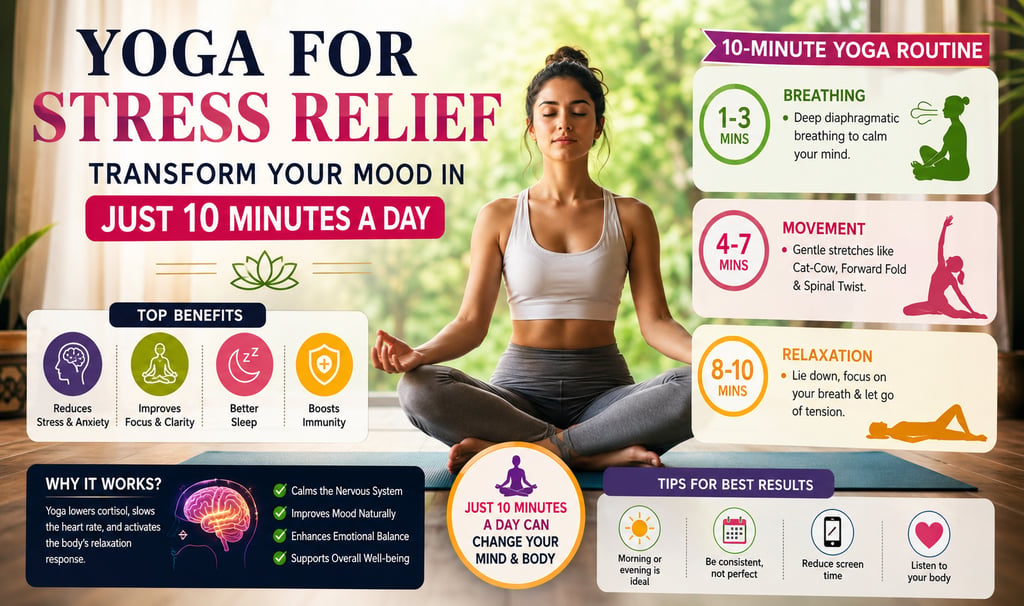
This is where theory dissolves into lived experience. A focused ten-minute yoga for stress relief practice, undertaken with genuine intention, consistently outperforms a distracted sixty-minute session. The nervous system responds to quality of attention, not volume of time.
Minute 1-3: Breathing
Sit cross-legged or upright in a chair, spine long, palms open on the knees. Begin 4-7-8 breathing: inhale for four counts, hold for seven, exhale for eight.
This ratio directly stimulates the vagus nerve and begins lowering cortisol within the first ninety seconds of practice.
The most common mistake here is forcing the breath into the count rather than allowing the count to serve the breath. Let it arrive on its own schedule; guide it rather than command it.
Minute 4-7: Movement
Move into Cat-Cow on all fours, arching on the inhale and rounding on the exhale for ten slow, considered rounds. Shift into a seated Forward Fold, reaching unhurriedly toward the feet without gripping or straining. Hold for sixty seconds, breathing into the resistance.
These yoga for stretching and flexibility movements release the posterior chain, the precise region where the body stores unresolved tension with particular loyalty.
Finish with a gentle Supine Twist on each side, thirty seconds apiece, breathing into the spaces that resist the most.
Minute 8-10: Relaxation
Arrive in Savasana or Legs Up the Wall and permit the body to become genuinely heavy. Do not guide the mind anywhere particular; allow it to wander and return of its own accord. This closing window is where yoga for stress relief performs its quietest and most enduring work.
The nervous system requires a formal, unhurried signal that effort has concluded. These final minutes deliver that signal with unmistakable gentleness, and from here, the day or the night that follows carries an entirely different quality.
What Is the 3-3-3 Rule for Anxiety?
The 3-3-3 rule is a grounding technique drawn from cognitive behavioural practice. When anxiety rises sharply, name three things you can see, identify three sounds you can hear, and deliberately move three parts of your body.
It interrupts the familiar loop of catastrophic thinking by returning attention to the present sensory moment, which anxiety cannot inhabit for long.
Real-Life Example
Arjun, a Bengaluru-based product manager, once described standing outside a boardroom, presentation notes trembling slightly in his hands. He named the framed print on the corridor wall, the water dispenser at the far end, and the single plant by the lift. He heard the hum of the air conditioning, a distant phone ringing, and his own breath.
He rolled his shoulders once, tilted his neck slowly left and right, and pressed his feet firmly into the floor. The dread did not vanish entirely. It receded enough to allow clarity through.
When to Use It
The 3-3-3 rule serves those moments when yoga for stress relief is not immediately accessible, during meetings, whilst commuting, before a difficult conversation.
Pairing even a single long exhalation with the technique amplifies its effect considerably, and it is yoga meditation that builds the breath awareness to make that exhalation instinctive rather than effortful.
Which Yoga Is Best for Osteoporosis?
Yoga for flexibility and bone health are more intimately connected than casual observation might suggest. Weight-bearing yoga postures stimulate osteoblast activity, the cellular process through which bone tissue is built and actively reinforced.
For those managing osteoporosis or age-related bone density decline, a carefully chosen yoga practice offers a dignified and accessible path toward skeletal preservation.
Safe Poses for Bone Strength
Warrior I, Warrior II, Tree Pose, and Chair Pose direct load-bearing pressure through the femoral neck and lumbar vertebrae, the precise regions most susceptible to osteoporotic fracture.
Mountain Pose, practised with full-body alignment awareness, trains the postural muscles that protect the spine under the quiet, persistent pressure of daily gravity.
What to Avoid
Deep forward folds with a rounded spine place compressive strain on already fragile vertebral bodies. Inversions, unless practised under skilled guidance, carry meaningful falling risk.
Yoga for beginners managing osteoporosis should always begin with medical clearance, honouring the distinction between productive discomfort and structural vulnerability.
What Are the 7 Ways of Relieving Stress?
Stress is plural in its origins and therefore demands a plural, layered response. No single practice, however devoted, holds the whole answer on its own.
Yoga for stress relief: Ten daily minutes of intentional breath and movement restructures the nervous system's baseline relationship with perceived threat.
Sleep hygiene: The body processes cortisol during deep sleep stages; protecting sleep architecture is not indulgent but essential.
Dietary rhythm: Irregular mealtimes spike cortisol; consistent, unhurried eating reduces physiological uncertainty in measurable ways.
Social connection: Brief, genuine conversation with a trusted person reduces stress hormones more reliably than most clinical interventions.
Purposeful stillness: Five screenless, unscheduled minutes each day trains the mind's tolerance for uncertainty.
Creative absorption: Drawing, writing,
or cooking without instruction; any pursuit demanding full attention to the present moment.
Yoga meditation: Even three minutes of breath-focused stillness recalibrates the space between stimulus and response, which is the precise territory where chronic stress either takes root or quietly dissolves.
Easy Yoga Poses for Stress Relief Yoga Beginners
True elegance in yoga for stress arrives not through difficulty but through fidelity to simple, well-chosen forms practised with consistent attention.
Child's Pose
Kneel and lower the chest toward the floor, arms extended forward or resting at the sides.
This shape deactivates the fight-or-flight response through gentle abdominal compression that stimulates the vagus nerve. Hold for ninety seconds, breathing slowly into the back of the ribcage.
Cat-Cow
On all fours, move precisely with the breath: inhale into the spinal arch, exhale into the spinal curve. Ten rounds.
The rhythmic synchronisation of breath and movement is the foundational mechanism through which yoga for stress management produces its most reliable physiological effects.
Forward Fold
Standing or seated, hinge at the hips with a lengthened spine and lower slowly toward the legs.
The gentle inversion of the head below the heart calms the nervous system through mild baroreceptor activation. Hold for sixty to ninety seconds without any forcing.
Legs Up the Wall
Lie on the back and extend the legs vertically against a wall. This supported inversion drains lactic acid from the lower limbs, reduces blood pressure, and produces a quality of bodily ease that is difficult to achieve through any other means.
For yoga for beginners, it remains the single most accessible and restorative posture available, requiring nothing beyond a floor and a wall.
How Breathing Speed Affects Stress
The precise speed of the exhale determines the degree of parasympathetic activation achieved. A six-second exhale produces measurably greater heart rate variability than a four-second one. Extending the exhale by even two seconds across a ten-minute yoga for stress relief session is the difference between surface relaxation and genuine neurological recalibration that carries into the hours following practice.
Why Consistency Matters More Than Duration
Yoga for stress relief youtube routines provide welcome guidance, yet the research is unambiguous: five minutes of daily practice produces greater long-term cortisol reduction than a ninety-minute weekly session. Frequency of return is the variable that rewires the stress response.
10 minute yoga for stress and anxiety practised six days each week produces measurable structural changes in the prefrontal cortex within eight weeks of consistent effort.
How Posture Impacts Emotional State
The body communicates emotional information upward to the brain as continuously as the brain directs the body. A collapsed chest signals defeat. A rounded spine sustains rumination.
Gentle yoga for flexibility work that opens the anterior chest and lifts the sternum actively shifts the emotional register of one's interior life. Posture is not vanity; it is lived physiology.
Common Mistakes in Yoga for Stress Relief
Overdoing Poses
Pushing a posture beyond present-moment capacity activates the body's threat response, precisely the circuitry that yoga for stress relief is designed to quieten.
When discomfort begins demanding conscious attention, the therapeutic threshold has already been exceeded.
Ignoring Breathing
Movement without breath awareness is simply stretching. Yoga for stress is defined entirely by the breath's primacy over the shape of the posture.
When the breath becomes strained or shallow, the body has received the pose as effort rather than ease, and the practice has ceased to serve its essential purpose.
Expecting Instant Results
Tension accumulated across months does not release in a single session, however devoted. Yoga for stress management is a practise, not a prescription. The results arrive gradually, almost imperceptibly, and then one quiet morning, with unmistakable clarity.
Conclusion
Yoga for stress relief asks for no retreat, no wardrobe, and no hour you do not already possess. It asks only for ten minutes and the gentle willingness to return. Practise with that constancy, and the inner life transforms in ways that no single session could ever reveal.
FAQs
1. What are 5 exercises that increase bone density?
Ans: Weight-bearing yoga poses such as Warrior and Tree Pose, brisk walking, resistance training with light weights, stair climbing, and low-impact aerobics all encourage osteoblast activity and stimulate meaningful bone formation. Each places beneficial load on the skeletal system, reducing long-term osteoporotic fracture risk when practised with consistency.
2. What is the silent killer of osteoporosis?
Ans: Osteoporosis advances entirely without pain until a fracture occurs. Its silent contributors include chronic calcium deficiency, prolonged sedentary behaviour, insufficient Vitamin D, and an absence of routine bone density screening. Most people discover significant bone loss only after a seemingly minor fall produces a serious and unexpected injury.
3. What vitamins help reduce stress?
Ans: Vitamin B complex supports the neurotransmitter production that regulates mood and emotional steadiness. Vitamin D deficiency correlates directly with elevated anxiety and reduced resilience. Magnesium, frequently depleted by chronic stress itself, regulates the nervous system's threat response and deepens restorative sleep when supplemented with reasonable consistency.
4. What are the first signs of stress?
Ans: Early signals are most commonly dismissed rather than recognised: persistent fatigue that adequate sleep fails to resolve, unexplained irritability, impaired concentration, and fragmented sleep. Physical manifestations include jaw tension, habitually shallow breathing, and a low-grade headache that lingers with particular persistence through screen-heavy working hours.
5. What exercises release stress?
Ans: Yoga for stress relief, diaphragmatic breathing, unhurried stretching, and light cardiovascular movement such as walking or gentle cycling all measurably reduce circulating cortisol. The deciding criterion is choosing movement that feels genuinely nourishing rather than demanding. Any activity that lengthens the exhalation and quietens internal commentary serves the nervous system's essential need for restoration.
About The Author
Neha Shukla is a writer and LinkedIn creator who demystifies wellness for modern lives. She writes about nutrition, mindfulness, and sustainable habits, grounded in research, infused with real-world wisdom. Her mission is to help you feel better without feeling overwhelmed.


Contact
Don't Let Your Wellness Journey Feel Boring! Get connected with us today to know your health better.
Phone
hello@nehashuklaa@gmail.com
+91 92110 33284
© 2026. All rights reserved.