
Depression Symptoms - Why People Are Suffering From It?
Depression symptoms often appear quietly, not as dramatic breakdowns but as persistent fatigue, emotional numbness, loss of interest, and recurring negative thoughts that feel convincingly true. This condition is shaped by a mix of psychological patterns, brain chemistry imbalances, chronic stress, and unresolved past experiences, all of which reinforce cycles of overthinking and self-doubt. Common cognitive distortions like all-or-nothing thinking, overgeneralisation, and emotional reasoning deepen the struggle, while modern factors such as social comparison and high performance pressure intensify it further. Depression is also closely linked with anxiety and panic responses, as prolonged stress can exhaust the nervous system over time. Practical techniques like grounding (3-3-3 rule), cognitive reframing, journaling, and physical movement can help manage intrusive thoughts, while professional support, including therapy and medication when necessary, plays a critical role in recovery. Ultimately, recognising depression symptoms early is essential, as they gradually erode emotional resilience and overall wellbeing. With awareness, structured support, and consistent self-care, recovery is not only possible but sustainable, allowing individuals to rebuild a sense of balance, clarity, and emotional strength.
Neha Shukla
5/7/20267 min read
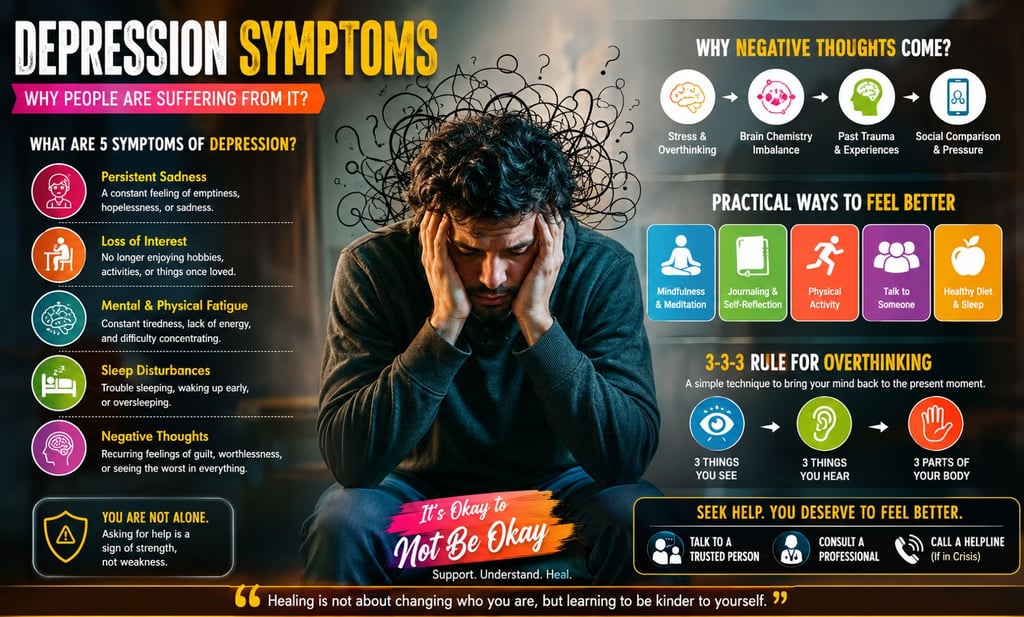
Depression Symptoms - Why People Are Suffering From It?
Depression symptoms do not always announce themselves with tears or breakdowns. More often, they arrive quietly, wearing the costume of exhaustion or a peculiar numbness the sufferer cannot quite explain to anyone.
The prevalence of this condition has risen markedly, yet so many endure it in dignified silence, uncertain that what they feel carries a name, a cause, and crucially, a way forward. What lies beneath it all is worth understanding.
So, let’s get deep into it and check out the depression symptoms in depth.
Also Read | Imbalance Hormones Symptoms - Balance Your Hormones in 7 Days.
What Are 5 Symptoms of Depression? (Core Understanding of Depression Symptoms)
Depression symptoms wear many faces, and recognising them is the first act of genuine self-care. Major depressive disorder symptoms extend far beyond ordinary sorrow. Persistent sadness is the most familiar, a grief without occasion, a melancholy that lingers past reason. Loss of interest follows: hobbies that once felt like a sanctuary begin to feel like ruins.
The person does not dislike these things; they simply feel nothing toward them. Mental fatigue is perhaps the most underestimated of all depression symptoms; the mind feels like a library where every book has been misplaced. Simple decisions become monumental.
Sleep disruption manifests in two opposing ways: the inability to sleep, or the inability to stop sleeping. Both signal a nervous system struggling to regulate itself. Recurring negative thoughts are the most insidious, arriving uninvited, looping endlessly, wearing the convincing disguise of truth.
Signs of depression in men often present as irritability or overwork, a restless striving that masks interior collapse.
Signs of depression in women frequently include physical aches and a persistent, unearned guilt. In introverts, these signs retreat inward, invisible to the outside world.
In extroverts, they hide behind social performance, the person who laughs loudest in the room and weeps alone at midnight.
Check Out | High Cholesterol Symptoms - Lower Cholesterol in 15 Days?
Why Are My Thoughts So Negative? Understanding the Root of Negative Thinking
Negative thoughts do not arise from weakness of character. They arise from patterns, mental frameworks shaped by accumulated stress, disappointment, and unprocessed mental trauma.
The mind, in its well-intentioned way, learns to anticipate pain before it arrives. It calls this protection. The sufferer calls it torment.
What Are the 9 Automatic Negative Thoughts?
Cognitive psychology identifies nine recurring patterns of distorted thinking, each one feeling perfectly rational in the moment:
All-or-nothing thinking - "I failed one task, so I am an utter failure.
Overgeneralisation - "This always happens to me."
Mental filtering - Seeing only what confirms the worst.
Discounting positives - "That compliment simply does not count."
Jumping to conclusions - Assuming catastrophe without evidence.
Magnification - Inflating flaws into defining truths.
Emotional reasoning - "I feel worthless, therefore I am worthless."
Should statements - Holding oneself to punishing, impossible standards.
Labelling - "I am stupid" rather than "I made a mistake."
These patterns share a close kinship with anxiety attacks and panic attacks, feeding the same nervous system, stoking the same alarm bells. One underexplored mechanism is thought loops triggered by unresolved micro-traumas: not dramatic events, but small accumulated slights, a dismissive remark, a public embarrassment never spoken of again, that become the quiet architects of chronic negative thinking.
Social media amplifies every such loop with extraordinary efficiency, rewarding comparison and punishing contentment.
Check Out | What Are the Causes of Pimples on Face and Different Types of Acne?
Why Negative Thoughts Come in Mind? The Science Behind Mental Patterns
The brain wires itself according to what it practises most. A mind that has rehearsed anxiety for years builds efficient neural highways for anxious thought. These highways, fortunately, are not permanent. Brain chemistry imbalance: Serotonin, dopamine, and norepinephrine require a delicate balance.
When that balance falters, emotional regulation becomes genuinely difficult, not merely a matter of willpower.
Role of cortisol and stress hormones: Chronic stress keeps cortisol elevated. Sustained elevated cortisol suppresses the brain regions responsible for rational thought and emotional steadiness, leaving a nervous system perpetually primed for threat.
Those researching supplements to reduce cortisol or noting the 7 warning signs of stress are often already experiencing this imbalance.
Impact of childhood mental trauma: A child who learns the world is unsafe does not simply forget that lesson in adulthood; it becomes the lens through which all experience is filtered.
Within the brain exists a structure called the "default mode network", the mental space occupied when the mind is not engaged in active tasks. In those prone to depression, this network grows extraordinarily busy, replaying past regrets and rehearsing future anxieties.
A small but powerful technique: simply name the thought. "This is catastrophising." "This is an old pattern." Naming creates distance. It restores a measure of sovereignty.
Check Out | What Are the Symptoms of Diabetes And How To Prevent Them?
What Is the 3-3-3 Rule for Overthinking? A Practical Method for Overthinkers
For overthinkers whose minds refuse to settle, the 3-3-3 rule offers a swift, elegant interruption. Name 3 things you see. Name 3 things you hear. Move 3 parts of your body. This works because it redirects neurological attention from abstract thought to concrete sensation.
Use it at the onset of a stress spiral before sleep, after a distressing exchange, mid-panic. It requires roughly sixty seconds. The most common mistake is treating it as distraction rather than grounding.
Distraction says "look away." Grounding says "come back to now." The 3-3-3 rule belongs firmly in the second category, and it grows more effective with repetition.
Also Read | Imbalance Hormones Symptoms - Balance Your Hormones in 7 Days.
Panic Attacks and Anxiety Attack - How They Connect With Depression Symptoms
A panic attack arrives as a storm: sudden, overwhelming, physical racing heart, breathlessness, the unshakeable conviction that something is terribly wrong. An anxiety attack, by contrast, is a slow tide hours of mounting dread without a single dramatic peak.
Both share deep roots in the same nervous system dysregulation that underpins depression symptoms. Panic attack treatment in the immediate moment includes controlled breathing and grounding. Long-term strategies involve therapy and lifestyle regulation.
The critical insight is that untreated anxiety does not remain anxiety. The nervous system's sustained state of alarm gradually exhausts the biological systems governing mood and motivation. Depression, in many cases, is anxiety that has grown too weary to fight.
Check Out | High Cholesterol Symptoms - Lower Cholesterol in 15 Days?
Is It Okay to Take Depression Pills? Truth About Medication and Recovery
Depression pills - antidepressants - are not a moral failing, nor are they a cure. They are a tool. When depression prevents basic functioning, medication can restore enough stability for therapy and lifestyle changes to take effect. Self-prescribing or abandoning prescribed doses without guidance carries genuine risk; brain chemistry is individual and precise.
Research from NIH consistently suggests the most durable recoveries involve both medication and therapy. Medication adjusts the biological conditions; therapy builds the mental architecture to sustain wellbeing.
It is worth noting that the placebo effect accounts for a portion of antidepressant response in milder cases, a testament to the brain's extraordinary sensitivity to belief and expectation.
Disclaimer: Please consult a qualified medical professional before beginning, changing, or discontinuing any medication.
Check Out | What Are the Causes of Pimples on Face and Different Types of Acne?
How to Get Rid of Evil Thoughts? Practical Strategies That Actually Work
The instinct to fight intrusive or troubling thoughts is entirely understandable, and profoundly counterproductive. The mind, instructed to suppress a thought, invests considerable energy in monitoring whether it has returned. It always has. This is precisely why fighting thoughts makes them stronger.
Cognitive reframing, rather than eliminating a thought, reframes it. "I am worthless" becomes "I am having a thought that I am worthless." The distance created is not trivial. Journaling - Write the thought in full. Externalising it removes it from the echo chamber of the interior mind.
Then write one honest counter-observation, not a forced positive, but a balanced truth. Behavioural interruption, physical movement disrupts the neurological loop.
A five-minute reset: stand, breathe deliberately for one minute, write one sentence about the present moment, drink a glass of water with full attention.
Check Out | What Are the Symptoms of Diabetes And How To Prevent Them?
Why People Are Suffering More Today Than Ever Before?
Social comparison culture, made frictionless by technology, has created a world where one's life is perpetually measured against the most luminous moments of everyone else's. Isolation deepens even as connectivity expands. Performance pressure, in professional and personal spheres alike, has reached a pitch that previous generations would find extraordinary.
What has emerged is a condition termed "high-functioning depression", the person who appears capable, perhaps even flourishing, whilst quietly sustaining significant interior damage.
They meet deadlines, attend gatherings, and respond to messages. They are not, by any visible measure, struggling. And yet they are.
Also Read | Imbalance Hormones Symptoms - Balance Your Hormones in 7 Days.
Conclusion
Depression symptoms are rarely dramatic announcements. They are quiet erosions of joy, of energy, of the belief that things might one day feel different. Recognising them, naming them, and seeking support for them is not surrender. It is the most courageous act available. You are not broken. You are human, and help exists.
FAQs
What are the signs of depression symptoms?
Ans: Depression symptoms include persistent low mood, withdrawal from once-loved activities, unexplained physical fatigue, and disrupted sleep. Emotional signs appear alongside behavioural ones, social retreat, reduced productivity, and an inability to access ordinary pleasure, making early recognition both vital and genuinely possible with awareness.
Why are depression and its symptoms so dangerous?
Ans: Unaddressed depression symptoms alter brain structure over time, impairing memory, decision-making, and immune function. Chronic depression raises the risk of serious physical illness and strains relationships profoundly, compounding the original condition with accumulating secondary losses that make recovery progressively more demanding without support.
How do depression symptoms attack mental health?
Ans: Depression symptoms erode mental health gradually, beginning with subtle shifts in mood before deepening into cognitive impairment and emotional withdrawal. Each untreated episode reinforces the neurological pathways of low mood, progressively narrowing the sufferer's capacity for resilience and making professional intervention increasingly important.
How to get rid of negative thoughts?
Ans: Two reliable techniques: first, name the thought without engaging it: "That is catastrophising." Second, write it down and compose one honest counter-observation. Both practices create cognitive distance, which measurably diminishes the thought's apparent authority and reduces its emotional charge over consistent practice.
How to overcome depression?
Ans: Recovery from depression is rarely linear but is genuinely achievable. A balanced approach combines professional therapy, appropriate medical support, consistent sleep and nutrition, meaningful social connection, and gradual self-awareness. Patience and professional guidance remain the most reliable and time-honoured companions throughout this deeply personal journey.
About The Author
Neha Shukla is a writer and LinkedIn creator who demystifies wellness for modern lives. She writes about nutrition, mindfulness, and sustainable habits, grounded in research, infused with real-world wisdom. Her mission is to help you feel better without feeling overwhelmed.



Contact
Don't Let Your Wellness Journey Feel Boring! Get connected with us today to know your health better.
Phone
hello@nehashuklaa@gmail.com
+91 92110 33284
© 2026. All rights reserved.