
Heart Attack Symptoms - What Are The Early Signs To Look For?
Heart attack symptoms are critical warning signals that occur when the heart muscle is deprived of oxygen-rich blood, often due to blockages caused by plaque and blood clots. These symptoms can range from noticeable chest discomfort and shortness of breath to subtle signs like unusual fatigue, nausea, or pain radiating to the arm, jaw, neck, or back, which are frequently overlooked. Many people miss early indicators, especially in cases of silent heart attacks, making awareness essential for timely action. Conditions such as Coronary Artery Disease, diabetes, high cholesterol, and smoking significantly increase the risk by damaging blood vessels and restricting blood flow. Preventive strategies play a vital role and include strict medication adherence, a heart-friendly diet rich in fibre, healthy fats, and antioxidants, and regular physical activity like walking, cycling, or yoga. Managing stress, maintaining good sleep habits, and staying hydrated further support cardiovascular health. Recognising heart attack symptoms early and adopting consistent lifestyle changes can greatly reduce the risk of severe complications and improve long-term heart health outcomes.
Neha Shukla
5/13/20268 min read
What Are The Heart Attack Symptoms?
I have witnessed people having heart attack symptoms, and realise it later. But, as usual, they lack time, and the situation gets serious afterwards. Understanding heart attack symptoms is not a luxury reserved for doctors. It is a life skill every person deserves to carry because early recognition can be the fragile thread between survival and tragedy.
Also Read | Breast Cancer Symptoms: How to Spot the Signs Early and Stay Safe
What Are Heart Attack Symptoms and Why People Often Miss Them?
Heart attack symptoms arise when the heart muscle is starved of oxygen-rich blood, and the signals range from elusive whispers to urgent, overwhelming roars.
Silent heart attacks are especially treacherous, producing no classic chest pain whatsoever, making them dangerously easy to overlook in those living with diabetes or in older adults whose nerve sensitivity has quietly diminished over the years.
Common Early Warning Signs You Should Never Ignore
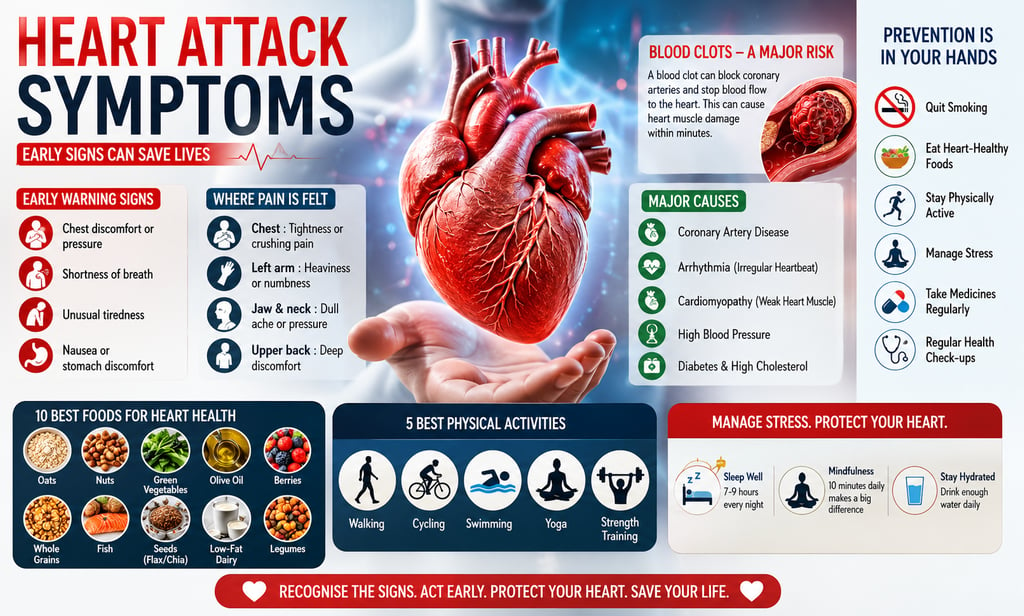
Chest discomfort that feels like an invisible hand tightening its grip from within.
Shortness of breath that arrives uninvited, even at rest or with the gentlest of efforts.
Unusual fatigue settles into the body like lead, sometimes days before any acute event.
Nausea or a churning stomach, frequently and fatally dismissed as ordinary indigestion.
Place Where Heart Attack Pain Felt
Grasping the place where heart attack pain is felt can mean the difference between seeking help and waiting dangerously long.
Chest: The epicentre, often described as crushing pressure or a deep, burning ache.
Left arm: A radiating heaviness or numbness travelling toward the wrist.
Jaw and neck: A dull, persistent throb that convincingly mimics a toothache.
Upper back: A diffuse, deep discomfort that many attribute to poor posture or strain.
Check Out | What Are Probiotics For Gut Health?
Does Blood Clots Is One of the Early Heart Attack Symptoms?
Yes, blood clotting is one of the early heart attack symptoms, and the mechanism deserves understanding. Blood clots are not merely incidental players, but are frequently the agents that seal a coronary artery shut.
When a clot obstructs blood flow, it starves the heart muscle of oxygen with startling efficiency.
How Blood Clots Affect the Heart
Clot formation typically begins where an arterial plaque ruptures. The body, interpreting this rupture as an injury, dispatches platelets to seal the breach. In a healthy vessel, this is a marvel of biological engineering. In a diseased artery already narrowed by years of accumulated damage, that clot can grow large enough to eliminate blood flow entirely.
The heart muscle downstream begins to die within minutes, which is precisely why speed of recognition is not overcaution. It is survival.
Also Read | Breast Cancer Symptoms: How to Spot the Signs Early and Stay Safe
Which Heart Disease Causes Heart Attack?
Coronary Artery Disease is a common disease that causes heart attacks. But, apart from it, there are several distinct forms of heart disease that can weaken, obstruct, or destabilise the heart to the point where a cardiac event becomes almost inevitable.
Major Conditions Leading to Heart Attack
Coronary artery disease: The most prevalent culprit, involving the progressive narrowing of the arteries that serve the heart directly.
Arrhythmia: Irregular electrical rhythms that reduce the heart's pumping efficiency, sometimes precipitating a dangerous cascade.
Cardiomyopathy: A condition in which the heart muscle itself becomes thickened or enlarged, compromising its ability to circulate blood with the vigour the body requires
Each of these conditions undermines the heart over the years, often without a single dramatic symptom until the damage reaches a breaking point.
Check Out | Breast Cancer Symptoms: How to Spot the Signs Early and Stay Safe
How Coronary Artery Disease Causes Heart Attack?
Coronary artery disease is a slow-burning catastrophe, built across decades of dietary choices, inherited vulnerabilities, and lifestyle habits accumulated quietly like sediment.
Step-by-Step Process
Fat deposits accumulate: Excess cholesterol and fats begin to settle along the inner arterial walls, forming plaque.
Arteries narrow: As plaque accrues, the channel through which blood flows becomes increasingly constricted, much like limescale slowly choking a pipe.
Reduced blood flow: The heart now labours under conditions it was never designed to endure for long.
Heart attack: A plaque ruptures, a clot forms, and the remaining channel seals. The heart muscle, deprived of oxygen, begins its silent, irreversible decline.
As you are done with this much, let’s move forward and check out how some common issues can be severe and lead to a heart attack.
Also Read | High Cholesterol Symptoms - Lower Cholesterol in 15 Days?
How Diabetes, High Cholesterol, and Blood Flow Are Linked to Heart Attack and Its Symptoms?
These three conditions do not operate in isolation. They form a compounding triad, each amplifying the destructive potential of the others, and together they deserve to be taken with the utmost seriousness. Diabetes erodes the walls of blood vessels with persistent, elevated blood sugar, rendering them fragile and inflamed, far more susceptible to plaque accumulation in the coronary arteries.
High cholesterol feeds the process upon which coronary artery disease depends. When low-density lipoprotein levels remain chronically elevated, plaque formation accelerates, and blood flow through the arteries grows ever more precarious.
Compromised blood flow means the heart perpetually operates at a deficit, and symptoms may emerge gradually or arrive with alarming force.
Managing all three through medication adherence, dietary discipline, and consistent monitoring is not optional for those at elevated risk.
Check Out | What Are the Symptoms of Diabetes And How To Prevent Them?
Why Is It Necessary to Stop Smoking to Prevent Heart Attacks?
Few habits damage the cardiovascular system with the concentrated ferocity of smoking. Every inhaled breath delivers compounds that damage arterial walls, accelerate plaque formation, reduce the blood's oxygen-carrying capacity, and encourage the formation of dangerous clots. The toll is cumulative and, for many, ultimately catastrophic.
The decision to stop smoking is perhaps the single most transformative act a person can undertake for their heart.
What Happens When You Stop Smoking
Improved blood flow: Arterial flexibility begins to recover within weeks, and circulation improves measurably.
Reduced clot risk: The blood's unhealthy tendency toward abnormal clotting diminishes as harmful compounds leave the system.
Better oxygen levels: Carbon monoxide clears from the blood, allowing the heart to function with far greater efficiency than it has in years.
Also, if you have witnessed heart attack symptoms, what are the medication adherence do you need to follow?
Check Out | Depression symptoms - why people are suffering from it?
What Are the Medication Adherence and Diet to Prevent Heart Attack Symptoms?
Prevention is never a single gesture. It is a sustained practice, built daily from conscious choice. Both medication adherence and a considered diet constitute its twin pillars, and neither can truly substitute for the other.
Medication Adherence to Prevent Heart Attack Symptoms
Those living with high blood pressure, high cholesterol, or diabetes must treat their prescribed medication not as a casual suggestion but as a covenant with their own longevity.
Take medicines at consistent times to maintain therapeutic levels without interruption.
Consult your doctor before adjusting any dose, no matter how well you feel in the moment.
Never skip doses under the assumption that a single missed tablet is inconsequential.
Also Read | High Cholesterol Symptoms - Lower Cholesterol in 15 Days?
10 Best Diet to Manage Heart Attack Symptoms
A diet crafted to protect the heart is an act of devotion to one's own vitality, not a punishment.
Oats actively lower cholesterol through their abundant soluble fibre.
Nuts offer heart-healthy fats and vital minerals in a single elegant handful.
Green vegetables deliver magnesium, potassium, and antioxidants in generous measure.
Olive oil, luminous and time-honoured, provides monounsaturated fats that the heart welcomes.
Fruits, particularly berries, carry flavonoids that reduce arterial inflammation.
Whole grains stabilise blood sugar and support healthy cholesterol levels.
Fish, especially oily varieties, deliver omega-3 fatty acids that calm systemic inflammation.
Seeds such as flax and chia contribute fibre and plant-based omega-3s gracefully.
Low-fat dairy provides calcium and protein without a heavy saturated fat burden.
Legumes are quietly extraordinary allies in managing both cholesterol and blood pressure.
Now that you have covered so far, let’s check out the 5 best physical activities to prevent heart attack symptoms.
Check Out | What Are the Symptoms of Diabetes And How To Prevent Them?
5 Best Physical Activity to Prevent Heart Attack Symptoms
Movement is medicine, and the heart responds to it with fidelity. Physical activity strengthens the cardiac muscle, improves blood flow, tempers high blood pressure, and supports healthy cholesterol metabolism.
Walking: Thirty minutes of brisk, daily walking is a profound and democratic investment in cardiac health.
Cycling: Low-impact and deeply effective, it builds cardiovascular endurance without punishing the joints.
Swimming: The water's gentle resistance makes it ideal for those returning to activity after illness or inactivity.
Yoga: A sophisticated instrument of stress management that directly and measurably benefits heart health.
Strength training: Light resistance work twice weekly supports metabolic health and helps manage both cholesterol and blood sugar.
Also Read | Breast Cancer Symptoms: How to Spot the Signs Early and Stay Safe
Stress Management and Lifestyle Changes That Truly Work
Chronic stress is not merely an emotional inconvenience. It elevates cortisol, raises high blood pressure, accelerates heart rate, and promotes inflammation throughout the cardiovascular system. Addressing it is not indulgence; it is medicine of the most necessary kind.
Check Out | Depression symptoms - why people are suffering from it?
Daily Habits That Improve Heart Health
Sleep routine: Seven to nine hours nightly allows blood pressure to lower and the body's inflammatory pathways to quieten.
Mindfulness: Even ten minutes of deliberate stillness each morning reduces the cortisol response that drives much cardiac damage over the years.
Hydration: Adequate water intake keeps the blood at a healthy viscosity, easing the heart's workload and supporting natural blood pressure regulation.
Also Read | Breast Cancer Symptoms: How to Spot the Signs Early and Stay Safe
Conclusion
Recognising heart attack symptoms early, understanding the role of blood clots and coronary artery disease, and committing daily to stop smoking, a sound diet, physical activity, medication adherence, and stress management together form a formidable shield. Your heart has sustained you faithfully. With knowledge and intention, it is time to sustain it in return.
FAQs
How do you know if you had a heart attack?
Ans: You may notice lingering fatigue, chest discomfort, or shortness of breath even after the episode has passed. Some individuals recall a vague sense of unease or weakness. Medical tests such as ECG and blood analysis are usually required to confirm whether a heart attack occurred.
What is a silent heart attack?
Ans: A silent heart attack happens without noticeable or intense symptoms. It may feel like mild discomfort, slight fatigue, or even pass entirely unnoticed. Many people only discover it later during routine medical check-ups, which is why regular monitoring is important for maintaining heart health.
What is the cause of a heart attack?
Ans: A heart attack usually occurs when blood flow to the heart is blocked, often due to plaque build-up and blood clots. Over time, factors such as high cholesterol, diabetes, smoking, and high blood pressure contribute to this blockage and increase overall risk.
What is the first warning of a heart attack?
Ans: The first warning often appears as subtle chest discomfort, mild breathlessness, or unusual tiredness. These early signs may seem harmless, but recognising them promptly can make a significant difference. Paying attention to these signals allows for quicker medical response and better outcomes.
What is a mini heart attack called?
Ans: A mini heart attack is medically known as a mild myocardial infarction or NSTEMI. While it may be less severe than a major event, it still indicates restricted blood flow to the heart. Recognising heart attack symptoms early can help prevent more serious complications later.
About The Author
Neha Shukla is a writer and LinkedIn creator who demystifies wellness for modern lives. She writes about nutrition, mindfulness, and sustainable habits, grounded in research, infused with real-world wisdom. Her mission is to help you feel better without feeling overwhelmed.



Contact
Don't Let Your Wellness Journey Feel Boring! Get connected with us today to know your health better.
Phone
hello@nehashuklaa@gmail.com
+91 92110 33284
© 2026. All rights reserved.