
How Do HIV AIDS Symptoms Look Like And Why Do They Happen?
HIV is a virus that gradually weakens the immune system by attacking CD4 cells, while AIDS represents its most advanced stage when untreated. HIV AIDS symptoms often appear subtly at first, resembling common illnesses like flu, with fever, fatigue, sore throat, rash, and muscle aches, which many people tend to ignore. As the infection progresses, more serious signs emerge, including persistent diarrhea, unexplained weight loss, swollen lymph nodes, recurring infections, and prolonged fever, indicating a declining immune response. These symptoms occur because the virus continuously replicates and damages the body’s natural defense system, leaving it vulnerable to opportunistic infections. HIV spreads through specific pathways such as unprotected sexual contact, shared needles, infected blood transfusions, and mother-to-child transmission, but not through casual contact. The condition typically advances through three stages—acute infection, clinical latency, and AIDS—making early testing and diagnosis crucial. Although there is no complete cure, antiretroviral therapy effectively controls the virus, allowing individuals to live long, healthy lives. Awareness, prevention measures, and timely treatment play a critical role in managing HIV AIDS symptoms and improving overall outcomes.
Neha Shukla
5/14/20267 min read
How Do HIV AIDS Symptoms Look Like And Why Do They Happen?
I will never forget the night when one of my close friends called me, and he could hardly speak, and he honestly thought he had the flu. He had a fever, exhaustion, a persistent sore throat and an outbreak of a rash that wouldn't go away. Weeks went by before anyone thought to get him an HIV AIDS test. That lack of knowledge cost him time. If you recognise any of these, it is really very important to sort things out and check out the reason behind it.
Also Read | Breast Cancer Symptoms: How to Spot the Signs Early and Stay Safe
What Is HIV and How Does It Affect the Immune System?
The HIV or Human Immuno Deficiency Virus is a uniquely silent pathogen. It strikes directly at the highway within the bloodstream and destroys the body's most critical barrier. Suppose your immune system is a seasoned security corps. HIV targets the CD4 cells, which are likely the commanding officers, and it reduces them steadily until infections get into the unguarded gates.
Adding to that, HIV aids, and AIDS are not the same. HIV is the virus. AIDS is the advanced, untreated consequence when CD4 counts collapse. The causes of HIV AIDS or HIV AIDS symptoms are strictly biological.
HIV AIDS symptoms emerge gradually because the body compensates quietly, masking erosion beneath ordinary-looking health.
HIV vs AIDS
HIV begins a long, often invisible journey. AIDS is where that journey ends without medicine. Years can pass between both stages, making early recognition genuinely critical. Not to mention, even after some phases, the virus can still enter clinical latency.
And, a person may feel well for a decade, whilst the immune architecture quietly erodes beneath the surface. As we are moving ahead, let’s check out the early signs of HIV.
Check Out | What Are Probiotics For Gut Health?
What are the early signs of HIV?
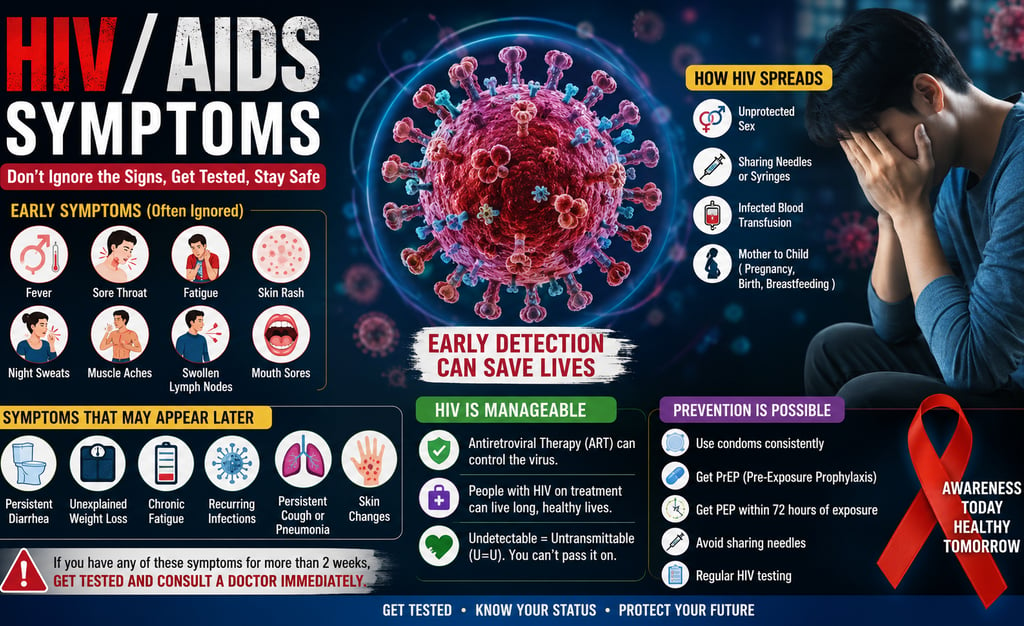
The early signs of HIV may feel ordinary. Fever, sore throat, muscle aches, joint pain, fatigue, night sweats, blotchy rash, and even mouth sores.
These early HIV AIDS symptoms people ignore a lot. And what top symptoms they ignore are mentioned below:
Which Early HIV AIDS Symptoms People Usually Ignore?
Fatigue dismissed as overwork.
Night sweats blamed on seasonal warmth.
Mouth sores are assumed to be stress ulcers.
Rash attributed to a food allergy.
Muscle aches blamed on physical exertion.
If you find any combination even after 2 weeks, you need to have an HIV test and consult a doctor immediately. You need to be quick in this matter because it makes understanding how the infection progresses all the more critical.
Now, let’s move to another section and check out the way you will analyse HIV AIDS symptoms better.
Also Read | Heart Attack Symptoms - What Are The Early Signs To Look For?
How to identify HIV AIDS symptoms?
HIV AIDS symptoms carry multiple signs. You will feel persistent diarrhea, pneumonia, skin changes, and so on. You will also feel recurring infections more often and will witness sudden weight loss without any dietary explanation. Lymph nodes in the neck, armpits, and groin swell and remain so for weeks.
Skin Changes That May Indicate HIV
Unusual discolouration appears in shades of red, brown, purple, or pink, forming blotches across the skin or along the mucous membranes of the mouth and eyelids. These are not cosmetic concerns but the surface communicating what is unfolding internally.
Symptoms That Suggest the Immune System Is Weakening
Persistent diarrhoea that continues for more than 4 weeks
Fever of unknown origin (recurrence)
Rapid, unexplained weight loss, chronic fatigue not improved by rest
Repeated episodes of pneumonia or persistent chest infections
Enlarged lymph nodes that have remained for more than three weeks.
Recurring fungal infections and repeated fever episodes frequently appear before formal diagnosis. These patterns must never be normalised. As the next section reveals, they can also present quite differently depending on biology.
Check Out | Breast Cancer Symptoms: How to Spot the Signs Early and Stay Safe
HIV Symptoms in Men and Women: What Changes in the Body?
Hiv symptoms in men frequently include genital ulcers that resist healing, skin irritation around the genitals, discomfort during urination, and persistent dermatological changes in the genital region.
Declining testosterone manifests as sustained low energy and mood disruption. Social embarrassment delays care for many men, allowing the virus to advance unimpeded.
HIV Symptoms in Women
Menstrual cycles become irregular or unusually severe. Pelvic pain with no clear gynaecological explanation persists across weeks. Women are statistically diagnosed later because many presentations are attributed to hormonal shifts, making that delay one of the most avoidable oversights in HIV care.
7 Symptoms of HIV AIDS Every Person Should Know
Prolonged fever, unexplained weight loss, chronic fatigue, night sweats, persistent diarrhea, swollen lymph nodes, and recurring opportunistic infections form the clearest collective warning this virus sends.
HIV AIDS Symptoms in body follow the same biological stages in every person. Universal awareness of this shared trajectory is the most powerful preventive tool we collectively possess.
Check Out | Breast Cancer Symptoms: How to Spot the Signs Early and Stay Safe
Why Do People Suffer From HIV?
The causes of HIV and AIDS, or HIV AIDS symptoms, follow precise biological pathways. HIV AIDS travels through unprotected sexual contact, shared needles, unscreened blood transfusions, and from a pregnant person to their child during delivery or breastfeeding. Fear and misinformation still delay diagnosis worldwide.
Common Myths About HIV Transmission
HIV does NOT spread through:
Casual physical contact or handshakes
Shared food, utensils, or drinking vessels
Coughing, sneezing, or saliva
Swimming pools or insect bites
Also Read | High Cholesterol Symptoms - Lower Cholesterol in 15 Days?
How does HIV AIDS Happen to a Person?
The progression of HIV AIDS symptoms follows three distinct stages, each with its own clinical character.
Stage 1: Acute Infection
Viral replication is explosive in the opening weeks. CD4 cells drop sharply, and the flu-like AIDS symptoms described earlier arrive with full intensity.
Stage 2: Clinical Latency
Replication slows, and symptoms subside. A person may feel well for years while the virus continues its internal work. This silent chapter makes routine testing indispensable.
Stage 3: AIDS
When CD4 cells fall below 200 per cubic millimetre of blood, AIDS symptoms erupt with severity. Pneumonia, certain cancers, and neurological complications take hold, demanding intensive medical management.
Check Out | What Are the Symptoms of Diabetes And How To Prevent Them?
Why is immunotherapy required in HIV?
HIV has no complete cure yet. The virus integrates its genetic code into the host's DNA, creating hidden reservoirs that present medicines cannot eradicate. Yet management has advanced so substantially that HIV is today a chronic, manageable condition.
How Antiretroviral Therapy Controls HIV or HIV AIDS Symptoms
Antiretroviral therapy disrupts the virus's replication cycle at multiple points. By suppressing viral load to undetectable levels, antiretroviral therapy allows CD4 cells to recover and the immune system to rebuild. Modern regimens often involve a single daily tablet. Long-acting injections, administered monthly, now offer a compelling alternative. Immunotherapy research continues exploring immune restoration beyond viral suppression alone.
Why Skipping Medicines Can Be Dangerous
Inconsistent adherence allows replication during treatment gaps, risking drug-resistant strains. A person on consistent antiretroviral therapy maintaining an undetectable viral load cannot sexually transmit the virus, a medically fact that transforms how the condition is lived.
Also Read | Heart Attack Symptoms - What Are The Early Signs To Look For?
Does HIV Cause Death?
HIV itself rarely kills directly. What endangers life is the cascade of opportunistic infections that emerge when the immune system is left undefended by untreated HIV AIDS. With early, consistent treatment, that cascade need never begin.
Can People With HIV Live a Normal Life?
Unequivocally, yes. Many people diagnosed today live full, decades-long lives. Early diagnosis and medication adherence are the decisive variables. Mental health support is equally vital because the psychological weight of an HIV diagnosis demands sustained compassionate care alongside every physical treatment.
Check Out | What Are the Symptoms of Diabetes And How To Prevent Them?
How to Prevent HIV?
Testing is the most powerful act in HIV prevention. Knowing one's status enables informed choices and early intervention. Testing four to six weeks after potential exposure yields the most reliable result. Annual testing is advisable for anyone sexually active with multiple partners.
Prevention Steps Most People Forget
Use condoms consistently during every sexual encounter.
Exploring Pre-Exposure Prophylaxis (PrEP), proven to reduce HIV acquisition dramatically.
Accessing Post-Exposure Prophylaxis (PEP) within 72 hours of any potential exposure.
Never sharing needles, syringes, or drug preparation equipment.
Seeking antenatal care and medically supervised delivery during pregnancy.
Communicating openly with partners about testing history and status.
Check Out | Depression symptoms - why people are suffering from it?
Final Words
Recognising HIV AIDS symptoms early transforms the trajectory of this condition. Testing is not frightening; prolonged unknowing is. Whether one symptom or several have surfaced, a doctor's counsel is always the wisest next step. Treatment today is remarkable, and a long, meaningful life with HIV is a well-documented present reality.
Frequently Asked Questions
What are the treatments for HIV?
Ans: Antiretroviral therapy is the global cornerstone of HIV treatment. It suppresses viral replication to undetectable levels, protecting immune function and reducing transmission risk. Treatment is lifelong, yet modern regimens are manageable, with patients maintaining control through a daily tablet or periodic long-acting injections administered clinically.
What are HIV symptoms?
Ans: HIV AIDS symptoms in the early stage closely mirror influenza, including fever, fatigue, rash, night sweats, sore throat, muscle aches, and weight loss. The immune system mounts an aggressive initial response, typically surfacing two to four weeks after exposure and then receding deceptively into silence.
Will a person die if they are diagnosed with HIV?
Ans: Not with proper, timely treatment. HIV is today a manageable chronic condition. Those beginning antiretroviral therapy early maintain near-normal life expectancy. Untreated aids symptoms, however, leave the immune system defenceless against opportunistic infections that become genuinely life-threatening without appropriate medical management.
Why is there no cure for HIV?
Ans: HIV integrates its genetic material directly into the host's DNA, forming hidden reservoirs beyond current medicine's reach. The virus also mutates rapidly, complicating vaccine development. Global research into gene-editing therapies, therapeutic vaccines, and long-acting agents continues with steady, encouraging scientific progress worldwide.
How long can one live with HIV positive?
Ans: With consistent antiretroviral therapy, many people with HIV now live well into their sixties, seventies, and beyond. Life expectancy correlates directly with timing of diagnosis, medication adherence, regular clinical monitoring, and a lifestyle that actively supports immune resilience and sustained general well-being.
5. Why does HIV happen?
Ans: HIV AIDS or HIV AIDS symptoms occur when the virus enters the bloodstream through unprotected sexual contact, shared needles, infected blood, or mother-to-child transmission. Prevention awareness, regular testing, consistent condom use, and timely access to PREP remain the most effective means of interrupting these pathways entirely.
About The Author
Neha Shukla is a writer and LinkedIn creator who demystifies wellness for modern lives. She writes about nutrition, mindfulness, and sustainable habits, grounded in research, infused with real-world wisdom. Her mission is to help you feel better without feeling overwhelmed.



Contact
Don't Let Your Wellness Journey Feel Boring! Get connected with us today to know your health better.
Phone
hello@nehashuklaa@gmail.com
+91 92110 33284
© 2026. All rights reserved.