
How to Increase Eyesight and Fix Blurry Vision: Natural Solutions Backed by Science
Many people search for how to increase eyesight, hoping for quick fixes, but protecting your vision begins with understanding what science truly supports. This guide explores practical, evidence-based ways to maintain healthy eyes through balanced nutrition, quality sleep, proper hydration, regular screen breaks, and daily lifestyle habits. It also explains the difference between improving eye comfort and reversing refractive errors, helping readers set realistic expectations. You'll discover the common causes of blurry vision, effective home routines to reduce digital eye strain, eye-friendly foods and nutrients, myths that deserve to be left behind, and warning signs that require prompt medical attention. Whether you want to preserve your eyesight as you age or simply reduce everyday eye fatigue, this comprehensive guide offers trustworthy advice to help you care for your vision with confidence while encouraging regular professional eye examinations for lasting eye health.
Neha Shukla
6/26/202613 min read

How to Increase Eyesight Naturally?
Vision, that most sovereign of senses, rarely announces its slow departure with drama. It simply retreats, quietly, until one day the blur becomes impossible to dismiss. Knowing how to increase eyesight through grounded, science-backed choices is not about chasing the impossible.
It is about understanding what genuinely shields the vision you still possess. Ageing, relentless screen exposure, nutritional gaps, and sedentary routines all conspire against clear sight.
The encouraging truth is that learning how to improve eyesight naturally is practical, evidence-supported, and entirely within reach for most people willing to commit to it honestly.
Also Read: Anti Ageing Skincare: Understanding Causes, Prevention, and Reverse Aging Tips
Understanding Eyesight: Why Vision Changes Over Time
Eyesight is the eye's capacity to gather and focus light precisely onto the retina. Eye health, by contrast, is the broader wellbeing of every structure that makes that gathering possible. The cornea, lens, retina, and optic nerve each carry their own sovereign responsibility in the act of seeing.
When light enters the eye, the cornea performs the initial bend, the lens refines the focus, and the retina translates it all into neural signals the brain decodes as the visible world.
How the Eye Focuses Light
The ciliary muscles encircling the crystalline lens contract and release to shift focus between near and distant objects, a process ophthalmologists call accommodation. Prolonged near-work at a screen exhausts these muscles systematically, producing the familiar, dull ache behind tired eyes at the end of a long working day.
Genetics establish your baseline vulnerability to myopia, hyperopia, and age-related macular degeneration. Nutrition, hydration, and lifestyle choices then shape whatever latitude heredity has left open.
Common Reasons Vision Becomes Blurry
Blurry vision causes span an enormous range, from something as straightforward as dehydration or screen fatigue to something as structural as refractive error or early cataract formation.
Dry eyes, inadequate sleep, uncorrected prescriptions, and nutritional deficiencies sit among the most frequently overlooked culprits.
Temporary Versus Permanent Vision Changes
Temporary blurry vision typically arises from digital eye strain, dehydration, fatigue, prolonged near-focus, and insufficient blinking. Permanent changes, including progressive myopia, cataracts, glaucoma-related field loss, and macular degeneration, involve structural deterioration that lifestyle habits can slow but rarely reverse.
Understanding this distinction is the foundation of any honest discussion about how to increase eyesight. With that foundation in place, the next question becomes what the science genuinely supports.
Also Read: A Complete Mental Disorders List: Exploring Common Mental Health Conditions
How to Improve Eyesight Naturally? What Science Really Says
The honest answer to how to improve eyesight naturally is layered and worth taking the time to understand properly. Lifestyle changes cannot reshape a myopic cornea or dissolve a cataract.
What the evidence does support, with genuine conviction, is that certain daily habits slow visual deterioration meaningfully, reduce strain symptoms considerably, and protect the retina from cumulative oxidative damage.
Can Healthy Habits Sharpen Vision?
They can sharpen functional clarity, meaning reduced fatigue, improved contrast sensitivity, and greater endurance of comfortable focus, without altering the underlying refractive state.
The Age-Related Eye Disease Study (AREDS2), conducted by the National Eye Institute, demonstrated that a specific combination of antioxidants reduced the risk of advanced macular degeneration by approximately 25% in high-risk individuals.
Separate longitudinal research has shown that children spending 90 minutes or more outdoors daily develop myopia at measurably lower rates. Knowing how to increase eyesight means knowing precisely where nature yields and where it holds firm.
Realistic Expectations
No amount of spinach reverses a minus four prescription. However, stabilising myopia progression, protecting the macula across decades, and eliminating the daily misery of eye strain are all legitimate, evidence-backed outcomes.
Those are not small victories. They are the difference between vision that deteriorates gracefully and vision that declines prematurely.
What you eat, how you sleep, and how you manage your screen exposure all contribute to that difference, and the next sections explain exactly how to act on each one.
How to Improve Vision in 7 Days? What Results Can You Realistically Expect
Seven days is not enough time to alter a refractive error. It is, however, enough time to feel a genuine and perceptible difference in visual comfort, clarity of focus, and the quality of sustained near work.
Reducing digital eye strain, restoring proper tear film, improving hydration, and achieving consistent sleep all deliver noticeable improvement within a week for most people.
7-Day Eye Comfort Checklist
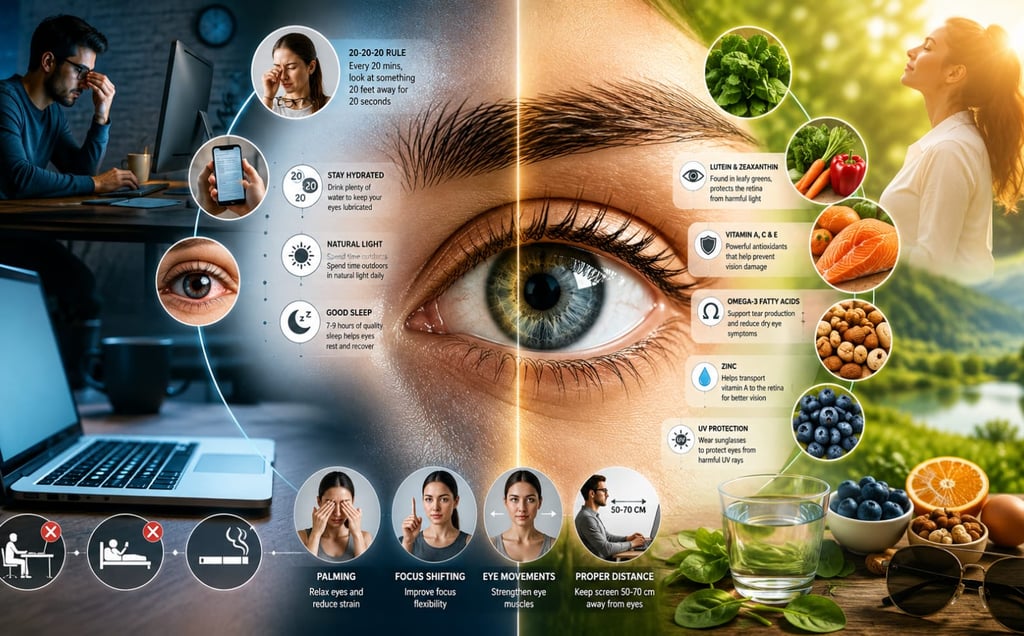
Day 1: Adopt the 20-20-20 rule rigorously; every 20 minutes of screen use, rest your gaze on something 20 feet away for 20 seconds.
Day 2: Drink at least eight glasses of water; dehydration is among the most overlooked dry eyes remedies.
Day 3: Add one lutein-rich food such as kale, spinach, or eggs to every meal.
Day 4: Position your screen 50 to 70 centimetres from your eyes and match its brightness to the ambient light around you.
Day 5: Achieve a full seven to nine hours of sleep; the eyes restore their tear film and clear metabolic debris during deep rest.
Day 6: Spend at least 30 minutes outdoors in natural daylight without a screen in hand.
Day 7: Practise five minutes of deliberate blinking drills morning and evening to redistribute the tear film evenly across the cornea.
Within seven days of these shifts, the majority of people report reduced eye fatigue, softer headaches, and genuinely more comfortable vision.
That is how to improve eyesight naturally at home in a week, held within honest and credible expectations, which leads us to the question of what happens when the blur has a deeper origin.
How to Fix Blurry Vision? Identify the Root Cause First
Blurry vision is a symptom, never a diagnosis in itself. Attempting to fix it without identifying its origin resembles silencing a fire alarm without looking for smoke.
Digital eye strain, chronic dry eyes, an outdated glasses prescription, poorly controlled blood glucose, early cataracts, elevated intraocular pressure, and ocular infections each produce blur through entirely different mechanisms and each demands a different response.
Warning Signs That Deserve Prompt Attention
Sudden blurring confined to one eye only
Blur accompanied by visual halos, headache, or nausea
Floating shapes, flashing lights, or a shadow drifting across vision
Blurry vision appearing immediately after a head injury
Blur that remains unchanged after rest, hydration, and two to three days of careful eye care
These are not ordinary eye strain. They are the body's articulate signals that something structural may be under pressure, and they warrant a proper examination by a qualified optometrist or ophthalmologist.
For the vast majority of people, however, the blur has a reversible origin, and addressing it begins with the daily habits explored next.
Best Daily Habits for How to Increase Eyesight
The architecture of lasting visual health is assembled one day at a time, through the quiet discipline of choices most people consider too small to matter. They are not.
Morning Habits for Eye Health
Begin every morning with a glass of water before any screen. Gentle, deliberate blinking in the first minutes of the day helps redistribute overnight tear secretions.
Fifteen to twenty minutes of outdoor morning light, taken without sunglasses, stimulates retinal dopamine release, a mechanism researchers have linked to reduced myopia progression in several compelling longitudinal studies.
Evening Habits for Eye Health
Dim screen brightness at least 90 minutes before sleep. Blue light at close range delays melatonin secretion and disrupts the quality of overnight ocular recovery.
Avoid rubbing tired eyes; the corneal epithelium is considerably more delicate than it feels, and habitual rubbing is associated with progressive corneal thinning in susceptible individuals.
Weekly Eye Care Habits
A weekly review of screen posture, lens hygiene, and contact lens schedules prevents the gradual accumulation of small errors that compound into larger problems. Consistent use of UV-400 sunglasses outdoors, across all seasons rather than merely summer, limits the cumulative ultraviolet exposure that accelerates cataract formation over decades.
These eye care tips, observed without drama or interruption, constitute the most reliable and cost-effective vision protection available. Building on them at home requires very little that is not already within reach.
Also Read: Top Antibiotics for Typhoid: Early Symptoms, Causes & Prevention Tips
How to Improve Eyesight Naturally at Home?
The home is full of quiet opportunity for those who know how to improve eyesight naturally at home. Proper indoor lighting, bright enough to read without effort but angled to eliminate glare on screens and pages, removes one of the most pervasive and under-acknowledged daily stressors on the visual system.
Daily Home Eye Care Routine
Morning: Splash the eyes with cool water; practise two minutes of slow, deliberate blinking.
After each meal: Step away from screens and allow the gaze to rest on a distant object for five minutes.
Midday: Check that the screen sits slightly below eye level and that the room light matches screen brightness.
Afternoon: Use a humidifier if indoor air is mechanically dried; ambient humidity supports tear film stability considerably.
Evening: Remove contact lenses without exception; apply lubricating drops if dry eyes have been present through the day.
Reading lamps with warm-spectrum bulbs, a desk positioned perpendicular to windows rather than facing them, and even the modest presence of indoor plants that raise humidity fractionally all contribute to a domestic environment that supports rather than strains the eyes.
These adjustments cost almost nothing and compound meaningfully over time. The exercises in the following section complement them well.
Eye Exercises That May Reduce Eye Strain
Eye exercises do not correct refractive errors. That distinction deserves to be stated plainly, without apology.
What eye exercises do, reliably and with decent scientific backing, is relieve the muscular fatigue that sustained near-work creates, and that relief translates into more comfortable, more sustained visual performance across a full day.
Eye Exercises to Improve Eyesight Naturally
Palming: Rub the palms together until warm, then cup them gently over closed eyes for 60 seconds. The warmth and complete darkness allow the ciliary muscles to release their sustained contraction.
Focus shifting: Hold a finger 15 centimetres from the nose, focus on it for five seconds, then shift focus to a distant object for five seconds. Ten cycles of this exercise strengthen the accommodation range without strain.
Figure of eight: Trace a slow, expansive figure of eight with the gaze across a blank wall, engaging all six extraocular muscles in fluid, unhurried movement.
Blinking drills: Blink slowly and fully 20 times in deliberate succession, redistributing the tear film and countering the reduced blink rate that screen use reliably produces.
Distance focusing: Stand at a window and alternate gaze between the glass surface and the furthest visible object beyond it, holding each for ten seconds.
These exercises are most effective when performed consistently, morning and evening, alongside the nutritional habits that form the next layer of eye care.
Also Read: Yoga for Stress Relief: Transform Your Mood in Just 10 Minutes a Day
Best Foods for Healthy Eyes
Nutrition is among the most underestimated influences on long-term visual health. The best foods for eyes are not rare or expensive.
They are the unhurried, time-honoured staples of a varied, vegetable-rich diet that any kitchen can accommodate.
Nutritional Foundations for Healthy Vision
Vitamin A, found in sweet potato, liver, and eggs, is essential for rhodopsin synthesis in rod cells; deficiency causes night blindness long before other symptoms appear.
Vitamin C, found in citrus fruits, bell peppers, and kiwi, protects lens proteins against oxidative damage and is associated in multiple studies with reduced cataract incidence.
Vitamin E, found in almonds, sunflower seeds, and avocado, serves as a synergistic antioxidant that guards retinal cell membranes against free radical accumulation.
Zinc, found in pumpkin seeds, beef, and chickpeas, transports vitamin A from liver stores to the retina and supports the density of macular pigment.
Omega-3 fatty acids, found in oily fish, walnuts, and flaxseed, reduce inflammation and are critical for meibomian gland function, which directly governs tear film quality.
Lutein and zeaxanthin, concentrated in kale, spinach, and egg yolk, accumulate in the macula and act as a natural optical filter against high-energy light.
Foods to improve eyesight without glasses are not mythological promises. They are the dark leafy greens, vibrant coloured vegetables, and quality proteins that nutritional science has consistently and rigorously endorsed.
The vitamins within them, and when to supplement them, deserve their own consideration.
Vitamins for Eye Health That Actually Matter
The AREDS2 research remains the most clinically robust investigation in this space. It demonstrated that a specific combination of vitamins C and E, alongside lutein, zeaxanthin, and zinc, reduced the progression to advanced macular degeneration by 25% in high-risk individuals.
These vitamins for eye health earned their standing through decades of peer-reviewed scrutiny rather than persuasive packaging. A food-first approach remains preferable for the majority of people. Supplementation becomes genuinely appropriate when dietary intake is consistently inadequate, particularly in older adults, those with fat malabsorption conditions, or individuals on severely restricted diets.
Supplementing beyond genuine need does not accelerate improvement and may create unintended imbalances. Eat with variety and intelligence first, and supplement only where a genuine gap exists. With that clarity established, the myths surrounding natural eye care deserve equally direct attention.
Also Read: How to Increase Height Naturally at Home: No Supplements Needed?
How to Cure Eyesight Naturally? Separating Facts from Myths
The question of how to cure eyesight naturally carries a weight of hope that merits a careful, respectful answer. Vision problems rooted in nutritional deficiency, chronic dry eyes, digital strain, and lifestyle-induced fatigue do respond meaningfully to natural intervention.
Refractive errors, structural degenerations, and genetic conditions do not yield to carrots or eye exercises, regardless of how warmly the internet presents these remedies. The belief that wearing glasses progressively weakens the eyes persists despite clear ophthalmological consensus to the contrary.
Corrective lenses do not alter the structure of the eye; they compensate optically for what the eye cannot achieve independently. Wearing the correct prescription does not accelerate myopia progression in any peer-reviewed study of credible design.
The journey toward how to increase eyesight through natural means begins, always, with replacing comforting myths with accurate and actionable knowledge.
How to Improve Eye Vision? Long-Term Lifestyle Plan
Sustaining visual health across decades is a practice of integration rather than intervention. How to improve eye vision over the long term is less about any single habit and more about the compounding effect of consistent, well-chosen daily choices.
30-Day Vision Improvement Checklist
Week 1: Implement the 20-20-20 rule; introduce lutein-rich foods at every meal; achieve 7 to 9 hours of sleep each night without exception.
Week 2: Schedule an eye examination if one has not occurred within the past 12 months; introduce daily outdoor walks of at least 30 minutes in natural light.
Week 3: Audit screen ergonomics fully; replace any contact lenses exceeding their recommended lifespan; add omega-3-rich foods at least three times per week.
Week 4: Review hydration habits; reduce alcohol consumption; prioritise smoking cessation if applicable; sustain palming and focus-shifting exercises daily.
Ongoing: Annual comprehensive eye examinations; UV-protective eyewear year-round; diligent management of blood pressure and blood glucose, both of which exert a profound and often unappreciated influence on retinal vascular health.
How to Increase Eye Power? Can It Really Be Done?
Eye power is the colloquial shorthand for refractive error, the dioptre figure your optometrist writes on a prescription. How to increase eye power in the strict clinical sense, meaning reducing that figure naturally, is not achievable for most adults through lifestyle change alone.
Refractive surgery alters the cornea's curvature to achieve this; lifestyle practices do not replicate that outcome. What natural habits genuinely influence is functional visual performance: sharpness of contrast, speed and ease of focus shifting, endurance through prolonged near work, and resistance to the fatigue that compounds a working day. These improve measurably with consistent practice.
Prescriptions can stabilise in adults who adopt these habits, particularly when blood glucose is well controlled, and progressive myopia is the primary concern, but the dioptre numbers do not diminish without surgical intervention.
Understanding that distinction removes the frustration of expecting the wrong outcome and allows you to appreciate the genuine improvements that are available.
Common Mistakes That Damage Your Eyesight
The most consequential errors are rarely dramatic. They are the quiet, habitual ones that nobody thinks to mention because they feel too minor to matter.
Habits That Quietly Erode Vision Quality
Sleeping in contact lenses reduces corneal oxygen supply substantially and increases the risk of serious infection far beyond what most wearers appreciate
Reading in dim light does not cause permanent structural damage, but creates chronic accommodative strain that accumulates into persistent fatigue over weeks and months.
Rubbing the eyes habitually is associated with corneal thinning and keratoconus risk in individuals with underlying susceptibility, and the habit is far more common than the risk is acknowledged.
Neglecting regular eye examinations allows glaucoma and macular degeneration to advance silently through stages where early intervention would have preserved significantly more vision.
Chronic dehydration impairs tear film stability directly and is one of the most frequently overlooked contributors to dry eyes across all age groups.
Smoking doubles the risk of age-related macular degeneration and raises cataract incidence substantially; it is among the most damaging habits a person with vision concerns can maintain.
Eye Care Tips Recommended by Eye Specialists
Expert Eye Care Checklist
Schedule a comprehensive eye examination every one to two years, regardless of whether vision feels stable.
Wear UV-400 rated sunglasses outdoors in every season, not only during the summer months.
Eat a diet consistently rich in lutein, zeaxanthin, vitamins C and E, zinc, and omega-3 fatty acids.
Apply the 20-20-20 rule throughout every screen-intensive day without exception.
Maintain rigorous contact lens hygiene; never extend wearing periods beyond the manufacturer's recommended schedule.
Drink at least 1.5 to 2 litres of water daily; adequate hydration is among the most undervalued dry eyes remedies available.
Eliminate or substantially reduce smoking; the ocular benefits of cessation begin appearing within months and compound over the years.
Also Read: How to Get Better Sleep Naturally: Simple Tips to Improve Sleep Quality Every Night
Conclusion
Healthy habits are the quiet custodians of lifelong clear sight. Natural methods genuinely support eye health, slow deterioration, and relieve the accumulated strain of modern living. If blur persists beyond a week of honest lifestyle change, a proper examination is the most intelligent and compassionate next step. Knowing how to increase eyesight, at its deepest level, means knowing what is in your hands and what belongs in someone else's.
Frequently Asked Questions
Can I improve my eyesight naturally?
Ans: Natural methods including improved nutrition, consistent sleep, adequate hydration, and reduced digital strain meaningfully enhance visual comfort and slow deterioration over time. They do not reverse structural refractive errors, but they protect existing vision effectively and support long-term eye health when applied with genuine consistency and patience.
How to develop 20/20 vision?
Ans: Reaching 20/20 vision naturally depends on your baseline eye structure entirely. People whose blur stems from strain or dehydration may recover near-normal clarity through rest and lifestyle changes. Those with structural refractive errors require corrective lenses or surgical intervention to achieve the 20/20 benchmark reliably and sustainably.
Is 4.5 eyesight able to be improved?
Ans: A prescription of minus 4.50 dioptres reflects a structural refractive error that lifestyle habits alone cannot reverse. Natural methods can stabilise the condition, reduce associated strain, and protect the retina from further degeneration. For meaningful dioptre reduction, refractive surgery remains the only clinically established route available.
Is it possible to gain eyesight?
Ans: Partial recovery of functional clarity is genuinely possible when vision loss stems from reversible causes such as nutritional deficiency, chronic dry eyes, poorly managed blood glucose, or accumulated eye strain. Structural losses from glaucoma or macular degeneration cannot be naturally reversed, but protective habits preserve what remains very effectively.
What is the 20-20-20 rule for eyesight?
Ans: Every 20 minutes of screen use, shift your gaze to something at least 20 feet away and hold it there for 20 seconds. This deliberate pause relaxes the ciliary muscles, reduces accommodative fatigue, restores partial blink function, and is among the most consistently endorsed habits for managing digital eye strain across working-age adults.
About The Author
Neha Shukla is a writer and LinkedIn creator who demystifies wellness for modern lives. She writes about nutrition, mindfulness, and sustainable habits, grounded in research, infused with real-world wisdom. Her mission is to help you feel better without feeling overwhelmed.



Contact
Don't Let Your Wellness Journey Feel Boring! Get connected with us today to know your health better.
Phone
hello@nehashuklaa@gmail.com
+91 92110 33284
© 2026. All rights reserved.