
A Complete Mental Disorders List: Exploring Common Mental Health Conditions
This comprehensive guide explores mental health conditions with clarity, empathy, and depth, offering readers a thoughtful understanding of how mental well-being shapes everyday life. It begins by gently explaining what mental health truly means, before presenting a structured mental disorders list that simplifies even the most complex mental health conditions. From anxiety and mood disorders to trauma-related and neurodevelopmental challenges, the article uncovers key symptoms, underlying causes, and subtle early signs often overlooked. It also highlights how prolonged stress can evolve into serious mental health conditions if left unaddressed. Beyond awareness, the piece offers practical, actionable strategies including daily habits, self-assessment techniques, and guidance on when to seek professional help. With a compassionate tone and elegant clarity, this guide empowers readers to recognise, manage, and support others through various mental health conditions with confidence and care.
Neha Shukla
6/24/20269 min read
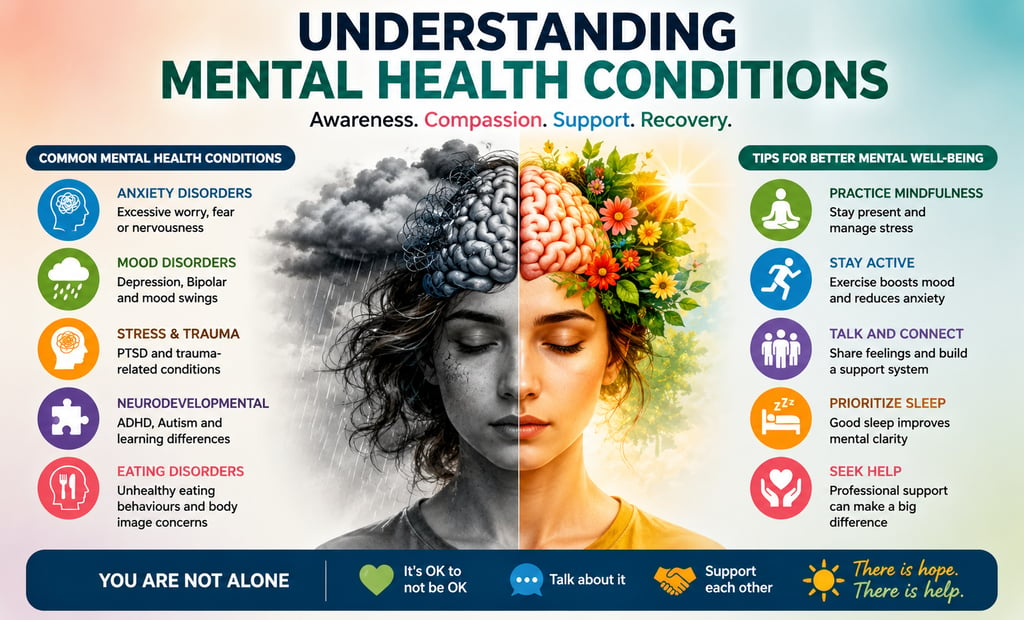
What Is Mental Health? A Deep Dive into Mental Health Conditions and Disorders
Millions carry mental health conditions that never quite surface at the breakfast table, folded into busyness, masked by routine and quietly endured. Mental health, in its truest sense, is the invisible architecture governing how a person thinks, feels, and recovers.
This article walks through a complete mental disorders list covering symptoms, causes, hidden signals, and guidance that actually holds up in real life. Mental health conditions are not failures of character. They are human realities, and understanding them is where everything begins.
Also Read: How to Be Happy in Life: What Are the Real Secrets to Living Happily Every Day?
What is Mental Health? What are Mental Health Disorders?
Mental health is not the absence of pain but the sustained capacity to feel, reason, connect, and recover. A mental health disorder differs from ordinary difficulty through persistence, intensity, and the weight it places on daily functioning.
Mental health disorders do not resolve through resolve alone; they require comprehension and, frequently, structured care. Mental wellness describes emotional steadiness, purposeful engagement, and the ability to absorb ordinary adversity.
Mental illness, by contrast, involves clinically significant disruptions to thought, emotion, or behaviour that reshape how a person moves through their days.
Mental health disorder examples span a vast spectrum, from generalised anxiety disorder to borderline personality disorder to schizophrenia, and none of them represents personal failing. That distinction, quietly transformative as it is, forms the bedrock of everything that follows.
What are the 7 Main Types of Mental Disorders?
Anxiety Disorders
Anxiety disorders are the most prevalent mental health conditions globally, characterised by persistent worry that exceeds its circumstances and manifests physically through racing heart, shallow breath, and muscular tension.
Try "scheduled worry": a fixed 15-minute daily window for anxious thoughts, deferring anything that surfaces outside it. This restructures rumination rather than suppressing it.
Mood Disorders
Mood disorders include major depressive disorder, which strips pleasure and motivation with quiet efficiency, and bipolar disorder, which cycles between depressive lows and manic highs of startling conviction.
Stabilising circadian rhythms, consistent sleep times, morning light, and reduced evening screens produce measurable improvements, particularly for those managing bipolar disorder. From mood, the spectrum broadens into experiences that fracture reality itself.
Psychotic Disorders
Psychotic disorders, foremost schizophrenia, involve hallucinations and delusions that sever a person's relationship with shared reality. These are not signs of danger, they are symptoms of a profoundly disorienting mental health condition that responds meaningfully to compassionate, consistent care.
Open Dialogue therapy, drawing in a person's natural social network alongside clinical support, has shown strong outcomes.
Eating Disorders
Eating disorders, anorexia nervosa, bulimia nervosa, and binge eating disorder, are not about food. They are intricate struggles with control, identity, and self-worth.
Early signs include rigid food rituals and secretive eating. Addressing the underlying need for control through journalling or narrative therapy produces more durable change than interventions focused solely on eating behaviour.
Personality Disorders
Personality disorders are enduring, inflexible patterns of inner experience causing sustained difficulty across relationships and self-concept. Borderline personality disorder, narcissistic personality disorder, and antisocial personality disorder typically crystallise in adolescence.
Dialectical Behaviour Therapy (DBT), built specifically for borderline personality disorder, develops distress tolerance, emotional regulation, and interpersonal effectiveness.
Trauma-Related Disorders
Post-traumatic stress disorder (PTSD) arises after events that overwhelm the mind's integrative capacity. Intrusive memories, hypervigilance, and avoidance define the experience.
Prolonged emotional neglect wounds as deeply as singular trauma. EMDR, Eye Movement Desensitisation and Reprocessing, carries robust evidence for PTSD and often unlocks progress where talking therapies have met a ceiling.
Neurodevelopmental Disorders
ADHD and autism spectrum disorder are neurological differences, not character deficits, differences that frequently clash with environments built for other kinds of minds.
Environmental scaffolding, predictable routines, reduced sensory overload, explicit task sequencing, supports people with neurodevelopmental mental health conditions far more sustainably than effort-based demands ever could.
Having mapped the principal categories, the next layer worth examining is what prolonged stress does to the body before it becomes something clinical.
Also Read: Yoga for Stress Relief: Transform Your Mood in Just 10 Minutes a Day
What are 7 Symptoms of Long-Term Stress?
Chronic stress leaves its marks in ways that feel oddly unrelated to any particular problem. Its signals are easy to attribute to ordinary tiredness until the pattern becomes too consistent to ignore.
Fatigue and sleep do not resolve, bone-deep weariness rooted in a nervous system that never fully stands down.
Recurring physical complaints, headaches, digestive disruption, and lowered immunity reflecting sustained cortisol elevation.
Unprovoked irritability, disproportionate reactions signalling depleted emotional reserves.
Cognitive fog, mental sluggishness that persists even after adequate rest.
Social withdrawal, retreating from connection in ways that compound mental health problems rather than resolve them.
Anhedonia, the flattening of pleasure across hobbies, relationships, and meaning.
Sleep disruption despite exhaustion, lying awake despite profound tiredness, or waking repeatedly without cause.
Hidden Signs People Ignore
The subtler signals are worth naming honestly: decision fatigue masquerades as indecisiveness, emotional numbness masquerades as composure, and a creeping escalation of perfectionism and re-doing tasks compulsively signals a need for control that deserves examination.
When Stress Turns Into Mental Illness
The passage from manageable stress to a diagnosable mental health condition is rarely a single moment. It is erosion. When stress outlasts its trigger, intensifies rather than recedes, and begins to structure daily life around avoidance, and that is the threshold.
Mental health conditions such as anxiety disorders and major depressive disorder frequently take root in chronic, unacknowledged stress.
Recognising this early is discernment, not dramatising, and it opens the door to something better. Understanding which conditions carry the greatest clinical weight is the natural next step.
Also Read: How to Get Better Sleep Naturally: Simple Tips to Improve Sleep Quality Every Night
What are 5 Serious Mental Illnesses?
Schizophrenia
Schizophrenia reshapes reality through hallucinations, delusions, and disorganised thought. A man whose brother lives with the condition once described it as "watching someone you love navigate a world you cannot enter."
With sustained antipsychotic treatment and psychosocial support, purposeful, connected lives are entirely possible. Brief, consistent social contact, without agenda, reduces relapse risk considerably.
Major Depressive Disorder
Major depressive disorder is not prolonged sadness, it is the evacuation of colour, motivation, and self-regard. It affects women at roughly twice the rate of men and peaks between ages 25 and 44.
Behavioural activation, scheduling small achievable actions before motivation returns, not after, is counterintuitive, clinically validated, and one of the most accessible early approaches available.
Bipolar Disorder
Bipolar disorder moves between depressive lows and manic highs that carry their own persuasive logic in the moment. Decisions made during mania can reshape a life before the episode passes.
Daily mood charting, tracking sleep, energy, and emotional tone, enables early identification of emerging episodes before escalation.
Obsessive-Compulsive Disorder
Obsessive-compulsive disorder (OCD) is persistently misread as a fondness for tidiness. The reality is a privately harrowing cycle of intrusive thoughts and compulsive rituals consuming hours of the day.
Exposure and Response Prevention (ERP) therapy, learning to tolerate the anxiety without performing the compulsion, remains the most effective clinical intervention available.
Severe Anxiety Disorder
Severe anxiety disorder can render ordinary life functionally impossible. Panic attacks arrive without warning, mimicking physical catastrophe convincingly enough to be frequently mistaken for cardiac events.
Somatic awareness practice, locating anxiety as a bodily sensation and breathing deliberately through it, builds genuine tolerance that accumulates. With the most serious conditions mapped, it is worth understanding how common the broader picture truly is.
Also Read: What Is Bipolar Disorder? Causes, Symptoms, and Treatment Explained
Most Common Mental Health Conditions You Should Know
Quick Snapshot
The five most prevalent mental health conditions globally are generalised anxiety disorder, major depressive disorder, PTSD, ADHD, and OCD, collectively affecting hundreds of millions across every demographic.
Generalised Anxiety Disorder responds to cognitive restructuring and structured mindfulness. Major Depressive Disorder responds to behavioural activation and sleep consistency. PTSD responds to EMDR and social reconnection.
ADHD responds to environmental structure rather than effort-based demands. OCD responds to Exposure and Response Prevention therapy.
These mental health conditions cut across class, geography, and constitution, with prevalence data consistently showing that economic pressure and social isolation amplify risk in measurable ways. Understanding why they emerge is as important as recognising them.
Causes and Risk Factors Behind Mental Health Conditions
Genetic and Brain Chemistry Factors
Biology contributes substantially to mental health conditions. Neurotransmitter dysregulation, across serotonin, dopamine, and norepinephrine pathways, and structural brain differences carry real clinical weight. A family history of mental illness elevates vulnerability without ever making it inevitable.
Hereditary patterns across mood and anxiety disorders.
Dopamine dysregulation central to psychotic and attentional conditions.
Hormonal shifts influencing emotional stability across the lifespan.
Neuroinflammation is a significant emerging area of research.
Lifestyle and Environmental Triggers
Chronic sleep deprivation erodes emotional regulation progressively.
Digital over-stimulation elevates baseline anxiety in ways that compound over time.
Nutritional insufficiency across omega-3s, magnesium, and B vitamins impairs neurological resilience.
Substance use accelerates existing mental health conditions rather than relieving them.
Physical inactivity independently associated with depressive episodes
Social and Cultural Influences
Loneliness now carries the same clinical gravity as smoking. Social isolation, discrimination, and cultural stigma compound individual vulnerability in ways no amount of personal resilience fully counteracts.
The prevalence of mental health conditions rises sharply in environments built on chronic disconnection. Communities with genuine belonging and accessible natural space consistently register lower rates of mental illness, because psychological health is irreducibly social.
Causes understood, the practical question becomes what actually helps.
Also Read: Are You Experiencing Anxiety Attack Symptoms? Here’s What Your Body Is Telling You
Practical Ways to Manage Mental Health Conditions
Daily Habits That Actually Work
The behaviours that durably shift the neurological landscape of mental health conditions are unglamorous. Consistent sleep and wake times rival pharmaceutical intervention in mood stabilisation studies. Brief social contact triggers oxytocin and lowers cortisol.
Twenty minutes of movement generates BDNF (brain-derived neurotrophic factor) that supports neurological repair. Journaling and time in natural surroundings complete a foundation that behavioural science vindicates consistently.
Recognising the Turning Point
There is a juncture when self-management begins to buckle. Symptoms worsen rather than plateau, relationships fray, and intrusive thoughts feel ungovernable.
These are not signs of weakness; they are accurate readings that mental health conditions have moved into territory requiring a different kind of attention. Naming that honestly is not concession, it is clarity.
Self-Assessment Techniques
Mental health disorder examples across the clinical spectrum share one commonality: early self-awareness accelerates outcomes. People managing mental health conditions who build structured self-monitoring habits report earlier intervention and more sustained progress.
Track sleep, energy, emotional stability, social engagement, and capacity for enjoyment across one week.
Three or more areas showing consistent decline is a pattern worth acting on. The same attentiveness that serves oneself applies, in a different register, to supporting others.
Also Read: Is It Just Stress, or Something More? Recognising the Signs of a Panic Attack
How to Support Someone With Mental Health Issues
What to Say and What to Avoid
Supporting someone with mental health conditions demands presence far more than solutions. "I am here, and that is not changing" carries more weight than any well-intentioned fix.
Minimising language such as "everyone feels like that" or "just get some fresh air" signals that their experience is inconvenient rather than real.
Recovery from mental health conditions is rarely linear, and patience expressed consistently is the most substantive offering available.
Small Actions That Make a Big Difference
The most profound support is frequently the most ordinary. Arriving at the door. Accompanying someone somewhere they find daunting.
Sending a message that genuinely requires no reply. Absorbing logistical burdens and tasks that feel impossible when depleted frees psychological space for healing.
These gestures do not resolve mental health conditions, but they confirm that someone is not navigating them alone. In the long architecture of recovery, that knowledge is far from small.
Also Read: Depression symptoms - why people are suffering from it?
Conclusion
Mental health conditions belong to no particular kind of person. They are woven through the fabric of shared human experience. Naming them, understanding them, and meeting them with both knowledge and warmth is how shame gives way to clarity. Awareness is the first movement. Begin there.
FAQs
What is mental health?
Ans: Mental health is the internal equilibrium governing how a person thinks, feels, connects, and recovers across the full range of daily life. It exists on a continuum, shifting with circumstance, history, and care, and shapes everything from professional functioning to the quality of one's closest relationships in ways rarely visible until something disrupts them.
What are the 4 types of mental health?
Ans: Mental health spans four dimensions: emotional wellbeing, managing and processing feelings; psychological health, encompassing cognitive patterns and resilience; social health, covering connection and belonging; and spiritual wellbeing, the sense of meaning and purpose underpinning direction. Together they form a holistic portrait of a person's inner life.
What is the 3-3-3 rule in mental health?
Ans: The 3-3-3 rule is a grounding technique for acute anxiety. Name three things visible in the immediate environment, identify three distinct sounds, then deliberately move three parts of the body. It redirects attention from internal catastrophising to immediate sensory reality, a deceptively simple method with genuine neurological credibility behind it.
What are 5 signs of mental health problems?
Ans: Five reliable indicators of emerging mental health problems: persistent low mood or anxiety lasting beyond a fortnight; marked changes in sleep or appetite; withdrawal from previously enjoyed social activities; difficulty concentrating or reaching decisions; and recurring physical complaints such as headaches, fatigue, and digestive unease without identifiable medical cause.
How do I check my mental health?
Ans: Track five areas honestly across one full week: sleep quality, sustained energy, emotional stability, social engagement, and genuine capacity for enjoyment. Three or more areas showing consistent decline is a pattern worth acting on. Writing observations rather than holding them mentally tends to surface a level of honesty that internal reflection alone rarely achieves.
About The Author
Neha Shukla is a writer and LinkedIn creator who demystifies wellness for modern lives. She writes about nutrition, mindfulness, and sustainable habits, grounded in research, infused with real-world wisdom. Her mission is to help you feel better without feeling overwhelmed.



Contact
Don't Let Your Wellness Journey Feel Boring! Get connected with us today to know your health better.
Phone
hello@nehashuklaa@gmail.com
+91 92110 33284
© 2026. All rights reserved.