
How to Get Better Sleep Naturally: Simple Tips to Improve Sleep Quality Every Night
Struggling with restless nights and tired mornings often leads us to wonder how to get better sleep in a way that truly works. This guide explores how to get better sleep by focusing not just on duration, but on quality, habits, and the body’s natural rhythm. From understanding your internal clock to identifying hidden disruptors like caffeine, alcohol, and screen time, it offers a thoughtful approach to better rest. You will also discover practical routines, calming techniques for anxiety, and smart lifestyle adjustments that support deep, restorative sleep. Whether you are dealing with stress, irregular schedules, or poor habits, this article provides clear, actionable steps to help you understand how to get better sleep consistently and wake up feeling refreshed, energised, and ready to embrace the day with clarity.
Neha Shukla
6/7/20267 min read
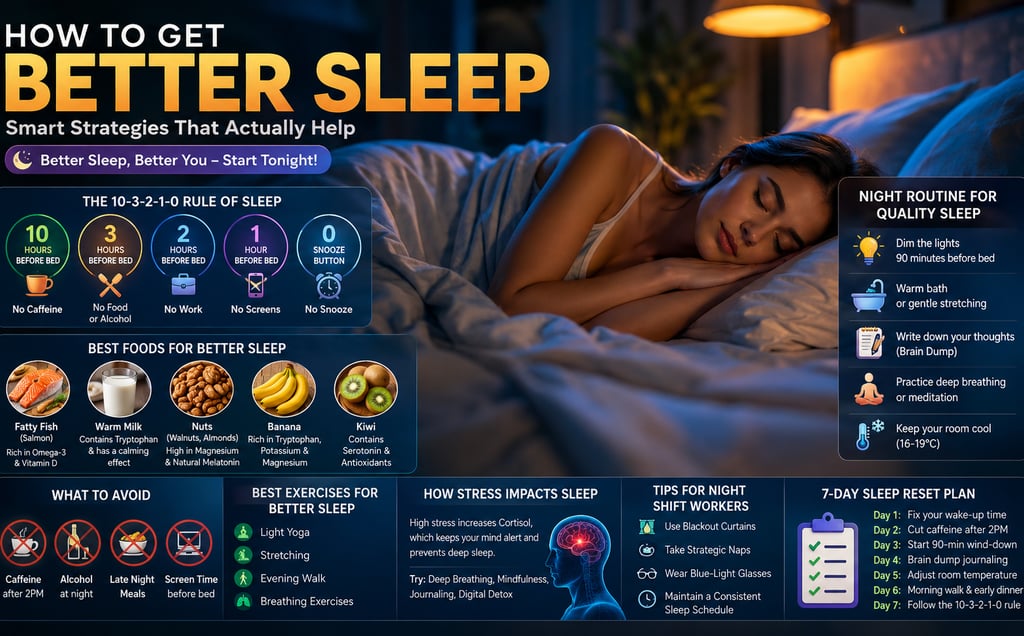
How to Get Better Sleep: Smart Strategies That Actually Help
Knowing how to get better sleep feels urgent when living that reality. Most advice on how to get better sleep barely scratches the surface. How to get better sleep is not merely about lying down earlier - it is about biology, habit architecture, and subtle saboteurs like stress, caffeine, screen time, and late night meals dismantling rest night after night.
This guide on how to get better sleep delivers uncommon, actionable strategies addressing not just duration but quality. Expect practical routines, clear science, and a complete picture of how to get better sleep in a way that truly endures. The strategies ahead answer what to avoid, what to build, and how to get better sleep starting tonight.
Also Read: What Is Bipolar Disorder? Causes, Symptoms, and Treatment Explained
How to Get Better Sleep? Start With Your Internal Body Clock
A dear friend once spent three months baffled by her exhaustion. She slept eight full hours yet woke hollow-eyed every morning. The culprit was not her bedtime,it was her circadian rhythm, the internal biological clock that governs alertness, drowsiness, and deep restoration on a 24-hour cycle. Disrupting it is the silent reason so many people who want to know how to get better sleep still wake depleted.
How to Improve Sleep Cycle Naturally
Fix your wake-up time first. Your wake-up time matters more than your bedtime. The body calibrates melatonin and cortisol from morning, not night.
Seek morning sunlight within 30 minutes of waking. Natural light suppresses residual melatonin and signals the day has truly begun.
Avoid irregular naps after 3pm. A nap longer than 20 minutes bleeds into your melatonin window and fragments overnight sleep.
Dim artificial lights at dusk, allowing adenosine, the sleepiness compound to accumulate naturally and undisturbed.
Understanding your circadian rhythm is the bedrock. Every habit in the next section is architecture built upon it.
Also Read: Are You Experiencing Anxiety Attack Symptoms? Here’s What Your Body Is Telling You
What to Avoid to Get Better Sleep? Hidden Habits That Ruin Your Night
Once the internal clock is understood, the illuminating question becomes: what to remove entirely? Certain everyday lifestyle habits function as invisible wrecking balls against sleep quality.
Don’t Do These Mistakes To Get Better Sleep
Caffeine timing matters more than quantity. Caffeine after 2pm lingers six to eight hours, reducing deep sleep without you ever feeling classically wired.
Alcohol reduces REM sleep quality. It creates deceptive sedation while fragmenting restorative cycles needed for memory and emotional regulation.
Late night meals force digestive effort when the body should be cooling and quietening toward rest.
Screen time in the final hour suppresses melatonin via blue light and sustains nervous system alertness no pillow can undo.
Eliminating these habits is the essential clearing before any new routine takes root. With that ground prepared, the night routine ahead becomes genuinely transformative.
Also Read: Is It Just Stress, or Something More? Recognising the Signs of a Panic Attack
How to Improve Sleep Quality? Science-Backed Night Routine
The hours before sleep are either building deep rest or eroding it. A deliberate pre-sleep routine is the most underutilised strategy among those researching how to get better sleep.
The 90-Minute Wind-Down System
Ninety minutes before bed, dim the lights to signal melatonin secretion. Reduce stimulation steadily. In the final 30 minutes, introduce gentle ritual: a warm bath, slow stretching, or unhurried reading. The body interprets these cues as permission to descend into rest.
How to Sleep Better With Anxiety
Cognitive shuffle: Visualise a random sequence of unconnected images - a red bicycle, a pine forest, a teacup. This interrupts the anxious narrative loop and mimics natural sleep onset.
Brain dump journaling: Write every unfinished thought for 10 minutes before bed, externalising what the brain would otherwise hold in active memory through the night.
Temperature regulation: A cool room between 16 and 19 degrees Celsius facilitates the core body temperature drop that is a physiological prerequisite for deep sleep.
These techniques address anxiety at its neurological root. The structured framework below anchors them to a precise daily timeline.
Also Read: Reason for High Blood Pressure: Causes, Symptoms & Natural Ways to Control It
What is 10 3 2 1 0 Rule of Sleep? A Practical Framework
This elegant protocol transforms good intentions into a timed daily sequence - one of the finest practical answers to how to get better sleep for modern, demanding lives.
10 hours before bed: No caffeine. Honours its extended half-life and allows adenosine to accumulate.
3 hours before bed: No food or alcohol. Both disrupt sleep architecture and temperature regulation.
2 hours before bed: No work. Mental disengagement lowers cortisol to sleep-ready levels.
1 hour before bed: No screens. Preserve the melatonin window and quieten the nervous system.
0: No snooze button. Fragmented early-morning sleep is low-quality and negotiates away your circadian anchor.
Treat this as a compass, not a court summons. Flexibility is what makes the framework sustain rather than collapse under real life. The right movement practice, explored next, multiplies its benefits.
Also Read: Heart Attack Symptoms - What Are The Early Signs To Look For?
What Are the Best Exercises to Sleep Early?
Movement is medicine for sleep, but timing and type matter considerably for those learning how to get better sleep through physical habits.
Top Exercises for Better Sleep
Light yoga in the evening activates the parasympathetic nervous system, lowering heart rate and releasing accumulated muscular tension.
Stretching targets the hips and shoulders where stress physically resides, creating bodily release that mirrors psychological unwinding.
Walking for 20 to 30 minutes in natural light regulates cortisol rhythms and produces a clean temperature drop conducive to sleep.
Breathing exercises such as the 4-7-8 technique reduce sympathetic nervous activation within minutes, ideal as the final pre-sleep ritual.
Avoid intense workouts within two to three hours of bedtime. Vigorous exercise raises core body temperature and adrenaline in ways requiring hours to subside. What nourishes the body feeding into this movement matters equally.
Also Read: Breast Cancer Symptoms: How to Spot the Signs Early and Stay Safe
What Are the Best Diet to Sleep Better?
Food and sleep share a more intimate relationship than most people recognise. What you consume, and precisely when, shapes the quality of every night.
Best Foods to Get Better Sleep
Fatty fish such as salmon provide omega-3 fatty acids and vitamin D, both supporting serotonin as the melatonin precursor.
Warm milk carries tryptophan alongside a genuine physiological calming effect rooted in warmth and familiar ritual.
Nuts, particularly walnuts and almonds, deliver magnesium and natural melatonin, relaxing muscles and quietening the nervous system.
Bananas offer tryptophan, potassium, and magnesium - a distinguished trio of natural muscle relaxants.
Tryptophan requires magnesium as a cofactor; without adequate magnesium, sleep chemistry falters. Time meals at least two hours before sleep. For those whose schedules run against the sun, these timing principles need thoughtful adjustment.
Also Read: Depression symptoms - why people are suffering from it?
How to Get Better Sleep for Night Shift Workers?
Night shift workers carry a particularly noble burden. Yet how to get better sleep in this context is absolutely achievable with deliberate, targeted strategy.
Smart Sleep Strategies for Shift Workers
Blackout curtains are non-negotiable - daylight suppresses melatonin relentlessly regardless of exhaustion level.
Strategic naps of 20 to 90 minutes before a shift reduce circadian misalignment and sustain cognitive sharpness.
Controlled light exposure using blue-light blocking glasses during the dawn commute prevents morning light from resetting the internal clock too early.
The anchor sleep method - a consistent four to five hour sleep block at the same time daily regardless of shift preserves circadian stability with remarkable effectiveness. The stress dimension of shift work and modern life at large deserves equal, dedicated attention.
Also Read: High Cholesterol Symptoms - Lower Cholesterol in 15 Days?
Mental Health, Stress, and Sleep: The Missing Link
Sleep disturbance and mental health share a bidirectional relationship so intimate that treating one without the other is like bailing a boat without finding the breach.
How Stress Impacts Sleep
Cortisol, the primary stress hormone, prevents the temperature drop initiating deep sleep. Under chronic stress it remains elevated through the night, producing fragmented rest that worsens anxiety the following day - a cycle both elegant and merciless.
Practical Ways to Reduce Night Stress
Breathing techniques such as box breathing activate the vagus nerve, reducing heart rate within minutes.
Mindfulness practice of even five minutes quietens the ruminative, anxiety-driven thinking that colonises bedtime.
Digital detox from one hour before bed removes the primary source of low-grade stress: the perpetual stream of notifications keeping the nervous system in mild, persistent alert.
With stress addressed, the final structured plan draws every strategy in this guide into one executable week.
Also Read: What Is Bipolar Disorder? Causes, Symptoms, and Treatment Explained
Action Plan: Your 7-Day Better Sleep Reset
Day 1: Fix your wake-up time and hold it regardless of the previous night.
Day 2: Cut caffeine after 2pm and observe the shift in evening wakefulness.
Day 3: Begin a 90-minute screen-free wind-down, replacing scrolling with stretching.
Day 4: Add a 10-minute brain dump journal each evening before bed.
Day 5: Adjust room temperature to between 16 and 19 degrees Celsius.
Day 6: Add a morning walk in natural light; eliminate late night meals after 8pm.
Day 7: Practise the complete 10-3-2-1-0 framework and observe how every layer compounds.
These habits stack with quiet elegance. The body responds to consistency with remarkable speed.
Also Read: Are You Experiencing Anxiety Attack Symptoms? Here’s What Your Body Is Telling You
Conclusion
Learning how to get better sleep is about consistency, not perfection. Small, deliberate shifts in habits, timing, and environment accumulate into something quietly transformative. Begin tonight, not tomorrow. Rest is not a luxury - it is the foundation upon which every well-lived day is built.
FAQs
What is the Japanese trick to sleep?
Ans: The most referenced Japanese sleep technique involves slow, rhythmic breathing with extended exhales, exhaling twice as long as the inhale activates the parasympathetic nervous system. Paired with Shizen relaxation principles of stillness and natural presence, this method lowers heart rate and guides the body toward sleep, often reducing onset time within evenings.
Is 9:30 to 4:30 enough sleep?
Ans: Seven hours can suffice for some adults, but individual variation is significant. Quality matters as much as duration - those seven hours must include adequate deep and REM cycles. Many adults require between seven and nine hours. Waking rested without an alarm is the most reliable indicator that your duration suits your particular biology.
What fruit helps you sleep?
Ans: Kiwi contains serotonin and antioxidants shown to improve sleep onset. Tart cherries provide natural melatonin, supporting circadian regulation. Bananas offer tryptophan, potassium, and magnesium, relaxing muscles and supporting melatonin production. Eating these fruits one to two hours before bed maximises benefit without burdening digestion during restorative sleep hours.
How do I fix my poor sleep?
Ans: Begin with three foundational shifts: fix your wake-up time daily, remove caffeine after 2pm, and eliminate screens in the final hour before bed. Layer in a cooler sleeping environment and a 90-minute wind-down routine. These habit-based changes address the most structural causes of poor sleep without requiring supplements to begin seeing meaningful results.
What vitamin is lacking for insomnia?
Ans: Magnesium deficiency is among the most overlooked contributors to insomnia, governing muscle relaxation and nervous system calming. Vitamin D regulates sleep-wake cycles and is deficient in many with limited sun exposure. Vitamin B12 supports melatonin production and nerve function; low levels are closely linked to disrupted circadian signalling and chronically fragmented rest.
About The Author
Mandeep Rawat is a writer who demystifies wellness for modern lives. He writes about nutrition, mindfulness, and sustainable habits, grounded in research, infused with real-world wisdom. His mission is to help you feel better without feeling overwhelmed.



Contact
Don't Let Your Wellness Journey Feel Boring! Get connected with us today to know your health better.
Phone
hello@nehashuklaa@gmail.com
+91 92110 33284
© 2026. All rights reserved.