
Signs of a Panic Attack: Nighttime Anxiety, Choking Sensations, and What They Mean
Understanding the signs of a panic attack is essential for distinguishing between ordinary stress and a deeper physiological and emotional response. This blog explores how panic attacks often begin with subtle cues such as mild dizziness, uneasiness, or changes in breathing, which are frequently overlooked. As symptoms intensify, individuals may experience a fast heartbeat, choking sensations, tightness in the chest, sweating, and a fear of losing control, all driven by the body’s fight-or-flight mechanism. It also highlights common triggers, including external pressures like crowds and deadlines, as well as internal factors such as negative thought patterns, poor sleep, and lifestyle imbalances. The article clearly differentiates between panic attacks and anxiety attacks based on onset, duration, and intensity, while also explaining various types of panic episodes. Practical strategies are provided, including grounding techniques, breathing exercises, therapy, and medical support, along with preventive lifestyle habits. By recognising early warning signs and understanding root causes, individuals can respond with greater awareness, reduce fear, and take meaningful steps towards improved mental health and emotional resilience.
Neha Shukla
5/16/20269 min read
Is It Just Stress, or Something More? Recognising the Signs of a Panic Attack
I recently went for a night's stay at my cousin’s home. She was a little depressed as her life was not going well. She had a breakup, and her family always blames her for any single thing, even if she hasn’t done that. She barely talks, and I was sensing that it may be signs of a panic attack or maybe she was having one. But we were having dinner, so I thought not to overthink, and suddenly, from the kitchen, I heard a loud noise from the kitchen.
I went there, she hurried to her room, I followed her, and she, out of crying, had a panic attack. Her voice was stammering, her heart was racing, and she was suffering from shortness of breath.
After a while, I calmed her. But it is still stuck in my mind. Why did it happen? Has she had any symptoms or signs of a panic attack before? This is the only thing I’m thinking right now.
Also Read | Depression symptoms - why people are suffering from it?
What Are the Early Signs of a Panic Attack That Most People Miss?
There are multiple signs of a panic attack. Some suffer from faint, some from shortness of breath, unexplained fatigue and dizziness. But there are more things to understand.
Most people silence this quiet prologue and arrive at a full panic attack without context. Learning to hear those early dispatches is where genuine understanding and genuine relief begin.
Subtle Physical Clues Before a Panic Attack
Faint dizziness, unexplained fatigue, and a barely perceptible tightening in the chest are the nervous system's earliest SOS calls. These feel trivial. They are the opposite of trivial, and they deserve your attention before the storm fully gathers.
Behavioural and Emotional Red Flags
Then come the behavioural signals. An urgent, reasonless desire to leave a room, uncharacteristic irritability, and feeling disconnected from your surroundings are classic anxiety attack symptoms that most people dismiss as a passing mood and nothing more.
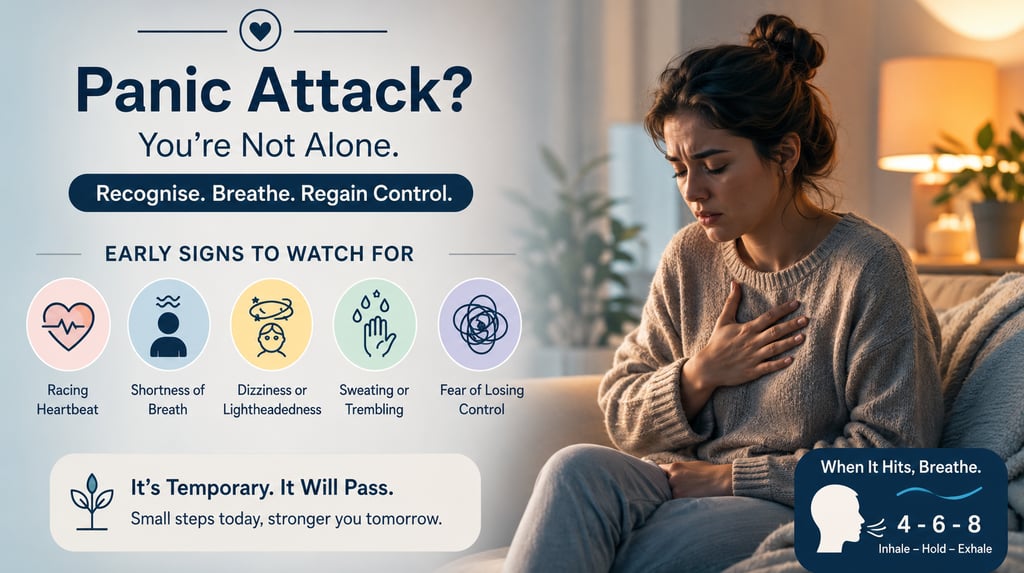
Five early-stage symptoms/signs of a panic attack:
Sudden fast heartbeat without physical exertion.
Sweating in the palms or brow without heat.
Mild stomach discomfort or unexplained nausea.
Numbness or tingling spreading through the fingertips.
A sourceless, creeping sensation of losing control.
These whispers, if heeded, can spare you the storm. And that storm has a very specific physiology worth understanding next.
Check Out | Heart Attack Symptoms - What Are The Early Signs To Look For?
Which Physical Symptoms Are Associated with Panic Attacks?
Once a panic attack reaches full momentum, the signs of a panic attack become unmistakable. The brain, perceiving threat whether real or imagined, floods the bloodstream with adrenaline. The heart accelerates, breathing shortens, and muscles tighten. This ancient survival mechanism misfires in modern life with alarming frequency, producing every measurable sensation behind panic attack symptoms.
Recognising the Full Spectrum
That adrenaline surge creates a thunderingly fast heartbeat, a choking sensation from hyperventilation, a crushing tightness in the chest, acute dizziness, and drenching sweat. These are real physiological events, not weakness. Knowing their origin is the first act of reclaiming composure. Knowing what ignites them is the next step.
Also Read | Breast Cancer Symptoms: How to Spot the Signs Early and Stay Safe
What Triggers Panic Attacks?
Understanding panic attack causes is the cartography of recovery. Triggers range from the immediately visible to the quietly hidden, and both categories demand equal attention.
External Triggers
Crowded environments, impossible deadlines, and unresolved conflict activate the signs of a panic attack. The nervous system reads social threat with the same urgency it reserves for physical danger and responds in kind.
Internal Triggers
Accumulated stress, suppressed grief, and unprocessed trauma sustain a low-grade nervous system vigilance that eventually seeks release. The panic attack is rarely the first signal. It is simply the loudest one delivered.
Hidden Triggers You Ignore
Excessive caffeine overstimulates an already reactive system.
Chronic sleep disruption strips the nervous system of recovery.
Hormonal fluctuations tied to menstrual cycles or thyroid function.
Genetics predispose certain nervous systems to heightened threat sensitivity.
Deteriorating physical health is amplifying baseline anxiety measurably.
An erratic daily routine removes the structural stability that the nervous system depends upon.
With triggers mapped clearly, a vital clinical distinction now deserves its own focused attention.
Check Out | How Do HIV AIDS Symptoms Look Like And Why Do They Happen?
What Is the Difference Between a Panic Attack and an Anxiety Attack?
The panic attack vs anxiety attack confusion pervades mental health conversations and routinely directs people toward the wrong support entirely. The distinction is both precise and practically essential for effective recovery.
Key Differences in Duration and Intensity
A panic attack is volcanic and brief, peaking savagely within ten minutes. An anxiety attack builds slowly over hours. Intensity is the sharpest dividing line between the two experiences.
Trigger Patterns
Panic attacks frequently arrive without any identifiable cause. Anxiety attacks are almost always traceable to a brewing stressor that has been quietly compounding beneath conscious awareness over time.
Recovery Timeline
A panic attack subsides within thirty minutes of its peak. Anxiety requires active, deliberate intervention to unwind. This critical distinction shapes which panic attack treatment is most appropriate and leads naturally to the next question.
Check Out | How Do HIV AIDS Symptoms Look Like And Why Do They Happen?
What Are the Different Types of Panic Attacks?
Not all panic attacks are architecturally identical. Recognising their varieties sharpens your ability to spot the signs of a panic attack before they escalate beyond the reach of easy self-intervention.
Expected Panic Attacks
These arise in response to a known trigger. The link between stressor and episode is traceable, making them the most accessible to structured panic attack treatment over sustained time and consistent therapeutic practice.
Unexpected Panic Attacks
These arrive without warning during apparent calm. They contradict every ordinary logic of stress and remain among the most bewildering and disorienting episodes a person will ever experience without prior education.
Situational Panic Attacks
Anchored to phobic circumstances, these signs of a panic attack are contextually predictable, which makes them particularly amenable to targeted intervention. Understanding when they are hardest to manage leads directly to what happens after dark.
Check Out | Heart Attack Symptoms - What Are The Early Signs To Look For?
Why Are Panic Attacks Worse at Night?
The nocturnal hours amplify panic attack symptoms through a convergence of physiological and psychological forces that quietly reinforce each other once the lights go out.
Role of Quietness and Overthinking
Without daytime distraction, anxious thought spirals unchecked. The silence most find restorative becomes, for a dysregulated nervous system, a canvas for catastrophic imagination and the unfiltered signs of a panic attack.
Hormonal Fluctuations at Night
Cortisol follows circadian rhythms that produce destabilising dips between two and four in the morning, making a panic attack physiologically more probable at night than at any other hour of the day.
Sleep and Nervous System Dysregulation
A sleep-deprived nervous system misreads ordinary sensations as emergencies, generating panic attack symptoms from physiological noise a rested system would never notice. Sleep is medicine, and its absence is a measurable risk to the body.
Also Read | Depression symptoms - why people are suffering from it?
Is Hyperventilating While Crying a Panic Attack?
Intense weeping accelerates breathing into hyperventilation, producing dizziness, tightness in chest, and tingling in the extremities. These sensations overlap directly with the signs of a panic attack, explaining the widespread and deeply understandable confusion between both experiences.
Key Differences to Identify
Crying-induced hyperventilation resolves once the emotion passes. A panic attack intensifies independently, following its own physiological arc regardless of whether the emotional trigger has resolved or even been identified.
When hyperventilating episodes are frequent or shadowed by persistent loss of control and dread, a therapist becomes essential. The body is communicating something that deserves a qualified and compassionate response without further delay.
Check Out | Heart Attack Symptoms - What Are The Early Signs To Look For?
What Is the Root Cause of Anxiety?
Brain chemistry, specifically the balance of serotonin and GABA, is foundational. Genetics can predispose an individual to an amygdala that registers threat disproportionately, producing the signs of a panic attack from stimuli others would never register at all.
Psychological Factors
Catastrophic thought patterns and an internalised belief that the world is fundamentally unsafe cultivate the soil in which anxiety flourishes. Thought is physiology, translated elegantly into physical sensation.
Lifestyle Factors
A fragmented daily routine, poor nutrition, and chronic sleep loss each compromise nervous system resilience in measurable ways. Physical health and mental health are one continuous conversation, never two entirely separate subjects.
Check Out | Imbalance Hormones Symptoms - How Will You Check It? - Every Step Disclosed
What's the Most Common Reason for Anxiety?
Occupational pressure, financial uncertainty, and the performance of constant productivity create a chronic stress that keeps the nervous system perpetually primed. The signs of a panic attack are partly a by-product of a civilisation that has forgotten how to rest properly.
Information Overload
The unceasing deluge of notifications taxes the brain's threat-detection architecture beyond its designed capacity. Anxiety is, at its core, a rational response to an irrational volume of stimulation that contemporary life has thoroughly normalised.
Social Comparison
Measuring one's imperfect interior against another's polished exterior is among the most reliable generators of the signs of a panic attack in modern life, and one of the least acknowledged contributors to sustained and worsening anxiety.
Also Read | Breast Cancer Symptoms: How to Spot the Signs Early and Stay Safe
How Long Do Anxiety Attacks Last?
A panic attack peaks within ten minutes and resolves within twenty to thirty. Anxiety attacks persist far longer, ebbing and surging across hours without clean resolution or a clear natural endpoint.
Why It Feels Longer?
The amygdala distorts time perception during acute fear. Ten minutes of panic attack symptoms can feel, with complete physiological conviction, like an inescapable hour-long ordeal with no visible way through it.
When anxiety attack symptoms recur so frequently that life organises itself around avoidance, that threshold signals the urgent need for structured professional intervention, not greater personal resolve or willpower alone.
Check Out | Depression symptoms - why people are suffering from it?
Panic Attack Treatment: What Actually Works in the Moment?
The most potent immediate techniques involve the breath. A slow exhale, twice the length of the inhale, activates the parasympathetic nervous system and begins dismantling the panic attack from within. Grounding, naming five visible objects and four touchable textures, anchors the mind firmly back to the present moment.
Long-Term Strategies
Cognitive Behavioural Therapy retrains the mind to interrogate catastrophic interpretations before they cascade. Consistent movement, restorative sleep, and a nourishing daily routine build resilience and reduce the signs of a panic attack progressively over time.
Medical Support
For some, medications prescribed under qualified guidance provide the neurological stabilisation necessary for therapeutic strategies to genuinely take root. A skilled therapist builds a recovery plan fitted precisely to your history, temperament, and life circumstances.
Check Out | Depression symptoms - why people are suffering from it?
Simple Daily Techniques to Reduce Panic Attacks
Ten minutes of intentional stillness before reaching for any screen establishes a calm neurological baseline each morning. Reducing caffeine before noon removes one of the most consistently overlooked dietary contributors to the signs of a panic attack.
Stress Management Techniques
Daily journalling, progressive muscle relaxation, and consistent human connection are measurable stress management techniques that lower baseline anxiety and reduce the frequency of panic attack symptoms over sustained, deliberate daily practice.
Diet and Sleep Improvements
Magnesium-rich foods and complex carbohydrates support neurotransmitter balance. Seven to nine hours of sleep is not a lifestyle preference. For a nervous system navigating the signs of a panic attack, it is a non-negotiable daily physiological foundation that cannot be substituted.
Check Out | Depression symptoms - why people are suffering from it?
Final Words
Recognising the signs of a panic attack early restores what anxiety steals first: your sense of agency. You are not fragile. You are navigating something with a name, a mechanism, and a clear path through. Seeking help is not surrender. It is the most quietly courageous act of self-regard you will ever undertake, and it begins with simply naming what you feel.
FAQs
What should you avoid during a panic attack?
Ans: Resist catastrophising or narrating the experience as permanent and endless. Avoid caffeine immediately afterwards. Do not isolate; quiet companionship interrupts the spiral far more effectively than solitude. Stress intensifies panic attack symptoms swiftly, while deliberate stillness and slow, extended exhalation begin to dismantle the episode from within.
Can panic attacks happen for no reason?
Ans: Unexpected panic attacks can and do arrive without any conscious trigger. Subconscious processing or subtle hormonal shifts can ignite the signs of a panic attack entirely beneath awareness. The absence of an obvious reason never diminishes the reality or the genuine hurt of what is experienced.
Should you touch someone having a panic attack?
Ans: Always seek consent before physical contact. Some find gentle touch grounding during an episode. Others experience it as intrusive and overwhelming. Ask quietly, remain calm, and follow their lead entirely. Your own composed presence is already a meaningful and genuinely steadying form of quiet support.
What vitamins are good for panic attacks and anxiety?
Ans: Magnesium glycinate supports nervous system regulation and is frequently deficient in those with chronic anxiety. A quality B-complex sustains neurotransmitter production and adrenal resilience. Both merit discussion with a qualified healthcare practitioner before commencing, as individual needs vary significantly and matter enormously.
Can lack of sleep cause panic attacks?
Ans: Profoundly so. Sleep deprivation elevates cortisol, heightens amygdala reactivity, and strips the prefrontal cortex of its capacity to regulate fear responses. A chronically underslept nervous system remains perpetually primed to generate the full signs of a panic attack from entirely ordinary physiological stimuli.

Contact
Don't Let Your Wellness Journey Feel Boring! Get connected with us today to know your health better.
Phone
hello@nehashuklaa@gmail.com
+91 92110 33284
© 2026. All rights reserved.