
Top 10 Hair Treatment for Hair Loss in India
Hair fall in India now affects people across age groups, driven by genetics, hormonal imbalances like PCOS, stress, poor nutrition, and environmental factors such as pollution and water quality. This blog explains that choosing the right hair treatment for hair loss begins with understanding the root cause, whether genetic or lifestyle-related. It highlights clinically proven options like Minoxidil, Finasteride, and PRP therapy, along with advanced treatments such as GFC, hair transplants, and laser therapy. At the same time, it emphasises the importance of nutritional support, including protein, iron, and vitamin D foods, and realistic home care practices like oil massage and scalp maintenance. The article also explores why Gen Z experiences early thinning due to modern habits such as screen overuse and irregular sleep. It offers practical guidance on diet, oils, and daily routines while setting honest expectations about hairline regrowth and treatment timelines. Overall, it presents a balanced approach where medical science, lifestyle correction, and consistency work together to manage and improve hair health effectively.
Neha Shukla
5/8/20269 min read
Hair Treatment for Hair Loss in India
Hair treatment for hair loss in India has made a remarkable journey till now. But, before going for treatment, do you know what hair loss really is? Hair loss treatment is a condition where your hair gets shed regularly without having any regrowth. And that’s what makes it different from hairfall. From age-old Ayurvedic wisdom passed through generations to clinically validated dermatological interventions that rival global standards. Whether the cause is genetic, hormonal, or written in your daily habits, solutions exist, and they are closer than you think.
Across every Indian city and town, men and women in every age bracket are quietly battling thinning crowns and receding hairlines. So, let’s cover the top 10 effective hair treatment for hair loss options, grounded in science, Indian realities, and genuine practicality.
Also Read | Imbalance Hormones Symptoms - Balance Your Hormones in 7 Days.
What Are the Causes of Baldness? (Root-Level Understanding Before Choosing Any Hair Treatment for Hair Loss)
Androgenetic alopecia is the most prevalent cause of hair loss in India, affecting nearly 58% of men and a significant proportion of women above 30. It is hereditary, meaning if your father or maternal grandfather lost hair early, your probability rises considerably. This is not fate, but it is biology, and it responds to early intervention beautifully.
Lifestyle-triggered hair loss, on the other hand, is rooted in chronic stress, erratic sleep, nutritional gaps, and exposure to hard water, a condition alarmingly common across Delhi, Bengaluru, and Mumbai.
Hormonal Triggers Most People Ignore
PCOS is one of the most underdiagnosed causes of hair loss in Indian women. Elevated androgen levels miniaturise hair follicles over time, producing diffuse thinning rather than dramatic patches. Thyroid imbalances and postpartum hormonal shifts carry similar consequences.
Warning Signs:
More than 100 strands are shed daily, and visible thinning at the crown.
Widening of the natural hair parting over months.
The scalp is becoming increasingly visible under direct light.
Persistent itching or inflammation without dandruff.
When to consult a Hair loss specialist for hair loss:
When shedding persists beyond three months consistently.
When patches appear suddenly or asymmetrically.
When home remedies produce zero visible change after six weeks.
Understanding the cause is step one. Now, step into the clinical world of proven solutions.
Check Out | High Cholesterol Symptoms - Lower Cholesterol in 15 Days?
What Are the Big 3 Hair Loss Treatments? (Clinically Proven Hair Treatment for Hair Loss)
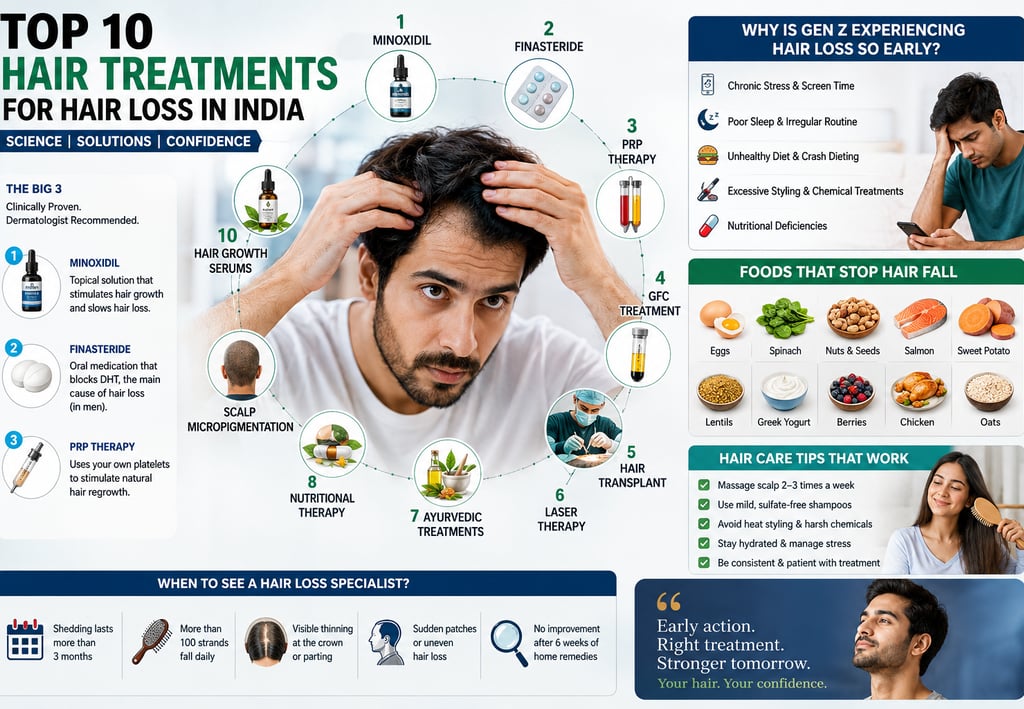
Minoxidil, Finasteride, and PSP therapy (Platelet-Rich Plasma) are three hair loss treatments. Now, let’s study these in depth.
Minoxidil
It is a topical vasodilator that extends the anagen (growth) phase of hair follicles. Applied directly to the scalp, it is available in 2% and 5% concentrations in Indian pharmacies without a prescription. Results typically appear between the third and sixth months of consistent use. Cost: approximately Rs 300–800 per bottle monthly.
Finasteride
It is an oral medication that inhibits DHT, the hormone responsible for follicle miniaturisation in androgenetic alopecia. It is exclusively for men and requires a dermatologist's prescription. Visible thickening is observed in most patients between months four and twelve. Cost: approximately Rs 500 - 1,200 monthly.
PRP Therapy (Platelet-Rich Plasma)
It involves drawing the patient's blood, centrifuging it to concentrate growth factors, and injecting it into thinning scalp areas. It is particularly effective in the early stages of hair loss. Cost in India: Rs 3,000 - 8,000 per session, with three to six sessions recommended.
Who Should Avoid These Treatments?
Finasteride is contraindicated for women, especially those of childbearing age. Minoxidil may cause initial shedding that alarms patients, though this typically subsides. PRP is unsuitable for individuals with clotting disorders or active scalp infections.
These three form the foundation. But the full picture of hair treatment for hair loss in India runs deeper, and the next section reveals it completely.
Check Out | What Are the Causes of Pimples on Face and Different Types of Acne?
Top 10 Hair Treatment for Hair Loss in India (Complete Breakdown)
1. Minoxidil
Topical minoxidil stimulates follicular activity and is the most accessible hair loss cure available over the counter. Best for early-stage thinning. Results visible by month four. Pros: affordable, widely available. Cons: requires lifelong use.
2. Finasteride
Oral DHT blocker, exclusively for men. Best for androgenetic alopecia. A hair loss specialist typically prescribes it for a 12-month minimum trial. Pros: clinically robust. Cons: possible libido-related side effects in a small percentage of users.
3. PRP Therapy
Autologous growth factor injections that revive dormant follicles. Best for early to moderate hair loss. Three to six sessions at Rs 3,000 - 8,000 each. Pros: natural, minimal downtime. Cons: multiple sessions needed.
4. GFC Treatment (Growth Factor Concentrate)
A refined evolution of PRP, GFC uses a higher concentration of isolated growth factors. It causes less discomfort and delivers more precise follicular stimulation. Cost: Rs 5,000 - 12,000 per session. Best for those who want superior results over standard PRP.
5. Hair Transplant
FUE (Follicular Unit Extraction) and FUT techniques relocate permanent hair follicles to bald regions. Best for baldness that has stabilised. Cost: Rs 40,000 - 1,50,000 depending on the graft count. Permanent results, but surgery carries a recovery time.
6. Laser Therapy (LLLT)
Low-Level Laser Therapy uses red light wavelengths to stimulate cellular activity in follicles. Available as clinic devices and home-use caps. Best for diffuse thinning. Cost: Rs 2,000 - 5,000 per clinic session. Gentle, painless, and increasingly popular across Indian metro clinics.
7. Ayurvedic Treatments
Treatments rooted in Bhringraj, Amla, Brahmi, and Ashwagandha formulations address hair loss through systemic balance rather than isolated follicular action. Best for stress-induced and nutritional hair loss. Cost: Rs 500 - 3,000 monthly. It gives slower results, but is gentle on the system.
8. Nutritional Therapy
Guided supplementation of biotin, iron, zinc, and Vitamin D, under a dermatologist's supervision, addresses deficiency-driven hair loss with elegant precision. The best medicine for hair growth and thickness when loss is nutritional in origin. Cost: Rs 800 - 2,500 monthly.
9. Scalp Micropigmentation (SMP)
SMP is a cosmetic tattooing technique that replicates the appearance of hair follicles on the scalp, offering an aesthetic solution for advanced baldness. Not a regrowth treatment, but a transformative confidence restorer. Cost: Rs 20,000 - 80,000.
10. Hair Growth Serums
Professional serums containing redensyl, procapil, and anagen are gaining serious traction in India. They are gentler than minoxidil and suitable for mild shedding. Cost: Rs 800 - 3,500. Best for early intervention and maintenance.
Now that every treatment is laid out, one question worth addressing is why a generation born in digital abundance is losing hair at an unprecedented rate.
Check Out | What Are the Symptoms of Diabetes And How To Prevent Them?
Why Do Gen Z Balding So Fast? (Modern Lifestyle and Hair Treatment for Hair Loss Needs)
Gen Z is experiencing hair thinning at ages that once seemed implausible. The culprits are not mysterious; they are embedded in the architecture of modern living.
Chronic screen exposure elevates cortisol, the body's principal stress hormone, which directly disrupts the hair growth cycle. Irregular sleep patterns, driven by late-night scrolling, suppress melatonin and growth hormone, both of which support follicular health. Crash diets, veganism without supplementation, and protein-deficient eating patterns create nutritional voids that hair follicles cannot endure silently.
Social Media Habits Affecting Hair Health
Ironically, the very platforms where Gen Z discovers beauty trends also accelerate their hair struggles. Heat styling for reels, chemical colouring for aesthetics, and the anxiety of perpetual comparison create a storm of physical and psychological stress that manifests in the mirror. Recognising this connection is the first act of wisdom.
Diet forms one of the most underappreciated pillars of hair restoration. The next section brings that clarity.
Also Read | Depression symptoms - why people are suffering from it?
Which Food Stops Hair Fall? (Diet-Based Hair Treatment for Hair Loss)
Protein, Iron-rich, Vitamin D-rich, biotin, and zinc-rich foods are the ones that can stop hair fall. To understand better, check out the section mentioned below:
Nutrient-rich foods for hair strength:
Protein: Eggs, paneer, lentils, chicken, and Greek yoghurt rebuild keratin architecture.
Iron: Spinach, rajma, jaggery, and beetroot oxygenate the scalp through improved blood flow.
Vitamin D foods: Fortified milk, fatty fish, mushrooms exposed to sunlight, and eggs support follicular cycling.
Biotin: Almonds, sweet potatoes, walnuts, and oats activate keratin production at the cellular level.
Zinc: Pumpkin seeds, chickpeas, and sesame seeds regulate oil gland function around follicles.
Weekly Diet Plan for Hair Strength
Monday through Sunday, rotate eggs, lentils, and paneer as protein anchors.
Include one serving of dark leafy greens daily for iron.
Add a small bowl of mixed seeds as a mid-morning ritual for zinc and biotin.
Prioritise 20 minutes of sunlight exposure before 10 AM for natural Vitamin D synthesis, particularly vital in North Indian winters.
Check Out | Imbalance Hormones Symptoms - Balance Your Hormones in 7 Days.
Hair Treatment for Hair Loss at Home That Actually Works
Hot oil massages performed with moderate pressure stimulate scalp microcirculation. A weekly 15-minute scalp massage using warmed oil increases follicular nutrient delivery measurably.
DIY masks combining egg yolk, castor oil, and a few drops of rosemary essential oil address protein loss and stimulate dormant follicles simultaneously.
Apply once weekly, leave for 30 minutes, and rinse with a sulphate-free shampoo.
Mistakes to avoid: Applying oil to unwashed, product-laden scalps, over-massaging with excessive force, and sleeping with wet hair regularly all undermine follicular integrity.
Also Read | What Are the Symptoms of Diabetes And How To Prevent Them?
What Is the Best Oil for Hairline Regrowth?
Rosemary oil has demonstrated in peer-reviewed studies a comparable efficacy to 2% minoxidil for stimulating hair regrowth, particularly around the hairline. It improves scalp microcirculation without greasy residue.
Castor oil, rich in ricinoleic acid, creates a protective coating around the hair shaft while nourishing follicle roots. Its thick viscosity demands dilution with a carrier oil such as coconut or jojoba.
Coconut oil penetrates the hair shaft more deeply than any other oil due to its low molecular weight, reducing protein loss and maintaining follicular moisture balance.
How to apply correctly:
Dilute essential oils to a 2% concentration before scalp application.
Warm carrier oils gently before massaging in circular motions.
Limit application to two to three times weekly to prevent buildup.
Check Out | What Are the Causes of Pimples on Face and Different Types of Acne?
Can Hairline Regrow Back? (Reality Check on Hair Treatment for Hair Loss)
Hairlines lost to temporary causes such as stress, nutritional deficiency, or postpartum changes respond well to treatment. Follicles in these cases are dormant, not destroyed, and revive with appropriate intervention.
Hairlines lost to advanced androgenetic alopecia, where follicle miniaturisation is complete, cannot regenerate without surgical intervention such as a hair transplant. Age amplifies permanence.
A 22-year-old with early recession carries far more regenerative potential than a 45-year-old with decade-long baldness. Early action is not vanity; it is strategy.
Check Out | High Cholesterol Symptoms - Lower Cholesterol in 15 Days?
How to Stop Hair Loss Immediately (Emergency Hair Treatment for Hair Loss Actions)
Start with diet correction within 48 hours: increase protein, add an iron supplement if haematology suggests deficiency, and eliminate crash dieting immediately. Introduce stress reduction through 10 minutes of breathwork or progressive muscle relaxation daily. Cortisol reduction visibly improves hair shedding rates within weeks.
Switch to a sulphate-free, fragrance-free shampoo immediately and stop all heat styling. Consult a dermatologist for hair loss within two weeks of noticing sudden, accelerated shedding.
Sudden patchy loss in circular shapes suggests alopecia areata, an autoimmune condition requiring immediate medical evaluation. Hair loss accompanied by fatigue, weight change, or skin alterations warrants thyroid and hormonal panel testing without delay.
Check Out | What Are the Symptoms of Diabetes And How To Prevent Them?
Conclusion
The most fitting hair treatment for hair loss is always the one matched precisely to its cause. Whether the path leads through clinical treatments, nutritional correction, or Ayurvedic restoration, early action and professional guidance define the outcome. Do not wait for the mirror to deliver the verdict. Begin today with knowledge, patience, and the right support. For more, check out wellnesscareandhealth.com
Disclaimer: The prices mentioned here are as per our bet research, it may change with time and location.
FAQs
What is the best treatment for hair loss?
Ans: The finest hair treatment for hair loss depends entirely on the underlying cause. Minoxidil and finasteride lead for androgenetic alopecia. PRP suits early-stage thinning. Nutritional therapy works best when deficiencies drive shedding. A dermatologist's assessment ensures the right match for each case.
What are the big 3 hair loss treatments?
Ans: The clinically established big 3 are minoxidil, finasteride, and PRP therapy. Together, they address hormonal, follicular, and circulatory dimensions of hair loss. Most dermatologists design protocols around these three before introducing advanced options like GFC or laser therapy.
How to stop 100% hair fall?
Ans: No treatment guarantees a complete halt, but combining a protein-rich diet, stress management, minoxidil, and scalp massage dramatically reduces shedding. Consulting a hair loss specialist within the first three months of noticeable loss offers the strongest chance of reversal and stabilisation.
Which is better, PRP or GFC?
Ans: GFC delivers a higher concentration of growth factors with fewer inflammatory components than PRP, making it more refined and often more effective. It is also marginally more comfortable during administration. However, both produce meaningful results, and the choice depends on individual scalp response and budget.
How to slow down hair loss?
Ans: Prioritise sleep, reduce refined sugar, and introduce biotin-rich foods daily. Use a gentle, sulphate-free shampoo and limit heat styling. Incorporate scalp massage three times weekly. Vitamin D foods and iron sources address two of the most common nutritional deficiencies linked to accelerated hair shedding in India.
About The Author
Neha Shukla is a writer and LinkedIn creator who demystifies wellness for modern lives. She writes about nutrition, mindfulness, and sustainable habits, grounded in research, infused with real-world wisdom. Her mission is to help you feel better without feeling overwhelmed.



Contact
Don't Let Your Wellness Journey Feel Boring! Get connected with us today to know your health better.
Phone
hello@nehashuklaa@gmail.com
+91 92110 33284
© 2026. All rights reserved.