
What Is Bipolar Disorder? Causes, Symptoms, and Treatment Explained
Understanding what is bipolar disorder is essential to recognising its impact on mental health. Bipolar disorder is a complex condition marked by extreme mood swings, ranging from intense emotional highs (mania or hypomania) to deep lows (depression). These shifts go far beyond normal mood changes, often affecting a person’s energy, behaviour, relationships, and daily functioning. The causes of bipolar disorder are multifaceted, involving genetic factors, brain chemistry imbalances, and environmental triggers like stress or trauma. Early identification of symptoms—such as impulsive behaviour, sleep disturbances, and drastic energy changes—can help in timely intervention. Although there is no permanent cure, effective treatments including medication, therapy, and lifestyle adjustments enable individuals to manage the condition successfully. With proper support and awareness, people living with bipolar disorder can lead stable, fulfilling, and meaningful lives.
Neha Shukla
5/29/202614 min read
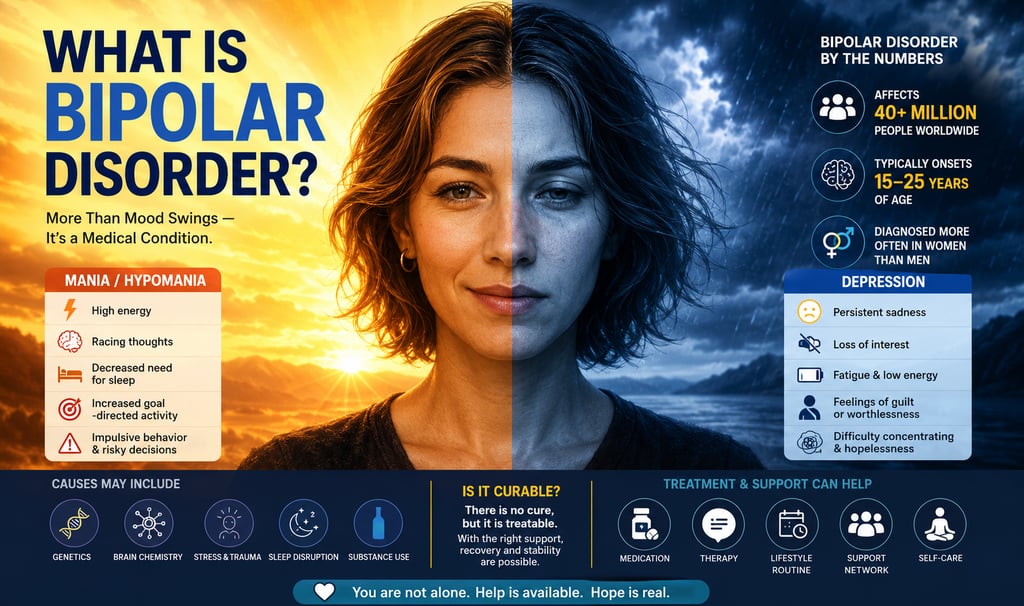
What Is Bipolar Disorder?
To understand what is bipolar disorder, picture a person who, on Tuesday morning, feels as though they could conquer empires. They speak with the velocity of a runaway train, barely sleep, and make decisions with the bravado of someone who believes the universe has personally appointed them. Then, by Thursday, the very same person cannot rise from bed. The curtains stay drawn. The world feels like a thick, grey fog that refuses to lift. Those around them are bewildered. How can someone swing so dramatically between these two worlds?
This is not mere moodiness. This is not a character flaw, a weakness of spirit, or a momentary crisis. What is bipolar disorder, truly? It is a serious, complex mental health condition that causes extreme shifts in mood, energy, and behaviour. These shifts are not trivial fluctuations. They are profound, life-altering episodes that can fracture relationships, derail careers, and quietly shatter a person from the inside out.
Understanding what is bipolar disorder is not just a clinical exercise. It is an act of compassion. Whether someone is navigating this condition personally or standing beside a loved one who is, knowledge is the most powerful tool available. This guide walks through everything from causes and symptoms to treatment and hope, so that the fog, in time, begins to lift.
Also Read: Depression symptoms - why people are suffering from it?
What Is Bipolar Disorder? A Simple Explanation
At its heart, what is bipolar disorder can be understood through a simple, striking analogy. Imagine the mind as a thermostat. In most people, it regulates temperature within a comfortable range. In bipolar disorder, the thermostat is broken. It swings from scorching heat to freezing cold, often with little warning and little control.
Clinically, what is bipolar disorder is defined as a brain condition characterised by episodes of mania or hypomania alternating with episodes of depression. These episodes are distinctly different from the normal highs and lows that all human beings experience. Ordinary mood shifts are brief and proportionate to life events. Bipolar episodes are prolonged, intense, and often entirely disconnected from any external cause.
The brain chemistry involved centres around neurotransmitters, particularly dopamine, serotonin, and norepinephrine. When these chemical messengers fall out of balance, the brain struggles to regulate mood. The result is a pendulum that swings far too wide, far too often.
Key characteristics of bipolar disorder include:
Episodes lasting days, weeks, or even months at a time.
Dramatic shifts between extreme euphoria and profound despair.
Impaired judgement and decision-making during manic phases.
Withdrawal, hopelessness, and fatigue during depressive phases.
Periods of relative stability between episodes.
The condition is lifelong but highly manageable with the right support.
A question many carry in silence is this: Is bipolar disorder curable? The honest, compassionate answer is that there is currently no cure, but it is eminently treatable.
Countless individuals live rich, full, purposeful lives with proper management. The types of bipolar disorder vary, and so do the approaches to treatment, which we shall explore in depth throughout this guide.
Check Out: Heart Attack Symptoms - What Are The Early Signs To Look For?
What Is Bipolar Disorder Caused By?
There is no single, tidy answer to what causes bipolar disorder. Like most profound conditions of the human mind, it emerges from a constellation of factors, each weaving into the next. Understanding these causes is not about assigning blame. It is about illuminating the path toward prevention and early intervention.
Genetic Factors
Family history plays a compelling and often decisive role in the development of bipolar disorder. Research consistently demonstrates that individuals with a first-degree relative, a parent or sibling, who carries the condition face a significantly elevated likelihood of developing it themselves. Studies suggest the heritability of bipolar disorder to be somewhere between 60 and 80 per cent.
However, genetics is not destiny. Carrying the relevant genes does not guarantee the condition will manifest. It simply means the soil is fertile. Environmental conditions still determine whether the seed takes root.
Brain Chemistry and Structure
Neurological research has revealed that the brains of individuals with bipolar disorder exhibit structural and functional differences. The prefrontal cortex, which governs rational thought and impulse control, often shows reduced activity during mood episodes. Meanwhile, the amygdala, the brain's emotional processing centre, tends to be overactive.
The dance between dopamine, serotonin, and norepinephrine is disrupted in ways that scientists are still working to fully comprehend. This chemical turbulence is what underpins the extraordinary mood swings that define what is bipolar disorder.
Environmental Triggers
Even in those with a genetic predisposition, bipolar disorder rarely emerges in a vacuum. Prolonged stress, significant trauma during childhood, bereavement, relationship collapse, or sudden life upheaval can serve as ignition points. The accumulation of these pressures chips away at the brain's resilience, eventually tipping the balance.
Actionable insight: Keep a simple stress journal. Track periods of heightened pressure and note any mood changes that follow within days or weeks. Over time, patterns will emerge that can inform early intervention.
Hidden Triggers Most People Ignore
Perhaps the most underestimated causes are the ones woven into daily life:
Sleep disruption: Even a single night of poor sleep can precipitate a hypomanic episode in vulnerable individuals. The relationship between sleep and bipolar disorder is not peripheral.
Substance use: Alcohol, cannabis, and stimulants can mimic, worsen, or unmask bipolar symptoms. Many individuals are misdiagnosed with depression or anxiety for years because substance use obscures the true picture.
Digital overstimulation: Constant screen exposure, particularly to social media and news cycles late at night, disrupts circadian rhythms and elevates cortisol, creating conditions ripe for mood destabilisation.
Early prevention checklist: Establish a consistent sleep and wake time. Reduce alcohol intake. Set boundaries around screen use after 9 PM. These are not trivial lifestyle tweaks. For those at risk, they are forms of armour.
Also Read: Is It Just Stress, or Something More? Recognising the Signs of a Panic Attack
What Are 5 Signs of Bipolar?
Recognising the signs of bipolar disorder early is one of the most powerful forms of intervention. Yet many of its symptoms masquerade as personality traits, quirks, or even strengths. Here are five clear signs of bipolar disorder to be aware of.
1. Extreme Mood Swings: Beyond ordinary emotional range, individuals with bipolar disorder experience episodes of euphoria or irritability so intense they feel alien to those who know them.
These swings are not reactive to events. They arise as though from nowhere and dissipate on their own timeline.
2. Impulsive Behaviour: During manic phases, impulsivity reigns. Extravagant spending, reckless romantic entanglements, quitting employment without cause, or making grand promises that cannot be kept are hallmark signs of bipolar disorder in its elevated state.
3. Sleep Disturbances: The need for sleep plummets during mania and becomes insatiable during depression. What is bipolar disorder if not, in part, a profound disorder of rest? Sleep patterns serve as one of the most reliable early warning indicators.
4. Energy Fluctuations: The contrast is stark. During mania, energy is volcanic. Projects begin at midnight. Ideas multiply without pause. During depression, even preparing a simple meal can feel as demanding as scaling a mountain.
5. Difficulty Concentrating: Concentration during depression becomes nearly impossible. Thoughts are sluggish and murky. During mania, thoughts move so rapidly that concentration is equally impaired, though for the opposite reason. Both states disrupt cognitive clarity.
Mania versus depression at a glance: During mania, one experiences elevated or irritable mood, decreased need for sleep, racing thoughts, inflated self-esteem, and reckless behaviour.
During bipolar depression, the picture inverts entirely: persistent low mood, hypersomnia or insomnia, slowed thinking, feelings of worthlessness, and withdrawal from life.
Check Out: Reason for High Blood Pressure: Causes, Symptoms & Natural Ways to Control It
What Are the 4 Stages of Bipolar Mania?
Mania does not arrive fully formed. It builds, layer by layer, often giving those who know what to look for a window of opportunity to intervene before the storm reaches its peak.
Hypomania
Hypomania is the gentler, more seductive cousin of full mania. The individual feels unusually good. Productivity soars. Social confidence blossoms. Creativity seems heightened. From the outside, and even from within, this phase can feel marvellous. Many individuals with bipolar disorder report that hypomania is something they mourn losing.
Warning sign: If this elevated state feels dramatically better than one's baseline and arrives without an obvious cause, it warrants serious attention.
Acute Mania
Without intervention, hypomania can escalate into acute mania. Here, the pleasant elevation curdles into something more volatile. Judgement deteriorates. Irritability surfaces. Grand plans multiply. Sleep becomes negligible. The individual may make life-altering decisions with startling rapidity.
Those around them often feel helpless, watching someone they love become a version of themselves that is recognisable but fundamentally altered.
Delirious Mania
At its most severe, mania can progress to a state of delirious mania, sometimes called Bell's mania. This represents a psychiatric emergency. Psychotic features, including hallucinations and delusions, may emerge. The individual loses touch with shared reality entirely. Immediate medical intervention is not optional at this stage.
Recovery Phase
Following a manic episode, the brain and body require significant time to recalibrate. This recovery phase is often accompanied by profound exhaustion, shame, and a reckoning with the consequences of decisions made during mania.
With compassionate support and structured care, this phase can become a launchpad for deeper self-understanding rather than a pit of regret.
Also Read: Depression symptoms - why people are suffering from it?
What Are the 7 Types of Bipolar Disorder?
The types of bipolar disorder are more varied than many realise. A diagnosis is not a monolith. Understanding the distinctions is essential for accurate treatment.
Bipolar I Disorder: This is the most classic form, characterised by at least one manic episode lasting a minimum of seven days, or so severe it necessitates hospitalisation. What is the most serious form of bipolar disorder?
Bipolar I holds that distinction, given the severity of its manic episodes and their potential to cause lasting harm.
Bipolar II Disorder: Bipolar II involves hypomanic rather than full manic episodes, alternating with depressive episodes. It is frequently misidentified as standard depression because the hypomanic phases may not seem alarming.
Yet the depressive episodes in Bipolar II are often deeply severe.
Cyclothymic Disorder: A milder but persistent pattern of hypomanic and depressive symptoms that do not meet the full diagnostic threshold.
Cyclothymia may seem less dramatic, but its chronic nature can be quietly debilitating.
Rapid Cycling Bipolar Disorder: Defined by four or more distinct mood episodes within a twelve-month period.
Rapid cycling is particularly challenging to treat and requires careful, ongoing medication management.
Mixed Episodes: Perhaps one of the most distressing presentations, mixed episodes involve simultaneous features of mania and depression.
High energy paired with profound hopelessness is a particularly dangerous combination that elevates the risk of self-harm.
Secondary Bipolar Disorder: This form arises as a consequence of another medical condition, neurological disorder, or substance use.
It underscores the importance of thorough medical evaluation before any diagnosis is confirmed.
Unspecified Bipolar Disorder: When an individual displays clinically significant bipolar symptoms but does not meet the full criteria for any of the above categories, this classification is used.
It is not a lesser diagnosis. It still deserves equal attention and care.
Check Out: Heart Attack Symptoms - What Are The Early Signs To Look For?
Bipolar Disorder Symptoms in Females
Bipolar disorder symptoms in females carry distinct nuances that are frequently overlooked, misinterpreted, or dismissed entirely. The condition does not manifest identically across all people, and biological sex plays a meaningful role in shaping its expression.
Hormonal fluctuations, particularly those linked to the menstrual cycle, pregnancy, and the postpartum period, can dramatically alter the frequency and intensity of mood episodes.
Many women find their bipolar symptoms sharpen in the days before menstruation, a phenomenon sometimes called premenstrual dysphoric exacerbation.
During pregnancy, some women experience a deceptive period of stability, only to be blindsided by severe postpartum mania or depression after delivery.
Misdiagnosis is a grave and common concern. Bipolar disorder symptoms in females are frequently mislabelled as borderline personality disorder, premenstrual syndrome, or simple anxiety.
The depressive episodes tend to be longer and more prominent in women, which means the manic or hypomanic phases can be entirely missed during clinical assessment.
Actionable advice for women who suspect bipolar disorder: Track mood patterns in relation to your menstrual cycle across several months. Share this detailed record with your clinician. Advocate for a full psychiatric evaluation rather than accepting a singular diagnosis of depression or anxiety, particularly if mood swings feel cyclical in nature.
Red flags often ignored: Uncharacteristic rage, excessive spending around particular times of month, or periods of dramatically reduced sleep with elevated energy that resolve without explanation. These are not personality quirks. They are symptoms deserving clinical attention.
Check Out: Reason for High Blood Pressure: Causes, Symptoms & Natural Ways to Control It
How to Calm a Bipolar Mind?
In the midst of a mood episode, whether swinging toward the heights of mania or the depths of depression, the question of how to calm a bipolar mind is one of urgent, practical importance. The answer lies not in a single intervention but in layered, deliberate strategy.
Immediate Techniques
When the mind begins to race or anxiety mounts, grounding techniques offer a tether back to the present moment. The 5-4-3-2-1 method, naming five things seen, four heard, three touched, two smelled, one tasted, draws attention away from the internal storm and anchors it in physical reality.
Controlled breathing is similarly powerful. Box breathing involves inhaling for a count of four, holding for four, exhaling for four, and resting for four before repeating. This rhythmic pattern activates the parasympathetic nervous system, signalling safety to an overwrought brain.
Daily Habits
Sleep is not a luxury for those who carry what is bipolar disorder. It is medicine. Maintaining a consistent sleep schedule, entering and leaving bed at identical times each day, even on weekends, is one of the most evidence-supported self-management strategies available.
Diet also plays a role. Anti-inflammatory foods, omega-3 rich options such as oily fish and walnuts, and blood-sugar stabilising meals reduce the physiological conditions that make mood destabilisation more likely.
Long-Term Stability Practices
Therapy, particularly Cognitive Behavioural Therapy adapted for bipolar disorder, builds the mental scaffolding needed to recognise episodes early and respond rather than react. Journaling, specifically mood tracking, deserves its own spotlight.
Unique tip, the Mood Tracking Method: Dedicate five minutes each morning to rating your mood on a scale of one to ten, noting your sleep quality, your energy level, and one significant thought from the previous evening.
After thirty days, patterns will become visible that neither you nor your clinician could see without the data. This simple practice has been cited in therapeutic literature as transformative for long-term bipolar management.
Routine planning, building each day around predictable anchors of activity, meals, rest, and connection, reduces the unpredictability that mood episodes thrive upon.
Also Read: Is It Just Stress, or Something More? Recognising the Signs of a Panic Attack
Bipolar Disorder Treatment Options Explained
Bipolar disorder treatment is not a single prescription or a single appointment. It is an ongoing, evolving collaboration between the individual, their clinical team, and the various pillars of support available. Understanding treatment for bipolar disorder in its full scope is essential for anyone navigating this condition.
Medication
Mood stabilisers remain the cornerstone of bipolar disorder treatment. Lithium, one of the oldest and most studied medications in psychiatry, continues to be highly effective for many individuals, particularly in preventing manic relapse.
Valproate and lamotrigine are also widely used, each with distinct profiles suited to different presentations of what is bipolar disorder.
Atypical antipsychotics, including quetiapine and olanzapine, play an important role in managing acute episodes and in long-term mood stabilisation.
It is worth noting that antidepressants, when prescribed in isolation without a mood stabiliser, can trigger manic episodes in individuals with bipolar disorder. This is one of the most common and dangerous mistakes made in treatment.
Check Out: Heart Attack Symptoms - What Are The Early Signs To Look For?
Therapy
Cognitive Behavioural Therapy adapted for bipolar disorder helps individuals identify the thought patterns and behavioural triggers that precede episodes.
Psychoeducation, arguably the most underrated component of treatment for bipolar disorder, equips individuals and their families with a thorough understanding of the condition, its patterns, and how to respond effectively.
Knowing what is bipolar disorder at an intellectual level transforms the experience from one of helpless confusion to informed participation.
Interpersonal and Social Rhythm Therapy is another evidence-based approach that focuses specifically on stabilising daily routines, recognising that rhythm is a form of medication for the bipolar mind.
Also Read: Depression symptoms - why people are suffering from it?
Lifestyle Treatment
Exercise has demonstrated measurable effects on mood stability. Aerobic activity in particular increases brain-derived neurotrophic factor, a protein that supports neurological health.
Even thirty minutes of walking five days a week has been associated with meaningful improvement in mood regulation. Sleep hygiene, as discussed, functions as a daily prophylactic. Its importance cannot be overstated.
What works best long-term is not any single element in isolation but the consistent application of medication, therapy, and lifestyle measures working in concert.
Mistakes people most commonly make include abandoning medication when they feel well, underestimating the role of sleep, or attempting to manage bipolar disorder through willpower alone.
Check Out: Heart Attack Symptoms - What Are The Early Signs To Look For?
Can Bipolar People Live a Normal Life?
The answer is yes. With nuance, and with intention, but yes. Can bipolar people live a normal life? Not only can they, but many lead lives of extraordinary richness. Careers, deep relationships, creative achievements, parenting: all of these remain available. What changes is the approach.
Many celebrated artists, scientists, and leaders have carried what is bipolar disorder through their life's work. The condition, when understood and managed, does not extinguish potential. It reshapes it.
What does require adjustment is the relationship with consistency. Relationships benefit from open communication about the condition. Partners and close friends who understand what is bipolar disorder can provide early warnings and compassionate support during episodes.
Daily Routine Blueprint for Stability:
Wake at the same time without exception.
Eat breakfast within sixty minutes of rising.
Exercise for thirty minutes before midday.
Schedule the most cognitively demanding work in the late morning.
Reserve evenings for low-stimulation activities.
Begin wind-down rituals ninety minutes before sleep.
This structure is not a cage. It is a compass.
Also Read: Is It Just Stress, or Something More? Recognising the Signs of a Panic Attack
Bipolar Depression Explained
Bipolar depression is one of the most misunderstood and most dangerous aspects of what is bipolar disorder. It differs from standard depression in ways that are clinically significant and practically consequential.
Whereas typical depression often emerges from life events and responds reasonably well to antidepressant medication, bipolar depression arises from a different neurological landscape.
It tends to involve more hypersomnia, more psychomotor retardation, more pronounced hopelessness, and a greater risk of psychotic features than unipolar depression.
Crucially, treating it with antidepressants alone can destabilise the entire mood cycle.
Warning signs that demand immediate attention include persistent thoughts of self-harm or suicide, complete withdrawal from relationships and responsibilities, an inability to experience any pleasure whatsoever, and a sense of profound unreality, as though watching one's own life through frosted glass.
If these signs are present, whether in oneself or in someone else, the step to take is clear. Reach out to a mental health professional without delay.
Bipolar depression is not a moral failing. It is a medical event. And medical events respond to medical care.
Also Read: Depression symptoms - why people are suffering from it?
Conclusion
Understanding what is bipolar disorder is the first act of compassion, both for oneself and for others. This condition is real, complex, and deeply manageable with the right knowledge and support. If any of this has resonated, please reach out to a qualified mental health professional. There is no virtue in navigating this alone.
FAQs
What is the major cause of bipolar?
Ans: What is bipolar disorder caused by? No single cause exists. It arises from a confluence of genetic predisposition, brain chemistry imbalances, and environmental triggers such as trauma, chronic stress, sleep disruption, and substance use. Family history significantly elevates risk, but lifestyle factors play an equally formidable role in whether the condition manifests.
Can you live with bipolar disorder?
Ans: Absolutely. Countless individuals live purposeful, connected, and fulfilling lives with what is bipolar disorder. The key lies in consistent treatment, whether medication, therapy, or lifestyle management, and in cultivating a support network that understands the condition. With the right scaffolding in place, bipolar disorder becomes something managed rather than something endured.
What are 5 signs of bipolar?
Ans: The five most recognisable signs of bipolar disorder are extreme mood swings between euphoria and despair, impulsive and reckless behaviour during elevated states, significant sleep disturbances, dramatic fluctuations in energy levels, and difficulty concentrating in both manic and depressive phases. Identifying these signs of bipolar disorder early opens the door to timely, effective intervention.
What is a bipolar person like?
Ans: Someone experiencing what is bipolar disorder is not simply moody. During episodes they may appear electrifyingly energetic or utterly unreachable. Between episodes, many function with remarkable competence and warmth. Understanding that the person and the disorder are separate is essential. What is bipolar disorder does not define the totality of who someone is.
What to avoid if you're bipolar?
Ans: Those managing what is bipolar disorder should avoid irregular sleep schedules, alcohol and recreational substances, high-stimulation environments during vulnerable periods, and abruptly stopping prescribed medication. Digital overstimulation, particularly late at night, is also worth curtailing. Each of these factors can destabilise mood and erode the stability that treatment works hard to build.

Contact
Don't Let Your Wellness Journey Feel Boring! Get connected with us today to know your health better.
Phone
hello@nehashuklaa@gmail.com
+91 92110 33284
© 2026. All rights reserved.