Anxiety Attack Symptoms and Relief: Home Remedies, Therapy, and Proven Techniques
Anxiety attack symptoms can feel sudden, overwhelming, and frightening, often mimicking serious medical conditions, but they are the body’s natural response to perceived danger rather than actual harm. Triggered by the brain’s threat detection system, particularly the amygdala, these episodes activate a fight-or-flight response that leads to physical effects like rapid heartbeat, shortness of breath, chest tightness, sweating, and dizziness, along with mental distress such as racing thoughts, fear of losing control, and a strong sense of impending doom. While anxiety attacks tend to build gradually and are often linked to identifiable stressors, they differ from panic attacks, which are more abrupt and intense. Practical techniques like the 3-3-3 grounding method, controlled breathing, and small lifestyle changes, including better sleep, reduced caffeine, and regular movement, can help manage symptoms effectively. Additionally, therapy options like cognitive behavioural therapy and, when necessary, medication provide structured support. Recognizing early warning signs and avoiding habits like overthinking, poor diet, and digital overload can significantly reduce the frequency and intensity of anxiety attack symptoms over time.
Neha Shukla
5/22/20269 min read
Are You Experiencing Anxiety Attack Symptoms? Here’s What Your Body Is Telling You
I was sitting at my desk, mid-sentence on a perfectly ordinary email, when my chest tightened without permission, my breath went thin, and my hands began trembling against the keyboard. Nobody had warned me that anxiety attack symptoms could arrive so silently, so convincingly, and with so little regard for timing or circumstance. I genuinely believed something was medically wrong. I closed my laptop, sat on the bathroom floor, and waited for the worst, which, mercifully, never came.
What I did not know then was that the body, during anxiety attack symptoms, is not breaking down. It is, in its own ancient and rather dramatic fashion, trying to protect you. Every racing heartbeat, every shallow breath, every wave of inexplicable dread, these are not signs of catastrophe. They are signals – urgent, overwhelming, deeply uncomfortable signals, but signals nonetheless.
If you have ever felt your heart hammer without cause, or found yourself convinced that something terrible was imminent despite every outward evidence of safety, this piece was written for you. Understanding anxiety attack symptoms, where they come from, what they mean, and how to move through them is where your recovery quietly begins.
Also Read: Depression symptoms - why people are suffering from it?
What Are Anxiety Attack Symptoms and Why Do They Feel So Real?
Anxiety attack symptoms are not the theatre of a dramatic imagination. They are the entirely authentic output of a brain that has decided, rightly or wrongly, that danger is present. The body registers stress and responds with surgical precision — flooding the bloodstream with adrenaline and cortisol, heightening the senses, and tightening every available muscle. Understanding this is the first mercy you can offer yourself.
How the Brain Triggers Physical Reactions?
Nestled deep within the brain is the amygdala, an almond-shaped sentinel that monitors for threat. The instant it detects stress, it fires a cascade that accelerates the heart, constricts the airways, and charges the muscles. An anxiety attack does not arrive from nowhere; it arrives from neurochemistry working exactly as designed, simply misfiring at the wrong moment.
Why does your body react even when there is no danger?
The quietly maddening truth about anxiety symptoms is that the amygdala holds no capacity for context. It cannot distinguish a genuinely perilous situation from an imagined one. This biological false alarm explains why anxiety attack symptoms ambush perfectly ordinary moments - a supermarket queue, a morning meeting, a quiet Sunday evening that should feel entirely safe.
Now that we understand the machinery behind anxiety attack symptoms, it becomes essential to distinguish them from their more dramatic cousin.
Check Out: Heart Attack Symptoms - What Are The Early Signs To Look For?
What Is the difference between an anxiety attack Symptoms and a panic attack?
An anxiety attack builds slowly, accumulating like weather, tethered to an identifiable source of stress or dread. A panic attack arrives without negotiation - sudden, ferocious, peaking within ten minutes and departing just as abruptly. Anxiety attack symptoms tend to simmer; panic attack symptoms detonate. Both produce physical distress - racing heart, shortness of breath, trembling, yet the panic attack possesses a particular, blinding intensity that anxiety attack symptoms rarely match.
Anxiety attack symptoms vs panic attack: anxiety builds from visible worry; panic erupts from invisible origins.
Anxiety attack causes: chronic stress, unresolved emotional conflict, and anticipatory fear are the most common triggers.
Knowing the distinction matters because the path forward differs for each. With that foundation laid, we can now examine precisely what the body endures.
Also Read: Reason for High Blood Pressure: Causes, Symptoms & Natural Ways to Control It
Physical Anxiety Attack Symptoms Your Body Uses to Alert You
The physical expressions of anxiety attack symptoms are numerous, convincing, and often frightening. Each one, however, carries a rational explanation.
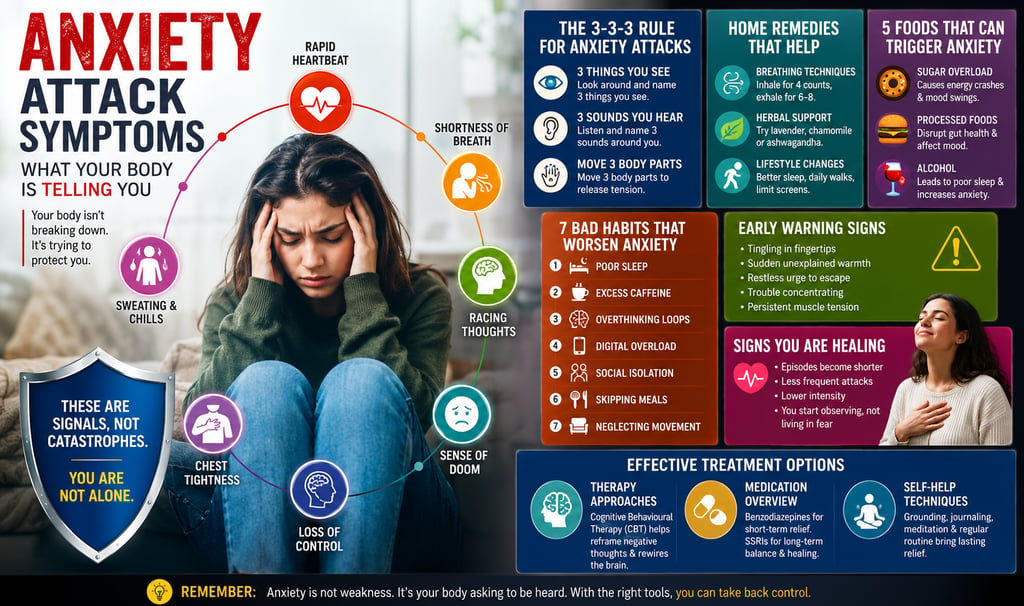
Rapid Heartbeat
The heart accelerates because it is preparing the body to either confront or escape. A racing pulse during anxiety attack symptoms is not a cardiac crisis in progress; it is evolutionary engineering doing its ancient job.
Sweating and Chills
Anxiety attack symptoms frequently produce perspiration and cold flushes in rapid alternation. The nervous system, simultaneously activating and attempting to cool the body, creates this contradictory and deeply uncomfortable pairing.
Shortness of Breath
Shortness of breath is perhaps the most distressing of all physical anxiety attack symptoms. Breathing becomes shallow and accelerated, reducing carbon dioxide in the blood and producing dizziness, tingling, and the awful sensation of suffocation despite breathing continuously.
Chest Tightness
The chest tightness that accompanies anxiety attack symptoms is responsible for countless unnecessary emergency visits. Intercostal muscles contract under stress, generating genuine, pressing discomfort that mimics cardiac events with unsettling accuracy.
Early warning signs: tingling in the fingertips, sudden unexplained warmth, a restless compulsion to escape a familiar room.
Hidden symptoms most people ignore: persistent jaw clenching, transient tunnel vision, and an inexplicable heaviness behind the eyes.
This masterful mimicry of serious illness is precisely why anxiety attack symptoms so reliably produce a profound fear of dying. The performance is so convincing that both the body and the mind accept it as a catastrophe. That bridge between the physical and the mental is where we turn next.
Check Out: Is It Just Stress, or Something More? Recognising the Signs of a Panic Attack
Mental and Emotional Anxiety Attack Symptoms You Should Not Ignore
The mental landscape during anxiety attack symptoms is as harrowing as any physical sensation, and considerably harder to explain to those who have not experienced it.
Racing Thoughts
The mind during an anxiety attack resembles a gramophone record left spinning without a needle - repetitive, accelerating, wearing grooves of dread into otherwise ordinary thinking. Each thought arrives before the previous one resolves.
Sense of Doom
One of the most classically misunderstood mental anxiety attack symptoms is the absolute, bone-deep certainty that something catastrophic is imminent. No rational argument dislodges it. It simply settles, heavy and uninvited.
Loss of Control
The internal dialogue during an anxiety attack symptoms often narrates in quiet devastation: "I cannot stop this. Something is irreparably wrong with me." This perceived dissolution of self-governance feeds the fear of dying and loops back into deepening anxiety. Naming this as a symptom rather than a truth is the beginning of its dissolution.
With both the physical and mental dimensions understood, practical intervention becomes far more accessible. And few tools are more elegant in their simplicity than what follows.
Also Read: Breast Cancer Symptoms: How to Spot the Signs Early and Stay Safe
What Is the 3 3 3 Rule for Anxiety Attacks?
The 3 3 3 rule is one of the most quietly brilliant interventions available for anxiety attack symptoms, simple enough to remember mid-crisis, powerful enough to actually work.
Step 1: Identify 3 Things You See
Name three visible objects deliberately. A door handle. A window latch. Your own knuckles. This conscious act recruits the prefrontal cortex - the rational, reasoning brain to gently override the amygdala's alarm during anxiety attack symptoms.
Step 2: Identify 3 Sounds
Listen for three distinct sounds and name them inwardly. The hum of a fan. Distant traffic. Your own breath. Auditory anchoring draws the nervous system away from internal spiralling and anchors it to the verifiable, present world.
Step 3: Move 3 Body Parts
Rotate your ankles. Roll your shoulders back. Spread and close your fingers. Physical movement during anxiety attack symptoms discharges accumulated muscular tension and signals safety to a nervous system that has mistaken stillness for paralysis.
How to distract yourself during a panic attack: Sensory grounding consistently outperforms intellectual reasoning because anxiety resides in the emotional brain, which does not respond to logic alone, but responds to experience
Once the immediate crisis is managed, longer-term home strategies become the next vital chapter.
Also Read: How Do HIV AIDS Symptoms Look Like And Why Do They Happen?
What Is a Home Remedy for Anxiety?
Home remedies for anxiety attack symptoms are not substitutes for professional anxiety treatment, but they are formidable allies in daily management.
Breathing Techniques
Extended exhalation is the most immediate, evidence-informed home remedy available. Inhale for four counts, hold briefly, exhale for six or eight.
This elongated exhale activates the parasympathetic nervous system, gently reversing the very mechanisms that generate anxiety attack symptoms.
Pair this daily with meditation for anxiety, and the cumulative effect on nervous system regulation is considerable.
Herbal Options
Lavender, chamomile, and ashwagandha carry centuries of traditional use and a growing body of supportive research. They will not eliminate anxiety attack symptoms, but consumed consistently, they soften the sharp edges of daily stress without pharmaceutical intervention.
Lifestyle Micro-Changes
Sleep at consistent hours. Limit screens in the final hour before bed. Walk outdoors briefly each morning. These adjustments are unglamorous, unheroic, and profoundly effective at reducing the baseline stress from which anxiety attack symptoms so readily spring.
The habits we keep, however, can either reinforce or quietly dismantle everything these remedies attempt to build.
Also Read: Depression symptoms - why people are suffering from it?
What Are the 7 Bad Habits for Your Brain That Worsen Anxiety?
Poor sleep: the sleep-deprived amygdala reacts with significantly heightened intensity to anxiety attack triggers.
Excess caffeine: stimulates identical neurological pathways that anxiety attack symptoms already exploit.
Overthinking loops: rehearsing catastrophic outcomes trains the brain to treat imagination as lived threat.
Digital overload: unrelenting notifications sustain low-grade stress that primes the body for anxiety attack symptoms.
Social isolation: prolonged disconnection feeds rumination, a core anxiety attack cause.
Skipping meals: blood sugar instability generates physical sensations that closely mirror anxiety attack symptoms.
Neglecting movement: sedentary living allows stress hormones to accumulate, manifesting reliably as anxiety symptoms.
What we eat belongs equally in this conversation, and the relationship between diet and anxiety attack symptoms is more intimate than most people realise.
Check Out: Heart Attack Symptoms - What Are The Early Signs To Look For?
What Are the Five Foods That Erase Memory and Trigger Anxiety?
The phrase "erase memory" belongs more to dramatic headlines than clinical literature, but certain foods do meaningfully worsen anxiety symptoms and cognitive clarity.
Sugar Overload
Rapid spikes and crashes in blood glucose produce trembling, irritability, and mental fog — all of which overlap convincingly with anxiety attack symptoms, creating a feedback loop that is easy to misread as pure anxiety.
Processed Foods
Ultra-processed foods impair the gut-brain axis. Given that the gut manufactures a substantial share of the body's serotonin, a chronically disrupted gut sustains the neurochemical conditions in which anxiety attack symptoms thrive.
Alcohol
Alcohol promises calm and delivers the opposite over time. It fragments sleep architecture, depletes B vitamins essential to nervous system health, and generates rebound anxiety that frequently surfaces as anxiety attack symptoms by morning.
A balanced note: occasional consumption at moderate levels carries far less risk than chronic reliance. The danger lies in using alcohol as a primary anxiety management tool, a habit that quietly deepens vulnerability over time.
These dietary patterns rarely act alone. The choices above intertwine with the treatments that now, fortunately, exist to meaningfully address anxiety attack symptoms.
Check Out: Heart Attack Symptoms - What Are The Early Signs To Look For?
Anxiety Treatment Options That Actually Work
Effective anxiety treatment is neither a single conversation nor a single prescription. It is a considered architecture built from several components.
Therapy Approaches
Cognitive behavioural therapy for anxiety remains the most robustly evidenced psychological intervention for anxiety attack symptoms available today. It trains individuals to identify the distorted thought patterns that sustain anxiety and reconstruct them with accuracy rather than catastrophe.
Therapy of this kind does not merely manage anxiety attack symptoms - it rewires the pathways that generate them.
And beyond CBT, acceptance-based therapy approaches have demonstrated impressive results for those whose anxiety attack symptoms are rooted in chronic resistance to uncertainty.
Medication Overview
Benzodiazepines remain a legitimate option for acute anxiety attack symptoms, offering rapid neurological quieting when the body is in genuine crisis. They require careful, supervised use given their potential for dependence.
For sustained anxiety treatment, SSRIs are typically preferred, slower to act but far more durable in their restructuring of neurochemical baselines. Benzodiazepines are the fire extinguisher; SSRIs are the fire safety system.
Self-Help Techniques
How to reduce anxiety immediately: pressing the wrists under cold running water, exhaling fully, and stating your physical location aloud can interrupt anxiety attack symptoms within two to three minutes.
Signs you are recovering from anxiety: episodes of anxiety attack symptoms grow shorter, less frequent, and carry less narrative power - you begin to observe them rather than inhabit them
When anxiety attack symptoms begin eroding sleep, relationships, or daily function, professional therapy and anxiety treatment are not luxuries. They are the most rational response available. And before we reach our conclusion, three final factors deserve their own honest reckoning.
Check Out: Is It Just Stress, or Something More? Recognising the Signs of a Panic Attack
Conclusion
Anxiety attack symptoms are not evidence of weakness, they are evidence of a body engaged in earnest, if misdirected, protection. From the neurological origins of anxiety attack symptoms to their physical expressions, their mental weight, and the proven paths toward relief, understanding is the architecture of recovery. Your body is not your adversary. It is, at long last, asking to be heard.
FAQs
How to stop an anxiety attack fast?
Ans: When anxiety attack symptoms strike, ground your feet firmly to the floor, exhale completely, and name three visible objects aloud. This sequence activates the prefrontal cortex and signals safety to the alarm-firing amygdala. Most anxiety attack symptoms begin to ease noticeably within five to ten minutes of sustained, deliberate grounding.
How to control anxiety and stress?
Ans: Long-term management of anxiety attack symptoms rests on sleep consistency, daily movement, reduced caffeine, and structured support from cognitive behavioural therapy for anxiety. Incorporating meditation for anxiety as a daily practice gradually lowers the baseline stress from which anxiety attack symptoms most readily emerge over weeks and months.
What is the 3 3 3 rule for anxiety attacks?
Ans: The 3 3 3 rule for anxiety attack symptoms asks you to name three things you see, identify three sounds you hear, and deliberately move three body parts. This grounds the nervous system in present sensory reality and interrupts the neurological spiral that sustains anxiety attack symptoms by re-engaging rational brain function.
What are 5 warning signs of anxiety?
Ans: Five reliable early warning signs of anxiety attack symptoms are: persistent, unexplained restlessness; muscle tension across the shoulders and jaw; disrupted or unrefreshing sleep; difficulty sustaining concentration; and a diffuse, low-grade sense of approaching dread. Catching these early anxiety symptoms allows intervention before a full anxiety attack takes hold.
What are the symptoms of an anxiety attack?
Ans: Anxiety attack symptoms encompass both body and mind: rapid heartbeat, shortness of breath, chest tightness, sweating, trembling, dizziness, racing thoughts, a pervasive sense of doom, and an acute fear of dying. Though these anxiety attack symptoms are genuinely distressing, they are not medically dangerous and, with the right tools, pass.

Contact
Don't Let Your Wellness Journey Feel Boring! Get connected with us today to know your health better.
Phone
hello@nehashuklaa@gmail.com
+91 92110 33284
© 2026. All rights reserved.