
Brain Clot in Brain: Early Signs, Causes, and Medical Solutions
A brain clot in brain is often a silent yet serious condition that begins with subtle signs many people overlook. From mild headaches and confusion to sudden weakness or speech difficulty, recognising early symptoms can make a life-saving difference. A brain clot in brain occurs when blood flow to the brain is blocked or disrupted, depriving vital cells of oxygen and leading to potential damage within minutes. This blog explores the essential aspects of brain clot in brain, including its early warning signs, underlying causes such as lifestyle habits and medical conditions, and modern treatment options like clot-dissolving therapies and surgical interventions. It also highlights recovery insights, survival rates, and practical prevention strategies that are often ignored. Understanding brain clot in brain is not just about awareness, but about taking timely action to protect long-term brain health and overall well-being.
Neha Shukla
6/16/20268 min read
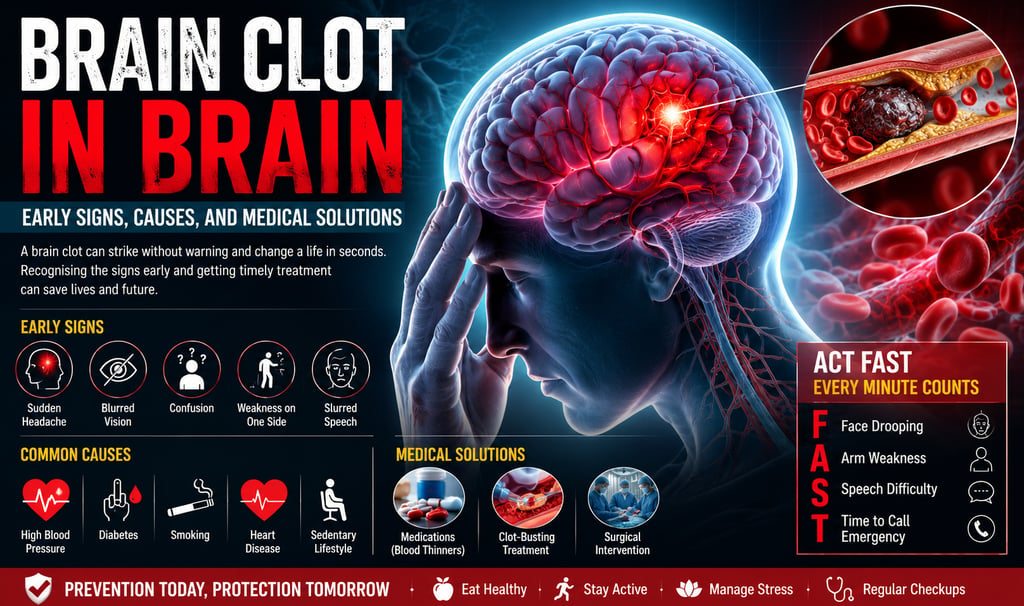
Brain Clot in Brain Treatment: What You Need to Know for Fast Recovery
A brain clot in brain forms when blood flow to a cerebral region is blocked or when a vessel ruptures inside brain tissue. What makes this condition particularly treacherous is that the body often whispers its warnings days or even weeks before the crisis. A fleeting numbness, a strange headache, a moment of inexplicable confusion- all dismissed, all dangerous.
Recognising a brain clot in brain early is not merely medically advisable, it is the architecture of survival. This guide walks through the symptoms, causes, treatments, and recovery insights that matter most when a brain clot in brain situation unfolds.
Also Read: Pneumonia Symptoms: Ignoring These Signs Could Cost You More Than Your Health
What Does Brain Clot in Brain Mean?
The brain is a sovereign organ. It demands a continuous, uninterrupted flow of oxygen-rich blood. When a brain clot in brain interrupts that flow, brain cells begin deteriorating at roughly 1.9 million neurons per minute. A brain clot in the brain is not a single condition but a spectrum of vascular crises, each with its own character and consequence.
Think of an ischaemic clot as a kink in a garden hose, the water stops reaching the flowers downstream. A haemorrhagic clot is the hose bursting entirely, flooding the garden with water that has no business being there. Both outcomes destroy what the flow was meant to nourish.
Types of Brain Clots
Ischaemic stroke accounts for approximately 85% of all cases. A clot lodges in a cerebral artery and severs oxygen supply to the tissue beyond it.
Haemorrhagic stroke occurs when a vessel ruptures, flooding surrounding brain matter with blood under pressure.
Transient Ischaemic Attack (TIA) is the brain's distress signal before the catastrophe. Symptoms resolve briefly, but the risk of a full brain clot in brain event within 48 hours is dramatically elevated
How It Affects Brain Function
When a brain clot in brain cuts off oxygen, the affected region does not pause; it begins to die. The cells in the direct deprivation zone perish first. The surrounding penumbra tissue survives longer but remains precarious.
The faster blood flow is restored, the more of that penumbra survives intact. Without intervention, the damage expands and with it the loss of speech, movement, or memory.
Also Read: Think It’s Just a Fever? These Dengue Symptoms Say Otherwise
What Are the Brain Clot in Brain Symptoms?
The architecture of brain clot in brain symptoms is deliberately deceptive. Early signs arrive wearing the costume of ordinary discomforts. Advanced signs arrive with a brutality that removes all ambiguity. Knowing both registers is what separates timely action from permanent damage.
Early Warning Signs (Often Ignored)
These are the body's quietest distress signals, the ones most people walk past entirely:
A peculiar headache that sits differently from the usual kind, often behind a single eye or at the skull's base.
Blurred or doubled vision that comes and vanishes without explanation.
Sudden confusion or a word that simply will not arrive in mid-sentence.
Fleeting numbness along one side of the face or arm, typically dismissed as having slept awkwardly.
Unexplained dizziness or coordination difficulty, particularly asymmetric
These brain clot symptoms carry no drama. That is precisely what makes them catastrophic when ignored.
Emergency Symptoms (Do Not Ignore)
Sudden paralysis or pronounced weakness on one side of the body.
Speech that is slurred, garbled, or entirely absent.
A headache of catastrophic and unprecedented intensity.
Complete or partial vision loss in one or both eyes.
FAST Method for Detection
The FAST method translates neurology into four observable moments:
Face: Ask the person to smile. Does one side droop?
Arms: Ask them to raise both. Does one drift involuntarily downward?
Speech: Ask them to repeat a simple phrase. Is it distorted or absent?
Time: Call emergency services immediately. No driving, no waiting for improvement.
Also Read: What Is Bipolar Disorder? Causes, Symptoms, and Treatment Explained
How to Identify Brain Clot Causes?
A brain clot in brain rarely arrives without a long history of accomplices. Understanding brain clot causes means identifying modifiable territories where genuine power exists.
Lifestyle-Based Causes
Smoking thickens blood, damages vessel walls, and accelerates arterial plaque formation over years of quiet destruction.
Sedentary habits allow blood to pool, particularly in deep veins, creating clots that can migrate through the circulatory system.
Poor diet, rich in saturated fats and excessive sodium, builds arterial plaque across decades before announcing itself violently.
Medical Conditions Linked to Brain Clots
High blood pressure is the most significant modifiable risk. It batters arterial walls with relentless hydraulic force, making rupture or narrowing far more likely.
Diabetes degrades small blood vessels throughout the body, including those supplying the brain, with quiet consistency.
Heart disease, particularly atrial fibrillation, creates turbulent blood flow that encourages clots to form in the heart's chambers and travel directly to the brain.
Also Read: Breast Cancer Symptoms: How to Spot the Signs Early and Stay Safe
Hidden Risk Factors Most People Miss
Dehydration thickens blood considerably, raising clot risk particularly in older adults and warm climates.
Long travel immobility encourages clots to form in the legs and potentially break free toward the brain.
Birth control pills, especially high-oestrogen formulations, elevate clotting factors meaningfully, more so in women who also smoke.
Also Read: Top Immune Boosting Foods That Help Strengthen Your Immune System Naturally
What Are the Brain Clot Treatment Options?
Speed and precision define brain clot treatment. The window for effective intervention is narrow, and what happens within the first hours of a brain clot in brain event shapes the entire trajectory of what follows.
Emergency Treatments
Thrombolysis involves intravenous tissue plasminogen activator (tPA), a clot-dissolving agent that must be administered within 4.5 hours of symptom onset. Extraordinarily effective when deployed on time; essentially unavailable when the patient arrives late.
Mechanical thrombectomy guides a catheter through the arterial system to physically retrieve the clot. Patients who arrived paralysed have walked out of hospital after this procedure. It has genuinely transformed brain clot in brain outcomes.
Medications Used
Blood thinners such as warfarin and apixaban prevent future brain clot in brain events, particularly for patients with atrial fibrillation.
Antiplatelets such as aspirin and clopidogrel prevent platelets from clumping into new clots.
Recovery and Rehabilitation
Physiotherapy rebuilds neural pathways governing movement through repetition and sustained effort.
Speech therapy addresses the aphasia that ischaemic damage to language centres produces.
Lifestyle changes, dietary discipline, smoking cessation, stress management, are not supplementary to recovery; they are its foundation.
Also Read: Reason for High Blood Pressure: Causes, Symptoms & Natural Ways to Control It
Blood Clot in Brain Survival Rate and Recovery Insights
The blood clot in brain survival rate cannot be reduced to a single number. Approximately 80 to 85 per cent of ischaemic stroke patients survive the initial event.
Haemorrhagic cases carry higher early mortality, with survival ranging between 26 and 55 per cent depending on severity. These figures, though sobering, are not destiny.
Factors That Affect Survival
Age shapes neuroplasticity, younger brains reroute function around damaged tissue with more facility.
Speed of treatment remains the most controllable variable. Patients treated within the golden window face dramatically better outcomes.
Overall health prior to the event directly determines how well the body tolerates and recovers from a brain clot in brain.
Recovery Timeline
First 24 hours: Stabilisation, imaging, and emergency intervention define this window.
First month: The most visible neurological recovery occurs here. The brain begins reorganising, finding alternative pathways.
Long-term recovery: Months to years. Patients who commit to rehabilitation and manage risk factors continue improving well beyond hospital discharge.
Also Read: How Do HIV AIDS Symptoms Look Like And Why Do They Happen?
Is Brain Clot Curable? What Doctors Do Not Tell You
Whether a brain clot in brain is curable depends entirely on which chapter of the condition the patient occupies when treatment begins.
When It Is Reversible
When a brain clot in brain is treated within the emergency window, particularly TIA and early ischaemic stroke cases, the brain can recover with minimal lasting deficit.
Patients who received mechanical thrombectomy within six hours have returned to full neurological function. The damage was real; the reversal was also real.
When Damage Becomes Permanent
When treatment is delayed beyond the critical window, the ischaemic core cannot be resurrected. The brain does not regenerate dead tissue; it reroutes around it.
The extent of permanent disability depends on the region affected and the volume of tissue lost, speech, movement, memory, emotional regulation, any of these can be impacted irreversibly.
Practical Steps to Improve Outcomes
An immediate hospital visit upon recognising any symptom is the single highest-leverage action available.
Follow-up care, repeat imaging, medication adherence, neurological assessment, prevent recurrence, which is the gravest ongoing threat after a brain clot in brain.
Lifestyle discipline remains the most powerful long-term medicine available to any survivor.
Prevention Strategies Most People Ignore
Prevention rarely carries the urgency of a crisis. Yet every brain clot in brain is built slowly, brick by brick, through years of overlooked choices.
Daily Habits That Reduce Risk
Hydration is consistently underestimated as a cerebrovascular protector. Adequate daily water intake keeps blood viscosity in a healthy range, reducing the ease with which clots form.
Regular movement, even thirty minutes of moderate walking daily, maintains healthy circulation and slows arterial plaque accumulation.
Balanced diet rich in leafy greens, oily fish, and whole grains provides omega-3 fatty acids and antioxidants that protect arterial walls with real consistency.
Medical Checkups That Matter
Blood pressure monitoring at least twice yearly catches silent hypertension before it inflicts vascular damage severe enough to trigger a brain clot in brain.
Cholesterol checks annually after the age of 40 identify lipid profiles that place arterial health at risk, providing a window for intervention before crisis arrives.
Bringing these pillars of awareness together creates a genuinely protective daily practice:
Actively tracking brain clot symptoms tracking with a simple daily log of any numbness, headache, or vision change is one of the most underrated protective habits available.
Understanding personal brain clot reasons, including family history, lifestyle patterns, and existing conditions.
Building brain clot treatment awareness so that if a brain clot in brain event arrives, the response is instinctive rather than bewildered.
Also Read: Heart Attack Symptoms - What Are The Early Signs To Look For?
Conclusion
A brain clot in brain does not announce itself with the gravity it deserves. Every undetected brain clot in brain was once a preventable one. It arrives in whispers before it arrives in thunder. Early detection, swift action, and disciplined prevention remain the three pillars of survival. Do not wait for the thunder.
Frequently Asked Questions
What happens if you have a blood clot in your brain?
Ans: A blood clot obstructs oxygen-rich blood from reaching brain cells, triggering rapid deterioration. Depending on the location and scale, this impairs speech, movement, or cognition. The situation demands emergency attention without hesitation, as outcomes worsen significantly with every minute the clot remains in place.
What is the survival rate for a brain clot?
Ans: Around 80 to 85 per cent of ischaemic stroke patients survive the initial event. Haemorrhagic cases carry greater early risk. Survival improves substantially with early treatment. Patients who receive specialist care within the first few hours face considerably better odds of meaningful recovery and return to functional daily life.
How long is brain clot surgery?
Ans: Mechanical thrombectomy typically takes between one and three hours. The clot's location, size, and the patient's arterial anatomy all influence duration. Haemorrhagic surgeries may extend longer depending on the severity and accessibility of the bleed requiring drainage or intervention.
What medication is used for blood clots in the brain?
Ans: Emergency treatment may include tPA, a powerful clot-dissolving agent given intravenously. Long-term management involves blood thinners such as warfarin or apixaban and antiplatelet agents like aspirin or clopidogrel. The appropriate medication depends on the clot type and individual patient risk profile.
How to remove a blood clot in the brain?
Ans: Mechanical thrombectomy removes the clot via a catheter-guided stent retriever inserted through the arterial system. Thrombolytic medication dissolves smaller clots. Haemorrhagic cases sometimes require surgical drainage. All approaches demand immediate care at a specialist stroke unit for the best possible outcome.
About The Author
Neha Shukla is a writer and LinkedIn creator who demystifies wellness for modern lives. She writes about nutrition, mindfulness, and sustainable habits, grounded in research, infused with real-world wisdom. Her mission is to help you feel better without feeling overwhelmed.



Contact
Don't Let Your Wellness Journey Feel Boring! Get connected with us today to know your health better.
Phone
hello@nehashuklaa@gmail.com
+91 92110 33284
© 2026. All rights reserved.