
Think It’s Just a Fever? These Dengue Symptoms Say Otherwise
What appears to be a simple fever can often conceal something far more serious. Dengue symptoms rarely arrive with urgency; instead, they unfold quietly through fatigue, body aches, and a rising temperature that feels deceptively ordinary. This blog explores how dengue symptoms develop in stages, from early warning signs like retro-orbital headache and joint pain to critical indicators that demand immediate care. It explains how the dengue virus operates within the body, how it spreads through the Aedes mosquito, and why recognising patterns early can prevent complications. With a clear breakdown of timelines, treatment approaches, and practical home care strategies, the guide equips readers to respond wisely. Understanding dengue symptoms is not about fear, but about awareness, precision, and timely action before the illness reaches its most dangerous phase.
Neha Shukla
6/13/202611 min read
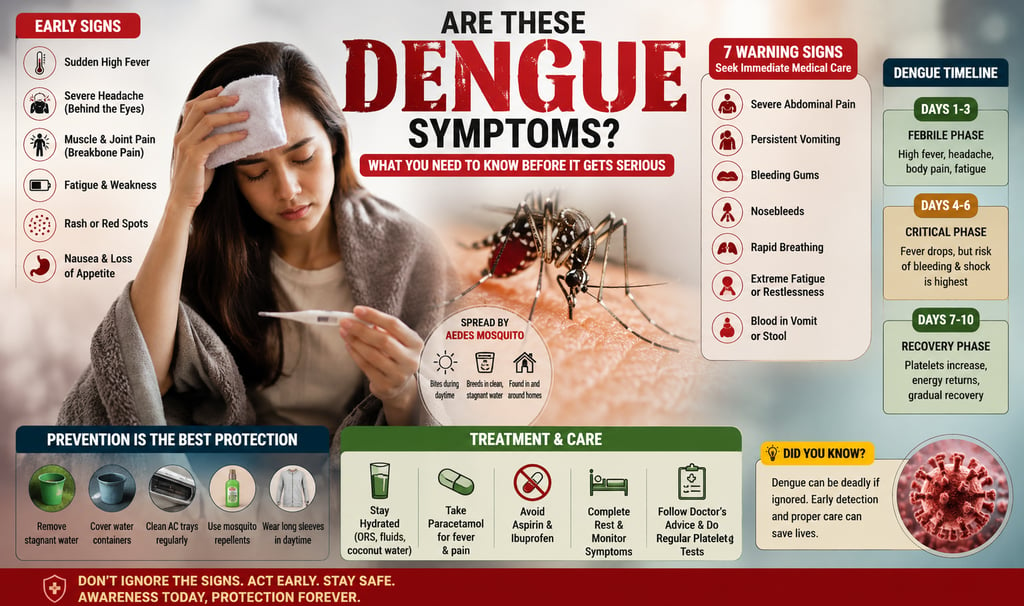
Are These Dengue Symptoms? What You Need to Know Before It Gets Serious
You wake up feeling slightly warm, a bit drained, and assume it is just another routine fever. Perhaps you take a tablet, sip some tea, and carry on. But dengue symptoms rarely make a dramatic entrance. They slip in quietly, often disguised as common fatigue or a mild viral illness. With the rising cases of dengue fever across cities, this silent arrival has become more concerning than ever.
The dengue virus does not always show its full hand immediately, which makes early recognition incredibly important. Many people overlook dengue symptoms during the initial days, only to realise their severity when the condition progresses. This delay can complicate recovery. The dengue virus simply speaks in a dialect most households have never been taught to read.
Cases are climbing across South Asia and beyond with a ferocity that seasonal complacency cannot afford to ignore. This guide will teach you exactly how to listen to those early dengue symptoms, read the warning signs with confidence, and act before the critical window closes.
Also Read: How Do HIV AIDS Symptoms Look Like And Why Do They Happen?
What Are the Signs to Identify Dengue Symptoms?
Recognising dengue symptoms in the first 48 hours is the difference between home management and hospitalisation. The body does not stay quiet; the signals are there, layered one atop another, each one quietly pointing toward a diagnosis that a dismissive "it's just a viral fever" will dangerously delay.
What Symptoms Come First in Dengue?
The illness opens with a sudden, high fever that climbs sharply rather than creeping upward the way a common cold does.
Within hours of that first temperature spike, the earliest dengue symptoms gather into a distinct constellation of complaints that no attentive observer should mistake for an ordinary viral episode.
Retro-orbital headache: A throbbing, pressure-like ache seated directly behind the eyes, worsening with eye movement, a hallmark early marker of dengue.
Breakbone pain: Severe myalgia and arthralgia so pronounced the illness earned the old name "breakbone fever," with joint pain striking hips, knees, and ankles.
Sudden profound fatigue: An almost immediate, disproportionate exhaustion that arrives before the fever has even peaked.
Flushed skin and mild rash: A reddish flush across the face and chest, sometimes followed by a fine macular rash by day two or three.
Complete appetite loss: The scent of food becomes actively repellent within the first twenty-four hours.
Symptom monitoring checklist to use daily:
Record temperature every six hours with time-stamps, not just once in the morning.
Note specifically whether the headache is behind the eyes or generalised across the forehead.
Log the hour when joint pain first appeared and rate its intensity out of ten.
Track fluid intake in millilitres to catch dehydration before it compounds the dengue symptoms.
Watch for any new skin changes, even a faint redness on the forearms or torso.
Start this diary on day one of fever without waiting for confirmation. The pattern across three days will tell a clinician more than any single consultation ever could, and it will sharpen your own ability to gauge whether dengue symptoms are improving or silently worsening.
Also Read: Breast Cancer Symptoms: How to Spot the Signs Early and Stay Safe
How Does Dengue Fever Occur?
Understanding what drives dengue fever from inside the body makes its seemingly erratic behaviour far less mysterious and far easier to track. The dengue virus belongs to the Flaviviridae family and enters the bloodstream through the bite of a single infected female mosquito.
Once inside, it binds to and replicates within monocytes and macrophages, the very white blood cells designed to eliminate invaders.
This triggers a cascade of immune chemicals called cytokines, producing the fever, vascular inflammation, and platelet suppression that define dengue fever at its most dangerous.
What Are the 4 Types of Dengue Fever?
The dengue virus exists in four serotypes, each one a biologically distinct strain: DENV-1, DENV-2, DENV-3, and DENV-4. Immunity gained from surviving one serotype is permanent for that strain only.
DENV-1: The most globally widespread; typically produces moderate classical dengue fever on first infection.
DENV-2: Clinically linked to the most severe outcomes, particularly dangerous in secondary infections.
DENV-3: Dominant across South Asia; frequently the driver behind large urban outbreaks.
DENV-4: Less common in incidence but clinically significant and found across Southeast Asia.
A second infection with a different serotype carries a mechanism most awareness campaigns understate: Antibody-Dependent Enhancement (ADE), where prior antibodies inadvertently escort the new virus deeper into cells, producing a more aggressive immune response.
This is why dengue haemorrhagic fever tends to appear in second infections, not first ones.
Also Read: Heart Attack Symptoms - What Are The Early Signs To Look For?
How Does the Dengue Virus Spread?
Knowing how the dengue virus travels through an insect intermediary closes the gap between abstract risk and concrete prevention, and explains why dengue symptoms can appear in multiple members of the same household within the same week.
No human-to-human transmission occurs. Every case traces back to a single insect vector.
Role of the Dengue Mosquito
The primary carrier is Aedes aegypti, a small, dark mosquito with a lifestyle almost entirely built around human habitation, which is what makes it so persistently difficult to eliminate.
Daytime biting pattern: Peak feeding occurs two hours after sunrise and again in the two hours before dusk, not at night, making bed nets alone an insufficient defence.
Low-altitude approach: It bites predominantly below the knee, so long lightweight trousers offer more meaningful protection than most people realise.
Silent landing: Unlike the audible whine of common mosquitoes, Aedes aegypti lands and feeds almost soundlessly.
Strictly domestic breeding: It does not breed in ponds or rivers; it breeds in small, still, clean water in domestic containers.
Prevention habits that most homes overlook entirely:
Scrub and dry AC drip trays every week; stagnant condensation is a prime breeding ground for the dengue mosquito.
Place tight covers over decorative indoor vases and the saucers beneath every potted plant.
Discard or invert unused buckets, bottles, and containers stored on balconies.
Replace water in pet bowls every single day, not once a week.
Check rain gutters above entrances after every monsoon shower for pooled water.
Also Read: Reason for High Blood Pressure: Causes, Symptoms & Natural Ways to Control It
How to Identify a Dengue Mosquito?
Being able to visually recognise the dengue mosquito inside your own home converts passive awareness into active household protection, and it is far simpler than most people expect.
Distinctive Markings and Resting Behaviour
Aedes aegypti carries a signature that distinguishes it at a glance from the common brown mosquito found near drains. Its body is small and jet black, adorned with brilliant white or silver markings along its legs and abdomen, resembling fine ivory inlay on ebonised wood.
On the thorax sits a distinctive lyre-shaped silver-white pattern, unmistakable once seen.
Black and white striped legs: The alternating bands are bold and evenly spaced, visible to the naked eye.
Silent, low resting posture: It rests in cool, shadowed corners, not on ceilings or high walls.
Active exclusively in daylight: Any mosquito biting during the day, indoors, deserves immediate suspicion.
Uncommon indoor hiding spots frequently missed during home checks include the inner folds of curtains near damp windowsills, the dark spaces behind large appliances, inside cupboards near plumbing, and within discarded footwear left near doorways.
Breeding occurs in quantities of water as small as a bottle cap.
Also Read: Are You Experiencing Anxiety Attack Symptoms? Here’s What Your Body Is Telling You
What Are the Dengue Symptoms That Signal Danger?
With the foundational picture established, the most urgent question now is this: when do dengue symptoms cross from manageable to life-threatening? The answer is specific, and every family needs to know it before they need it.
What Are the 7 Warning Signs of Dengue?
These seven signs require immediate hospital attendance. Not the next morning. Not after one more glass of water.
Severe abdominal pain: Persistent, localised pain in the upper abdomen that does not ease with rest or position change.
Persistent vomiting: Three or more episodes within sixty minutes, making oral rehydration physically impossible.
Spontaneous bleeding from gums: Blood appearing without any trauma, brushing, or injury to the mouth.
Nosebleeds: Unexplained epistaxis, especially when recurrent or prolonged beyond five minutes.
Rapid or laboured breathing: Breathing that has become noticeably faster or shallower without physical exertion.
Sudden extreme lethargy or agitation: A dramatic, rapid shift in the patient's alertness, responsiveness, or behaviour.
Blood in vomit or stool: Coffee-ground appearance in vomit or unusually dark, tarry stools.
A normal platelet count sits between 150,000 and 400,000. In severe dengue, it can fall below 20,000 within hours. Tiny red spots called petechiae appearing on the skin, cold extremities, and restlessness are the body's visible signals of this internal collapse.
Also Read: What Is Bipolar Disorder? Causes, Symptoms, and Treatment Explained
How Long Do Dengue Symptoms Last?
Once the dangerous warning signs are understood, the next essential knowledge is the timeline itself, because dengue symptoms do not unfold randomly. They follow a defined, predictable arc that every affected household must understand.
The Three Clinical Phases of Dengue
Days 1 to 3: Febrile Phase
Sudden high fever, severe joint pain, retro-orbital headache, and early dengue symptoms dominate.
The patient feels profoundly unwell but is typically stable if hydration is maintained.
Days 4 to 6: Critical Phase
Fever begins dropping or disappears entirely, which is routinely and fatally mistaken for recovery.
Plasma leaks from blood vessels; platelet count drops at its steepest rate during this window.
This is when dengue haemorrhagic complications and shock are most likely to develop.
Days 7 to 10: Recovery Phase
Leaked plasma returns to vessels; blood pressure and platelet counts begin normalising.
Appetite and energy return gradually; a lingering fatigue and mild rash may persist for days.
How long does dengue last? The acute phase spans seven to ten days; post-viral fatigue may extend the full recovery to three weeks.
The single most dangerous misconception in dengue management: the moment fever drops is not the moment the crisis ends. It is the moment it peaks. The 48 hours after fever reduction demand the closest vigilance of the entire illness.
Also Read: Yeast Infection Treatment: Causes, Symptoms, and Effective Remedies You Should Know
What Are the Dengue Treatment Options?
Knowing the timeline naturally leads to the next question every family asks: what should actually be done at each stage when dengue symptoms are active? The answer is more precise than most general guidance suggests.
Managing Dengue Safely at Home and in Hospital
Hydration first and always: Oral rehydration salts, coconut water, and clear broths form the backbone of dengue treatment; the adult target is 2.5 to 3 litres daily.
Paracetamol only: Safe and effective for fever and pain when used at correct intervals; it is the only appropriate analgesic for dengue.
Strict avoidance of NSAIDs: Ibuprofen, aspirin, naproxen, and diclofenac all inhibit platelet aggregation and dramatically increase bleeding risk in dengue treatment.
Dengue treatment at home vs hospital: Home management is appropriate in the febrile phase for patients who are alert, tolerating fluids, and showing none of the seven warning signs.
IV fluid therapy: Indicated when vomiting prevents adequate oral intake or when plasma leakage is confirmed through rising haematocrit levels on blood tests.
Hydration schedule for home care:
Offer 200 to 250 ml of fluid every hour throughout waking hours.
Follow each vomiting episode with ORS immediately rather than waiting for the next scheduled drink.
Room-temperature fluids absorb more readily than chilled ones; avoid icy drinks during the critical phase.
Also Read: How to Get Better Sleep Naturally: Simple Tips to Improve Sleep Quality Every Night
What Does Dengue Cure Include?
There is no licensed antiviral that eliminates the dengue virus once it has taken hold, and no medication that reverses dengue symptoms overnight.
That fact is not a reason for despair; it is a reason for precision. Recovery is supported, structured, and entirely achievable with the right approach.
Supporting the Body Through Recovery
Platelet monitoring: Daily blood counts during the critical phase allow clinicians to intervene before the count reaches dangerous thresholds.
Nutritional support: Soft, low-fibre foods including porridge, khichdi, mashed vegetables, and clear soups reduce gastrointestinal stress during peak dengue illness.
Absolute rest: Any physical exertion during the critical phase can accelerate plasma leakage and precipitate complications.
On papaya leaf juice: its reputation as a platelet booster has spread widely. Clinical studies offer limited and inconsistent findings.
In moderate amounts, it carries no known harm, but it is not a dengue cure, it is not a replacement for blood monitoring, and it must never delay hospital attendance when warning signs appear.
Also Read: How to Increase Testosterone Level Naturally (Most Men Ignore These 5 Tricks)
How to Confirm Dengue Symptoms at Home Before Testing?
Equipped now with the full clinical picture, the practical question becomes timing: when exactly should a patient go for testing, and which test is appropriate?
Symptom Tracking Before Formal Diagnosis
NS1 antigen test: Detects the dengue virus directly; most accurate between days one and five of fever onset.
IgM antibody test: Becomes reliably positive from day four onwards; used when NS1 is negative, and dengue symptoms persist.
When to test: Day two or three for NS1; return for IgM serology if fever continues past day four with no confirmed diagnosis.
The symptom diary method: Begin a written log from the first day of fever. Record temperature six-hourly, describe pain location and intensity, note fluid intake in millilitres, and mark any new developments.
When you present this diary at a clinic, a physician can determine with significant accuracy which phase of dengue the patient has entered, what tests to order, and whether hospitalisation is warranted without waiting for results. A diary is not a medical tool. It is a clinical gift.
Also Read: White Discharge During Pregnancy: What’s Normal & What Could Be Dangerous
Practical Ways to Control Dengue Symptoms at Home
Managing the environment around a dengue patient with the same rigour applied to their hydration is what separates a safe recovery from a preventable deterioration.
How to control dengue spread: Apply mosquito repellent to every person in the household during daylight hours, not only the patient, because an infected patient bitten again becomes a transmission source for others.
Use permethrin-treated nets around the patient's bed throughout the illness, regardless of the season.
Seal all indoor water sources and maintain a repellent barrier in the recovery room.
Room temperature and rest comfort:
Keep the room between 24 and 26°C; excessive heat accelerates fluid loss through sweating.
A gentle fan directed away from the patient is preferable to cold forced air conditioning directly on them.
Hydration hacks:
Freeze ORS solution into small ice chips for patients who cannot tolerate full sips due to nausea.
Watermelon, cucumber slices, and tender coconut offer electrolytes and fluid simultaneously.
Sleep positioning during dengue symptoms:
Elevate the head by ten to fifteen degrees during rest.
Avoid lying completely flat if nausea is present to reduce aspiration risk during vomiting episodes.
Also Read: How Do HIV AIDS Symptoms Look Like And Why Do They Happen?
Conclusion
Dengue symptoms are never truly silent. They arrive promptly, speak plainly, and escalate with discipline. The fever, the bone-deep ache, the eyes that throb with every glance; these are not coincidences. They are credentials. Recognise them early, document them carefully, and act before the critical phase decides for you. That is not overcaution. That is the oldest, most reliable form of medicine there is.
Frequently Asked Questions
Which organ is damaged by dengue?
Ans: Dengue primarily injures the liver, blood vessels, and bone marrow. The liver develops inflammation reflected in elevated enzyme levels, whilst blood vessel walls become permeable, causing dangerous plasma leakage. The bone marrow's platelet-producing cells are directly suppressed by the dengue virus, driving the platelet count to critically low levels in severe dengue cases.
What is the fastest cure for dengue?
Ans: No rapid or specific cure exists for dengue. The immune system must clear the dengue virus independently. The most effective acceleration of recovery involves beginning aggressive oral hydration from day one of dengue symptoms, complete bed rest, paracetamol for fever, and daily platelet monitoring. Early, diligent supportive care shortens the illness and prevents escalation.
What is the final stage of dengue?
Ans: The final stage is the recovery phase, spanning roughly days seven to ten. Fever resolves, plasma leakage reverses, and platelet counts begin climbing back toward normal. However, clinical vigilance must continue through this phase, as fluid overload and secondary infections can still emerge if monitoring is withdrawn too early.
Which body part is most affected by dengue?
Ans: The blood and immune system bear the greatest burden. The dengue virus depletes platelets, damages white blood cells, and compromises blood vessel integrity simultaneously. This triple assault on the circulatory system explains why dengue symptoms can shift from manageable to life-threatening within a single day during the critical phase.
What happens on day 7 of dengue?
Ans: Day seven typically opens the recovery phase for most patients, with fever resolved and platelet counts beginning to rise. For a smaller subset, however, day seven reveals complications from an inadequately managed critical phase, including internal bleeding or severe fluid shifts. Platelet and haematocrit monitoring on day seven remains an important clinical safeguard, not an optional one.
About The Author
Neha Shukla is a writer and LinkedIn creator who demystifies wellness for modern lives. She writes about nutrition, mindfulness, and sustainable habits, grounded in research, infused with real-world wisdom. Her mission is to help you feel better without feeling overwhelmed.



Contact
Don't Let Your Wellness Journey Feel Boring! Get connected with us today to know your health better.
Phone
hello@nehashuklaa@gmail.com
+91 92110 33284
© 2026. All rights reserved.