
Side Effects of Alcohol: What It Does to Your Brain, Liver, Heart, and Overall Health
Alcohol is often associated with celebrations and social gatherings, yet its impact on the body extends far beyond a temporary buzz or the symptoms of a hangover. Understanding the side effects of alcohol is essential for making informed decisions about your health. From impairing brain function and disrupting sleep to placing immense strain on the liver, heart, digestive system, and immune defences, the side effects of alcohol can begin sooner than many people realise. This guide explores both the immediate and long-term consequences of drinking, explains how alcohol affects different organs, highlights diseases linked to excessive consumption, and outlines the warning signs of harmful drinking. You will also discover practical, evidence-based strategies to reduce the side effects of alcohol, support your overall wellbeing, and recognise when it may be time to seek professional advice for healthier, more mindful drinking habits.
Neha Shukla
6/27/202610 min read
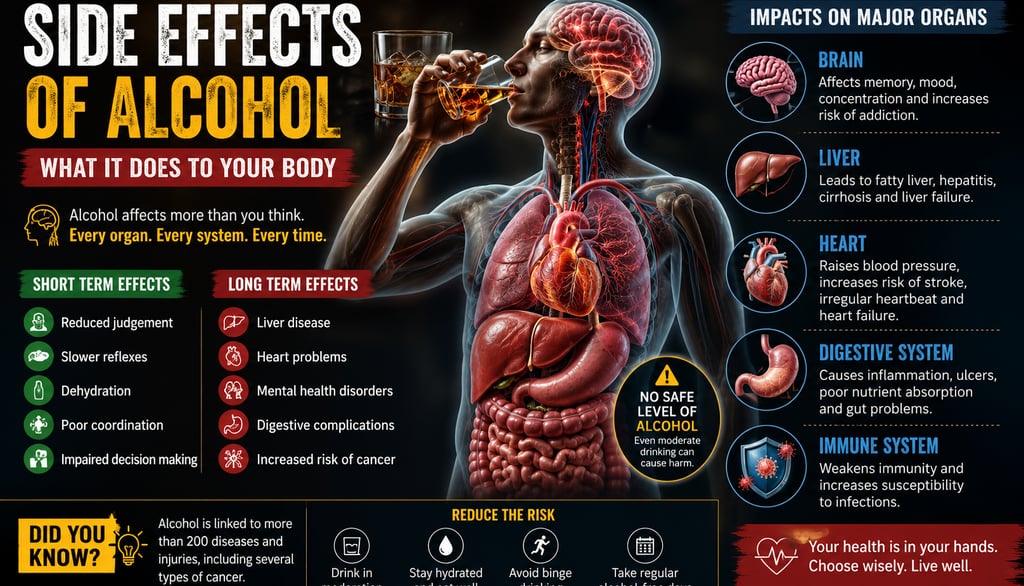
Side Effects of Alcohol Explained: Short-Term and Long-Term Risks Backed by Science
The side effects of alcohol have always been there, patient and unhurried, accumulating in livers and brains and hearts whilst the decanters gleamed under lamplight. Today, science is unambiguous: alcohol is not merely a social lubricant with a rough morning attached.
It is a substance that begins altering the body within minutes of the first sip, touches every major organ, and compounds its damage with extraordinary reliability the longer it is invited in.
From the occasional weekend indulgence to the nightly ritual, the effects of alcohol in the body operate on the same biological terms for everyone. Understanding them is not an act of temperance. It is an act of intelligence.
Also Read: Anti Ageing Skincare: Understanding Causes, Prevention, and Reverse Aging Tips
Understanding How Alcohol Affects the Human Body
Alcohol wastes no time. The moment it enters the stomach, roughly twenty per cent crosses directly into the bloodstream through the stomach wall. The rest floods in through the small intestine, and within moments, the blood carries it to every organ in the body simultaneously, not sequentially. That is what makes alcohol different from most things consumed: it does not wait politely in the digestive queue.
How Alcohol Is Processed
The liver draws the short straw every single time. It metabolises alcohol at a fixed rate of approximately one unit per hour, dismantling it first into acetaldehyde, a compound considerably more toxic than the alcohol itself, before converting that into acetate and eventually eliminating it as water and carbon dioxide.
When drinking outpaces this timetable, alcohol accumulates in the blood and the familiar architecture of intoxication begins to assemble itself.
Why Even Moderate Drinking Can Affect Multiple Organs
Not everyone processes alcohol at the same rate, and this is where individual biology becomes relevant. Age slows metabolism. Women absorb more alcohol per unit than men due to lower concentrations of the enzyme alcohol dehydrogenase.
Body composition, genetic variants, medications, and whether one has eaten all shift the outcome. The effects of alcohol in the body, in short, are never neutral, regardless of how modest the quantity.
Also Read: A Complete Mental Disorders List: Exploring Common Mental Health Conditions
What Are 5 Negative Effects on Alcohol?
Before any conversation about long-term disease, alcohol delivers five immediate and measurable effects that begin within the first hour of drinking. These are not reserved for those who overindulge; they arrive reliably and without discrimination.
Impaired judgement: The prefrontal cortex, the brain's chief executive, is depressed before a person even feels intoxicated.
Slowed reflexes: Neural signal transmission decelerates, reducing reaction time in ways the individual rarely perceives.
Dehydration: Alcohol suppresses vasopressin, causing the kidneys to expel more fluid than is being consumed.
Poor coordination: The cerebellum, which governs balance and motor precision, is among the brain's most alcohol-sensitive regions.
Compromised decision-making: Risk calibration becomes distorted even at blood alcohol levels well below legal drink-drive limits.
These are not edge cases. They are the reliable, well-documented side effects of alcohol at quantities most people would consider unremarkable.
What Are the 7 Effects of Alcohol?
The body is not a collection of isolated departments, and alcohol does not respect organ boundaries. Seven systems bear its effects concurrently, each in its own distinct fashion.
Brain
Alcohol slows neurotransmitter activity and, with repeated exposure, begins remodelling the brain's reward architecture in ways that make abstinence genuinely uncomfortable.
Liver
Every unit consumed passes through the liver for processing, and the cumulative chemical burden of that work is what eventually transforms healthy tissue into scarred, dysfunctional matter.
Heart
Acute drinking dilates blood vessels; chronic drinking raises blood pressure, disrupts cardiac rhythm, and progressively weakens the heart muscle itself.
Digestive System
Alcohol erodes the stomach lining, suppresses digestive enzyme production, and impairs the absorption of B vitamins, zinc, and folate that the body depends upon for cellular repair.
Immune System
Chronic exposure diminishes white blood cell activity, leaving the body less capable of repelling infections it would otherwise neutralise without effort.
Kidneys
Responsible for filtering alcohol-laden blood, the kidneys are placed under sustained pressure by regular drinking, with long-term use linked to chronic kidney disease.
Hormonal Balance
Alcohol suppresses testosterone in men, disturbs oestrogen metabolism in women, and interferes with cortisol and thyroid regulation in both, with consequences that ripple across energy, mood, and fertility.
Also Read: How to Be Happy in Life: What Are the Real Secrets to Living Happily Every Day?
Side Effects of Alcohol on the Brain
The brain is alcohol's most immediate and most consequential target. Its sensitivity to alcohol is not a flaw in human biology; it reflects how profoundly the central nervous system depends upon chemical precision.
A Mini Timeline of Brain Effects
After 10 minutes: Dopamine floods the nucleus accumbens. Inhibitions begin to soften. The prefrontal cortex, which usually governs restraint and consequence-weighing, stands progressively down.
After 1 hour: Memory consolidation falters. The hippocampus struggles to encode new information. Emotional regulation becomes unreliable. Coordination and vision degrade in tandem.
After repeated drinking over years: The hippocampus measurably shrinks. Anxiety and depression embed themselves as chronic states rather than passing moods.
The long-term effects of alcohol on sleep architecture are so severe that individuals who stop drinking can require months before restorative deep sleep returns.
The long-term effects of alcohol on the brain include accelerated cognitive decline, alcohol-related dementia, and a recalibrated reward system that registers ordinary pleasures as insufficient. That last effect is the quiet engine of dependency.
Side Effects of Alcohol on the Liver
No organ is more faithfully sacrificed to alcohol than the liver, and no organ gives less warning before the damage becomes permanent. That stoic silence is precisely what makes alcoholic liver disease so treacherous.
A healthy liver regenerates with extraordinary efficiency. Alcohol exploits that resilience across a merciless progression.
Fatty liver is the first stage, accumulating fat in liver cells as a byproduct of alcohol metabolism. It is reversible at this point, which is why it so often goes unaddressed.
Alcoholic hepatitis follows sustained drinking. The liver inflames, jaundice may appear, and in severe cases the condition is life-threatening without intervention.
Fibrosis marks the point where scar tissue begins replacing functional liver cells, altering the organ's internal structure permanently.
Cirrhosis is the terminal stage of this progression. Scar tissue dominates the organ's architecture, blood flow is obstructed, and the liver's capacity to perform its four hundred daily functions collapses.
By the time symptoms such as spider naevi, abdominal fluid accumulation, and extreme fatigue appear, the window for reversal has typically closed.
The liver's tolerance for early injury is, in the cruellest irony, the very quality that allows the damage to advance so far unseen.
Side Effects of Alcohol on the Heart and Blood Vessels
The cardiovascular implications of alcohol have been muddied for years by a stubbornly persistent myth about the protective properties of red wine. Contemporary research from institutions including the NHS and the WHO has substantially eroded that narrative.
The side effects of alcohol on the heart are structural as much as they are functional. Regular drinking raises blood pressure, increases the risk of atrial fibrillation, and over years can produce alcoholic cardiomyopathy, a condition in which the heart muscle thins and weakens under sustained toxic exposure.
Stroke risk rises through both haemorrhagic and ischaemic pathways. Practical steps that carry genuine cardiovascular benefit:
Observe recommended weekly unit limits consistently, not just on average.
Monitor resting blood pressure if drinking is a regular feature of life.
Avoid binge patterns entirely; acute alcohol spikes place disproportionate strain on the heart.
What Organ Is Most Damaged by Alcohol?
This is a question the body answers with a rather unambiguous hierarchy. The pancreas suffers acutely; pancreatitis triggered by alcohol is amongst the most physically agonising conditions on the clinical register. The brain deteriorates measurably with sustained exposure.
The heart weakens across decades of reliable use. But the liver absorbs the greatest and most direct damage. It is the site of primary metabolism, the organ that encounters the full toxic force of acetaldehyde with every single unit consumed, and the one whose damage most consistently proves irreversible once a threshold is crossed.
When the question is which organ alcohol most reliably destroys, the liver answers first, and it answers quietly.
What Are 10 Diseases Caused by Drinking Alcohol?
According to the World Health Organisation, alcohol is causally linked to over two hundred distinct disease and injury conditions. Ten of the most clinically significant include:
Liver cirrhosis: permanent scarring that extinguishes hepatic function over time.
Pancreatitis: acute and chronic inflammation of the pancreas with severe systemic consequences.
Hypertension: raised arterial pressure compounding cardiovascular risk across all organs.
Alcoholic cardiomyopathy: structural weakening of the heart muscle through sustained toxic exposure.
Stroke: elevated risk through both haemorrhagic and ischaemic mechanisms.
Oesophageal cancer: linked to repeated mucosal damage from alcohol's corrosive passage.
Liver cancer: arising in the scarred terrain of long-standing cirrhosis.
Clinical depression: neurologically compounded and sustained by alcohol's interference with serotonin and dopamine systems.
Alcohol dependence: a physiological and psychiatric disorder with measurable neurobiological substrates.
Alcohol-related dementia: progressive cognitive deterioration through hippocampal and cortical damage.
Also Read: Top Immune Boosting Foods That Help Strengthen Your Immune System Naturally
What Are 10 Things That Alcohol Does to the Body?
Widening the lens beyond disease, alcohol's effects on the body's daily functioning are equally worth naming.
Induces cellular dehydration that impairs cognitive and physical performance simultaneously.
Depletes B vitamins, folate, zinc, and magnesium essential to cellular repair.
Suppresses white blood cell production and immune responsiveness.
Disrupts oestrogen and testosterone balance with measurable consequences for mood and fertility.
Fragments sleep architecture, reducing time spent in restorative slow-wave sleep.
Triggers systemic inflammation that accelerates biological ageing at the cellular level.
Contributes to visceral fat accumulation through excess caloric intake and metabolic disruption.
Slows wound healing and delays muscular recovery following physical exertion.
Reduces fertility markers in both men and women with regular use.
Progressively erodes working memory, processing speed, and sustained concentration.
Short Term Effects of Alcohol vs Long-term Effects of Alcohol
What are 10 negative effects of alcohol across both timescales?
Understanding the difference between what alcohol does tonight and what it arranges over years is one of the more clarifying exercises available to any regular drinker. The short-term effects of alcohol are familiar to most: impaired reaction time, emotional volatility, dehydration, nausea, and the physical toll that arrives as the symptoms of a hangover the following morning.
These effects are largely reversible, resolving within twenty-four to seventy-two hours. The symptoms of a hangover, namely the headache, the gastric distress, and the exhaustion, are the body's way of presenting its bill for the previous evening's metabolic labour.
The long-term effects of alcohol occupy a different register entirely. Organ damage, neurological deterioration, hormonal dysregulation, elevated cancer risk, and psychological dependency are not temporary inconveniences.
Many become permanent beyond a certain threshold of accumulated exposure. The short-term risk is situational; the long-term risk is architectural.
Also Read: Weight Loss Exercise: Routines, Workouts, And Training - Everything You Need To Know
What Happens When You Drink Alcohol Everyday?
20 disadvantages of alcohol on a cumulative timetable
Week 1: Sleep quality declines perceptibly. Liver enzymes begin to rise. The emotional baseline between drinking occasions flattens.
Month 1: Blood pressure creeps upward. Nutrient absorption deteriorates. The brain's dopamine system begins recalibrating its baseline around alcohol's presence.
Year 1: Fatty liver is now a genuine probability. Cognitive performance on tasks requiring sustained attention shows measurable decline. Social and professional functioning begins to carry the weight of dependency.
Several years: Cirrhosis risk accelerates. Cardiovascular damage becomes structural rather than merely functional. The side effects of alcohol are no longer episodic. They are the background noise of daily life.
What happens when you drink alcohol every day without obvious intoxication is perhaps the most misunderstood aspect of the entire subject. Sobriety of appearance is not sobriety of biology. The organs do not make that distinction.
Also Read: Is It Just Stress, or Something More? Recognising the Signs of a Panic Attack
Symptoms of a Hangover and When They Signal Something More Serious
The symptoms of a hangover are the body's thoroughly unglamorous invoice for the previous evening: a splitting headache driven by dehydration and acetaldehyde residue, nausea from gastric irritation, dizziness from electrolyte imbalance, and a fatigue that no quantity of coffee fully resolves.
Deeply unpleasant. Reliably transient. What belongs in a different category entirely is severe confusion that does not lift with time, unrelenting vomiting sustained across many hours, seizures, loss of consciousness, or a bluish tinge at the lips and fingertips. These are not the signatures of a bad hangover.
They are indicators of acute alcohol poisoning, a condition that is both underrecognised and potentially fatal. Knowing the distinction between a wretched morning and a genuine emergency is, in the most literal sense, worth knowing.
Practical Ways to Reduce the Side Effects of Alcohol
Before drinking: Eat a meal containing protein and healthy fats. This slows gastric emptying and materially reduces the rate at which alcohol enters the bloodstream. While drinking: Alternate alcoholic drinks with still water.
This is not a piece of wellness theatre; it genuinely moderates total intake and mitigates the dehydration that drives most hangover symptoms.
Never mix alcohol with energy drinks; the stimulant effect masks the sedative cues that ordinarily tell the body it has had enough. After drinking: Drink water before sleeping. Take a B-complex supplement if drinking has been sustained. Allow at least three hours between the last drink and bed for sleep quality that is even remotely restorative.
The next morning: Eat something slow-digesting and plain. Resist the hair-of-the-dog instinct with some firmness; it extends metabolic stress rather than alleviating it.
Weekly: Count units honestly. Note whether certain moods, social situations, or evenings alone reliably prompt a drink. That pattern, when it solidifies, is the most important thing to notice early.
Also Read: How Do HIV AIDS Symptoms Look Like And Why Do They Happen?
Conclusion
Alcohol reaches every major organ with every unit consumed, and the side effects of alcohol accumulate in quiet proportion to frequency and quantity. Small, honest adjustments made consistently alter the trajectory. The body keeps meticulous records, even when the mind prefers not to.
FAQs
Which drink has 70% alcohol?
Ans: Certain grain spirits, overproof rums, and rectified spirits such as Everclear reach seventy per cent alcohol by volume or beyond. These are not intended for undiluted or rapid consumption. At such concentrations, the side effects of alcohol escalate with dangerous speed, and the threshold between intoxication and alcohol poisoning narrows considerably.
Is it bad to drink alcohol every day?
Ans: Even at quantities that feel moderate, daily drinking accumulates biological consequences. Blood pressure rises, liver enzymes elevate, sleep quality deteriorates, and the brain's reward pathways adapt in ways that make abstinence progressively less comfortable. The risk profile varies by genetics and overall health, but no daily quantity has been established as genuinely without consequence.
Is alcohol worse than sugar?
Ans: They cause harm through different mechanisms. Alcohol is a direct cellular toxin processed with metabolic priority above all other nutrients, is causally linked to multiple cancers, and establishes neurological dependency. Excess sugar drives insulin resistance, metabolic disease, and systemic inflammation. Both are genuinely damaging at excess. Alcohol carries the additional dimension of physiological dependency that sugar, by comparison, does not.
What are three signs you're drinking too much alcohol?
Ans: The first is tolerance, meaning a person requires noticeably more alcohol than previously to produce the same effect. The second is interference, where drinking begins to shape decisions around work, relationships, or daily responsibilities in ways others notice before the individual does. The third is the discomfort of absence, a restlessness or low-level anxiety that arrives reliably when alcohol is not consumed at its usual time.
How long does alcohol stay in your system?
Ans: Alcohol remains detectable in blood for up to twelve hours and on a breathalyser for a comparable window. Urine tests can detect it for up to eighty hours depending on the volume consumed and the sensitivity of the test. Individual metabolism, hydration levels, liver health, and body composition all influence these figures in ways that make any single timeline an approximation rather than a guarantee.
About The Author
Neha Shukla is a writer and LinkedIn creator who demystifies wellness for modern lives. She writes about nutrition, mindfulness, and sustainable habits, grounded in research, infused with real-world wisdom. Her mission is to help you feel better without feeling overwhelmed.



Contact
Don't Let Your Wellness Journey Feel Boring! Get connected with us today to know your health better.
Phone
hello@nehashuklaa@gmail.com
+91 92110 33284
© 2026. All rights reserved.