
How to Be Happy in Life: What Are the Real Secrets to Living Happily Every Day?
Understanding how to be happy in life is not about chasing constant joy but about building sustainable habits, managing stress, and developing a positive mindset. This blog explores practical and science-backed strategies that help you understand how to be happy in life in a realistic and achievable way. From daily micro habits and emotional awareness to effective stress management techniques, it provides actionable steps that can transform your overall wellbeing. It also dives into deeper aspects such as finding happiness alone, maintaining joy after marriage, and applying simple rules like the 5 by 5 principle to reduce overthinking. Whether you are struggling with stress, comparison, or lack of purpose, this guide offers clear answers to help you learn how to be happy in life and create a more balanced, meaningful, and fulfilling everyday experience.
Neha Shukla
6/23/202610 min read
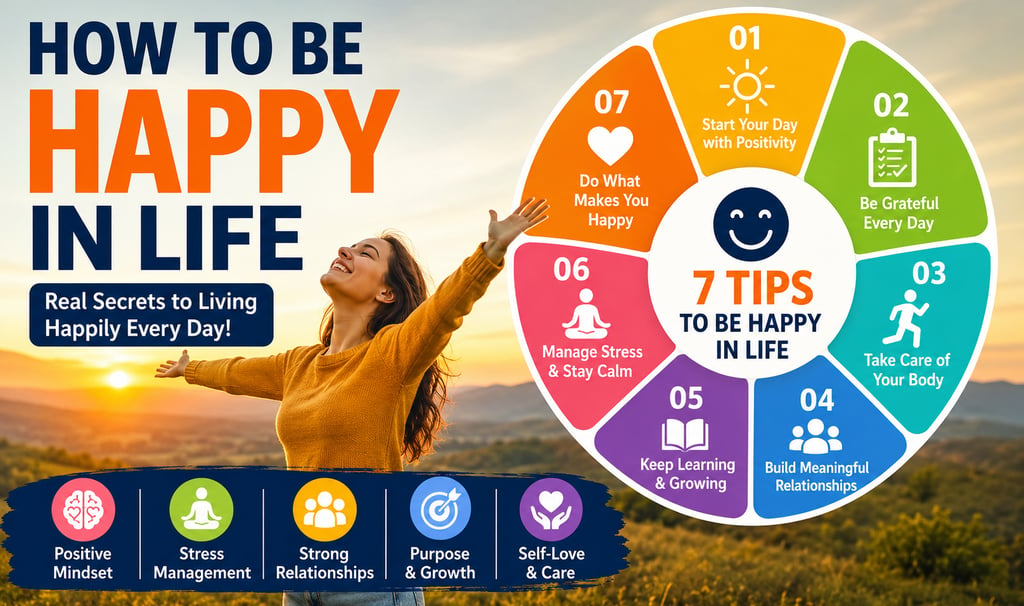

How to Be Happy in Life: Secrets to Living a Meaningful and Joyful Life
Comparison culture has become the modern affliction, and nearly every soul keeps circling the same burning question: how to be happy in life, truly and sustainably. The honest truth is that most answers found online are either painfully obvious or breathtakingly shallow. Happiness is not a destination stamped on a boarding pass. It is a skill, a practice, a slow and deliberate cultivation.
The science confirms it, philosophy echoes it, and the quiet wisdom of lived experience seals it entirely. What follows are real, uncommon, and surprisingly powerful strategies for anyone ready to genuinely learn how to be happy in life, not as a performance, but as a way of being. Because how to be happy in life is trainable, not accidental.
How to Live a Happy Life? What Are the Tips to Live Happily in Life?
Understanding how to be happy in life begins not with grand gestures but with the unremarkable architecture of daily routine. Those who have genuinely cracked how to be happy in life will tell you almost without exception: it started with one small, quiet habit, not a sweeping revelation.
Research in positive psychology consistently demonstrates that happiness is less about circumstance and far more about the texture of ordinary days, which is precisely why the following habits carry so much weight.
Daily Micro Habits That Rewire Your Brain
A close friend once confessed that the happiest chapter of her life began not with a promotion or a romance, but the morning she started writing three sentences of gratitude before her tea went cold. That single ritual, fragile as it seemed, rewired the lens through which she experienced everything that followed.
Gratitude journaling trains the reticular activating system, the brain's filtering mechanism, to notice abundance rather than lack. Even three specific observations each morning can shift neurological baselines over thirty days.
Morning sunlight exposure within the first hour of waking regulates circadian rhythms, boosts serotonin, and provides a biological anchor that stabilises mood across the entire day. This is not wellness theatre. It is photobiological reality.
Limiting negative inputs, whether the news, certain conversations, or digital noise, is not avoidance. It is curation. The mind absorbs everything it is fed, and consistently feeding it catastrophe produces a catastrophic outlook.
10 Ways to Be Happy
Digital fasting: One full day each week without social platforms restores a quieter relationship with your own thoughts.
Dopamine detox days: Removing instant gratification recalibrates the brain's reward threshold, making ordinary pleasures feel exquisite again.
Weekly solitude hour: Not isolation but intentional aloneness, walking or simply being without agenda.
Handwriting letters: Writing to someone without expecting instant reply reactivates the slow, generous parts of the mind.
Learning something impractical: A language, an instrument, a craft, purely for the pleasure of becoming.
Nature immersion: Forty minutes in green space measurably reduces cortisol and increases belonging.
Acts of anonymous generosity: Giving without being seen produces a genuine neurochemical lift.
Cooking from scratch: Preparing food with full attention is a meditation disguised as dinner.
Celebrating micro-wins: Acknowledging small completions conditions a success-oriented identity.
Evening technology curfew: Stepping away from screens ninety minutes before sleep dramatically improves rest.
Also Read: Yoga for Stress Relief: Transform Your Mood in Just 10 Minutes a Day
What Are the Secrets of Living a Happy Life?
The deeper secrets of how to be happy in life are not hidden in luxury or achievement. If you truly want to understand how to be happy in life at a soul level, the journey turns inward rather than outward.
Many people live entire lives reacting to feelings they never paused to examine, and that unexamined interior is precisely where lasting happiness either takes root or quietly withers.
Psychological Tricks to Make Yourself Happy
Cognitive reframing is perhaps the most liberating of all psychological tools. It does not ask you to deny pain. It invites you to reconsider the story being told about it. A redundancy becomes an opening.
A rejection becomes a redirection. Circumstances remain identical, only the narrative shifts, and with it the entire emotional landscape.
Anchoring positive memories involves deliberately returning to vivid, joyful recollections with sensory richness, the smell of rain on a particular afternoon, laughter around a specific table.
The brain cannot fully distinguish between a richly remembered experience and a present one, making memory a renewable source of genuine warmth.
Behavioural activation operates on a deceptively simple principle: action precedes motivation. One does not wait to feel happy before doing something joyful.
One does the thing, and the feeling follows, reversing the passivity trap that keeps so many people perpetually waiting for life to begin.
The Role of Positive Mindsets and Identity Shifts
Behaviour follows identity. A person who believes themselves to be someone who moves their body will exercise without negotiation. Positive mindsets are not affirmations plastered on a vision board.
They are beliefs, absorbed gradually through evidence accumulated by small repeated actions. To change how you feel, begin by changing what you do, because what you do, over time, reshapes who you believe yourself to be entirely.
Also Read: How to Get Better Sleep Naturally: Simple Tips to Improve Sleep Quality Every Night
7 Tips to Be Happy in Life That Actually Work
Much of what passes for advice on how to be happy in life is recycled platitude dressed in fresh typography. This system is drawn from psychology, philosophy, and the quiet testimony of genuinely contented people, and it works precisely because it demands nothing dramatic, only consistency.
Actionable 7-Step System
1. Build emotional awareness. Name what you feel specifically. Not "bad" but anxious, overlooked, tender, or quietly proud. Emotional granularity gives the nervous system clarity instead of noise.
2. Reduce comparison triggers. Audit feeds, environments, and conversations that leave you feeling diminished. Removing them is intelligent self-governance, not weakness.
3. Control stress using breathing patterns. Box breathing, four counts in, hold four, four out, hold four, activates the parasympathetic nervous system within minutes. Stress management is not an annual retreat. It is a daily micro-practice. When the body learns to regulate itself through breath, control stress becomes accessible rather than aspirational.
4. Create a purpose-driven routine. Each morning, one task connecting to something meaningful. Purpose does not demand scale.
5. Invest in relationships. The Harvard Study of Adult Development, spanning eighty-plus years, reached one majestic conclusion: the quality of relationships is the greatest predictor of happiness and longevity. Not wealth. Relationships.
6. Prioritise physical health. Sleep, movement, hydration, and nourishment are the biological substrates upon which all other happiness rests.
7. Learn to detach from outcomes. Do the work with a full heart. Release the verdict. Attachment to results is the source of most unnecessary suffering.
Also Read: Are You Experiencing Anxiety Attack Symptoms? Here’s What Your Body Is Telling You
How to Be Happy in Life Alone?
Society rarely teaches people how to be happy in life without an audience, yet it is one of the most essential skills available. Truly understanding how to be happy in life requires first understanding how to be enough company for oneself.
There is a profound and largely underrated art to how to be happy in life in one's own company, and solitude is not synonymous with loneliness. Loneliness is an involuntary absence of connection. Solitude is a chosen, nourishing relationship with oneself, and that distinction changes everything.
How to Be Happy in Life Alone
Building a self-relationship means treating oneself with the curiosity and patience offered to a beloved friend, knowing one's own preferences and rhythms without filtering them through others' expectations.
Solo routines create a private architecture of comfort. A morning walk taken alone, a particular café visited without company. These are not signs of isolation. They are the furniture of a rich interior life.
Emotional independence means developing the capacity to soothe and encourage oneself without perpetually requiring external validation, which is among the most durable foundations of happiness any person can build.
How to Be Happy When Depressed
Depression narrows the world to a pinpoint. In these seasons, the aim is not happiness. It is movement. One degree of warmth.
Movement therapy requires only a change of physical position. A five-minute walk. Stretching in a patch of sunlight. Shifting the body shifts the mind in ways that pills and willpower alone rarely achieve.
Breaking inertia cycles means completing one microscopic action, making the bed, washing a single cup, sending one message.
Momentum is built from the smallest possible unit of motion, and reaching out to a trusted soul is not surrender. It is the most courageous act available in a dark season.
Also Read: Is It Just Stress, or Something More? Recognising the Signs of a Panic Attack
How to Be Happy in Life After Marriage?
Knowing how to be happy in life as an individual is the prerequisite for knowing how to be happy in life within a partnership.
Marriage is one of the most beautiful and demanding experiments in coexistence ever devised, and the collision between expectation and reality is where most marital unhappiness is quietly manufactured.
Balancing Individual and Shared Happiness
One arrives at marriage with an image assembled from films, inherited patterns, and personal longing. The other person arrives with an entirely different image. The work of a lasting union is not finding someone who matches the image but building something real and singular together.
Individual happiness within marriage is not selfish. It is the oxygen that makes shared happiness sustainable across a lifetime.
Communication and Emotional Safety
The single most transformative practice in any intimate relationship is the creation of emotional safety, the felt certainty that one may speak truthfully without fear of contempt or dismissal.
Replace accusation with curiosity. Speak feelings, not verdicts. Repair quickly after conflict rather than allowing resentment to calcify.
Choose regularly to see the best in the person beside you. It is a choice, not a condition, and that choice, made consistently, is what separates enduring partnerships from exhausted ones.
Also Read: Reason for High Blood Pressure: Causes, Symptoms & Natural Ways to Control It
What Is the 5 by 5 Rule of Happiness?
The 5 by 5 rule offers one of the most elegant frameworks for those learning how to be happy in life on an everyday, practical level, and it works because it introduces proportion where the mind defaults to catastrophe.
Practical Application of the 5 by 5 Rule
The rule is disarmingly simple: if something will not matter in five years, do not spend more than five minutes distressed by it. Most of the things that derail a perfectly good day, a rude exchange, a missed train, a small professional slight, belong entirely to this category. They evaporate with time, yet are granted enormous emotional real estate in the present.
Applied consistently, this rule trains the mind to distinguish between inconvenience and genuine difficulty.
A spilled coffee, a forgotten reply: five minutes, then release. That distinction accumulates, over months, into a genuinely calmer and more spacious interior life.
Also Read: Heart Attack Symptoms - What Are The Early Signs To Look For?
How Can I Live a Happy Life and Control Stress Effectively?
Genuinely understanding how to be happy in life means understanding the nervous system, because stress and happiness are not opposites.
How to be happy in life does not require the absence of stress. It requires the capacity to move through it without being consumed, a skill built incrementally through the right daily practices.
Stress Management Techniques That Actually Work
Box breathing, equal counts of inhale, hold, exhale, hold, engages the vagus nerve directly, signalling the nervous system to shift from threat response to restoration. Surgeons, soldiers, and competitive athletes use it for this precise reason.
Nervous system reset through cold water on the face, grounding exercises, or a ten-minute walk in fresh air are physiological resets with measurable, documented effect on cortisol and heart rate variability.
Journaling, specifically writing worries out in full and writing a single realistic reassurance in response, externalises the cognitive loop that anxiety depends upon. Exposure to the page diminishes its authority with remarkable swiftness.
Building Long-Term Emotional Resilience
Every person who has genuinely cracked how to be happy in life over the long arc will point to one unglamorous truth: consistency over inspiration. This is, ultimately, the most honest answer to how to be happy in life that any science or philosophy has ever produced.
Resilience is not built in crisis. It is built in ordinary moments when one chooses, again and again, the habits that strengthen rather than deplete. Motivation is a visitor. Consistency is the architecture that holds the house together in its absence.
Also Read: Depression symptoms - why people are suffering from it?
Conclusion
How to be happy in life is a craft, not a discovery. Every strategy here is a doorway. Step through one, then another, with patience and genuine curiosity. The life you are reaching for is assembled, quietly, from exactly these kinds of daily, unglamorous, luminous choices.
FAQs
What are the 7 pillars of happiness?
Ans: The seven pillars are health, relationships, purpose, mindset, personal growth, freedom, and contribution. Each reinforces the others, and neglecting one destabilises the rest. Lasting happiness tends to emerge naturally when all seven are tended with consistent, thoughtful attention across the full breadth of an ordinary, well-lived life.
What is the 90-second rule for happiness?
Ans: Neuroscientist Dr Jill Bolte Taylor identified that an emotional wave lasts physiologically for roughly ninety seconds. If the emotion lingers beyond that, it is being actively sustained by continued thought. Allowing the wave to pass without attaching a narrative restores equilibrium far more quickly than most people expect.
Is intelligence 80% genetic?
Ans: Twin studies suggest a hereditary component ranging between 50% and 80% in adults. However, environment, early stimulation, nutrition, and cultivated habits of thought play a substantial role throughout development. Intelligence is less a fixed endowment and more a capacity shaped by both inheritance and lived experience in nuanced, inseparable proportion.
What is the biggest cause of happiness?
Ans: The most robust evidence points to the quality of human connection as the single greatest contributor to sustained happiness. The Harvard Study of Adult Development found that warm relationships predicted longevity and life satisfaction more reliably than wealth or professional accomplishment. Meaning derived from belonging to something beyond oneself also features prominently.
How can I make my life happy?
Ans: Begin with one small, consistent action: a morning gratitude note, a daily walk, a weekly honest conversation with someone trusted. Happiness is not summoned in bulk. It is assembled incrementally through the quality of daily choices. Invest steadily in relationships, physical health, and purpose, and the rest follows with time.
About The Author
Neha Shukla is a writer and LinkedIn creator who demystifies wellness for modern lives. She writes about nutrition, mindfulness, and sustainable habits, grounded in research, infused with real-world wisdom. Her mission is to help you feel better without feeling overwhelmed.



Contact
Don't Let Your Wellness Journey Feel Boring! Get connected with us today to know your health better.
Phone
hello@nehashuklaa@gmail.com
+91 92110 33284
© 2026. All rights reserved.