
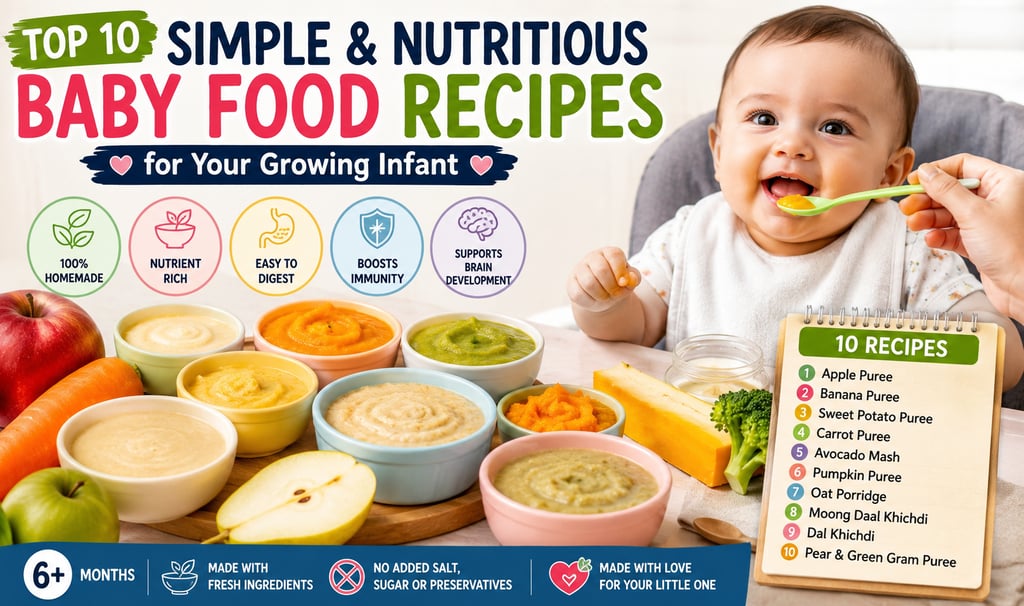
Top 10 Simple and Nutritious Baby Food Recipes for Your Growing Infant
Introducing your little one to solid foods is a memorable milestone, and choosing nutritious homemade meals can make the journey both rewarding and reassuring. This guide explores wholesome baby food recipes that are simple to prepare, packed with essential nutrients, and suitable for different stages of your infant's growth. From smooth fruit and vegetable purees to nourishing porridges and traditional favourites like moong daal khichdi, each recipe is designed to support healthy development while introducing new flavours and textures. You'll also discover practical feeding advice, safe food preparation methods, storage tips, and age-appropriate meal ideas to make weaning easier. Whether you're preparing your baby's very first spoonful or expanding their menu with balanced homemade options, these baby food recipes provide a wholesome foundation for healthy eating habits that can benefit your child for years to come.
Neha Shukla
7/3/20267 min read
How to Create Balanced Baby Food Recipes Using Fresh Ingredients?
Welcoming your little one to the delightful world of solids is one of parenthood's most heart-warming milestones. One day, your baby is content with breast milk or baby formula, and before long, curious little eyes begin following every spoonful on your plate. Alongside the excitement often comes uncertainty.
Which ingredients are gentle enough? How do you prepare meals that are both nourishing and delicious? Most importantly, how can you ensure every bite supports healthy growth? The good news is that preparing wholesome meals at home is far simpler than many parents imagine.
Fresh, carefully selected ingredients allow you to create meals bursting with natural goodness while avoiding unnecessary sugar, salt, and preservatives often found in processed alternatives.
This guide brings together ten wholesome baby food recipes designed for every stage of early weaning. Alongside practical cooking methods, you'll discover nutritional insights, texture tips, storage advice, and clever feeding secrets that make homemade meals both convenient and enjoyable.
Whether you're preparing your baby's very first puree or introducing heartier family-inspired dishes, these nourishing baby food recipes will help you serve every spoonful with confidence and love.
Also Read: What Are The Impact of Vitamin D Deficiency?
What is the best homemade baby food?
The finest baby food recipes are rarely the most complicated ones. Homemade infant food recipes rely on whole, seasonal produce cooked gently and served without the excess sodium, stabilisers, or added sugars that often creep into shop-bought pouches.
A commercial jar may promise convenience, but a home kitchen offers something far superior: control over freshness, texture, and nutrient density.
This is the quiet philosophy behind traditional feeding wisdom, passed down through generations long before packaged options existed on supermarket shelves.
Homemade baby food also allows the flavour palette to widen naturally, easing an infant towards family meals rather than keeping them tethered to bland, uniform textures.
Parents typically progress through gentle stages, such as:
Baby food recipes 4-6 months, focused on single-ingredient, thin purees.
Baby food recipes 6-8 months, which introduce slightly thicker, combined textures.
Understanding these stages makes the transition from milk to solids feel far less daunting, and this is precisely where the earliest baby food recipes ought to begin.
Also Read: Why Do I Sweat So Much? Causes, Symptoms, and Effective Treatments Explained
How to make 6 month old baby food?
The six-month mark is often the true beginning of the weaning journey, and this is where most baby food recipes rightly start. Apple puree is the classic first offering, prized for its natural sweetness and gentle fibre content.
Apple Puree:
Peel, core, and chop one ripe apple into small pieces.
Steam gently for eight to ten minutes until soft enough to pierce with a fork.
Blend with a splash of cooled boiled water until silky and lump-free.
Pass through a fine sieve for the very first attempts, as newborn palates favour extreme smoothness.
A rarely mentioned trick among seasoned mothers is the "drip test": let a spoonful fall from height. If it splashes rather than plops, the puree is thin enough for a beginner.
As confidence grows, single-ingredient purees of pear, sweet potato, and pumpkin can follow the same method, each introduced across a three-day gap to watch for any reaction.
These early baby food recipes build the foundation for every texture that follows, so patience here pays handsome dividends later.
From these silky first spoonfuls, the next stage brings a welcome shift in texture and ambition.
Also Read: How to Be Happy in Life: What Are the Real Secrets to Living Happily Every Day?
What to cook for a 7 month old baby?
By seven months, many infants are ready to graduate from thin purees towards mildly textured meals, and this is where baby food recipes begin to feel more like proper cooking.
A soft, well-cooked porridge made from rice or oats becomes a wonderful canvas, easily blended with fruit or vegetable purees for variety.
Green Gram Porridge
Soak split green gram (moong) for two hours, then pressure cook with rice until thoroughly soft.
Mash with a fork rather than a blender, allowing tiny, safe lumps to build oral strength.
Stir in a teaspoon of ghee for warmth and easy digestibility.
This stage often overlaps with two important milestones worth noting:
Baby food recipes 6 months, marking the confident start of mixed-texture meals.
Baby food recipes 10 months, which welcome finger foods and self-feeding attempts.
Each of these infant food recipes should be introduced with unhurried patience, letting the baby's own cues guide the pace rather than a rigid calendar.
Also Read: How to Increase Height Naturally at Home: No Supplements Needed?
What baby foods are good mixed together?
Once single flavours are familiar, combining them becomes both a nutritional and sensory adventure. Sweet and savoury pairings tend to be particularly well received, and this is one of the more delightful areas within baby food recipes to experiment.
A ripe Pear blended with a spoonful of cooked lentils offers an unusual pairing, softening the earthiness of lentils with natural fruit sweetness.
Sweet potato mixed with cooked spinach, or banana folded into plain porridge, are equally cherished combinations. The golden rule within these baby food recipes is to introduce only one new ingredient at a time, so any sensitivity can be traced with ease.
These flavour marriages naturally set the stage for a more purposeful focus on nourishment for the growing mind.
What are the 7 brain foods for kids?
Certain ingredients carry an almost storied reputation for supporting cognitive growth, and weaving them into early baby food recipes is a quietly powerful habit. Seven such ingredients stand out with particular grace:
Walnuts, finely ground into porridge for healthy fats.
Eggs, rich in choline for memory development.
Oats, offering slow-release energy for a growing brain.
Spinach, laden with folate and iron.
Pumpkin seeds, a quiet source of zinc.
Yoghurt, supporting gut and brain communication.
Sweet potato, rich in beta-carotene.
These ingredients pair beautifully across two widening windows:
Baby food recipes 9-12 months, when chewing confidence grows steadily.
Baby food recipes 9 12 months, a stretch where appetite often surprises new parents.
From brain-nourishing ingredients, the conversation turns naturally towards one of the most time-honoured traditions in infant feeding.
Also Read: White Discharge During Pregnancy: What’s Normal & What Could Be Dangerous
Nutrient-Dense Indian Staples for Your Infant
Few dishes carry the same comforting reputation as moong daal khichdi, a staple that has nourished Indian infants for generations.
This humble dal khichdi, made from rice and split lentils cooked to a soft, homogenous consistency, delivers plant protein, iron, and easily digestible carbohydrates in a single bowl.
Moong Daal Khichdi:
Wash and soak equal parts rice and split green gram.
Pressure cook with a pinch of turmeric until thoroughly mushy.
Mash lightly and stir through a spoon of ghee before serving warm.
These traditional baby food recipes work beautifully alongside breast milk or baby formula, which continue to serve as the primary source of nutrition well into the weaning journey.
Solids at this stage are complementary rather than a replacement, gently building alongside milk feeds.
As the infant matures, families often explore:
Indian baby food recipes 12-18 months, incorporating soft rotis and mild vegetable curries.
Baby food recipes Indian, celebrating regional grains such as ragi and jowar.
Once the feeding repertoire has grown this rich, the practical question of preserving these efforts becomes rather pressing.
Also Read: How to Increase Testosterone Level Naturally (Most Men Ignore These 5 Tricks)
Tips for Storing Homemade Purees
A batch-cooking session can save considerable time, provided storage is handled with a touch of wisdom rarely shared elsewhere.
Freezing purees in ice cube trays creates perfectly portioned servings that thaw within minutes, with each cube transferred into labelled freezer bags within twenty-four hours to prevent freezer burn.
A lesser-known trick lies in cooling purees rapidly in a shallow dish before freezing, as slow cooling encourages damaging ice crystals.
Refrigerated food recipes should be consumed within forty-eight hours, while frozen batches stay fresh for up to one month at a steady temperature.
Reheating should always bring the puree to a piping hot stage before cooling to a safe serving temperature.
Also Read: Childbirth Normal Delivery: How to Increase Chances of Natural Birth Without C-Section
Conclusion
Weaning is a season of small victories, sticky highchairs, and quiet pride. These baby food recipes offer a gentle, nourishing path through those early months. Every spoonful matters, and this Baby care journey, handled with such care and patience, is already being done beautifully.
FAQs
At what age is 90% of the brain developed?
Ans: By the age of five, approximately ninety per cent of a child's brain has developed, with the most rapid growth occurring within the first three years. This period relies heavily on nutrient-dense feeding, consistent sleep, and warm interaction, making early baby food recipes genuinely formative for long-term cognitive foundations.
What foods give kids energy?
Ans: Complex carbohydrates such as oats, brown rice, and sweet potato release energy gradually, avoiding sharp spikes and crashes. Healthy fats from avocado, ghee, and nut pastes further sustain a toddler's activity levels. Together, these ingredients form the backbone of balanced, energising baby food recipes throughout the day.
What are the 10 genius foods?
Ans: Eggs, walnuts, oats, spinach, blueberries, yoghurt, sweet potato, pumpkin seeds, lentils, and salmon are widely regarded as genius foods. Each supports brain, immune, and physical development when introduced appropriately within age-suitable baby food recipes, offering a well-rounded nutritional foundation for growing infants.
What food did Einstein eat?
Ans: Historical records suggest Einstein favoured simple, home-cooked meals, with a notable fondness for honey, herring, and hearty soups. While anecdotal, this reflects a broader nutritional truth still relevant today, that whole, minimally processed ingredients, much like those used in wholesome baby food recipes, support sustained mental clarity.
What is 70% of the brain made of?
Ans: The brain is composed of roughly seventy per cent water and a significant proportion of fat, particularly DHA. This is precisely why fat-rich ingredients feature prominently across infant food recipes, supporting neural membrane development during the crucial early years of rapid brain growth.
About The Author
Neha Shukla is a writer and LinkedIn creator who demystifies wellness for modern lives. She writes about nutrition, mindfulness, and sustainable habits, grounded in research, infused with real-world wisdom. Her mission is to help you feel better without feeling overwhelmed.



Contact
Don't Let Your Wellness Journey Feel Boring! Get connected with us today to know your health better.
Phone
hello@nehashuklaa@gmail.com
+91 92110 33284
© 2026. All rights reserved.