
Top Reasons for Delayed Periods and How to Fix Irregular Cycles Naturally
Understanding the reasons for delayed periods can ease a great deal of unnecessary worry and help you reconnect with your body’s natural rhythm. This blog gently explores the most common causes, ranging from hormonal imbalances and lifestyle shifts to conditions like PCOS, pregnancy, and perimenopause. It highlights how everyday factors such as stress, poor sleep, diet, and exercise habits quietly influence menstrual cycles. More importantly, it offers practical and natural ways to restore balance, including mindful routines, nourishing foods, and suitable physical activity. Rather than treating delayed periods as a problem, the article encourages you to see them as signals your body sends for attention and care. With a blend of medical insight and holistic guidance, this guide empowers you to manage and prevent irregular cycles with confidence and clarity.
Neha Shukla
6/19/20269 min read
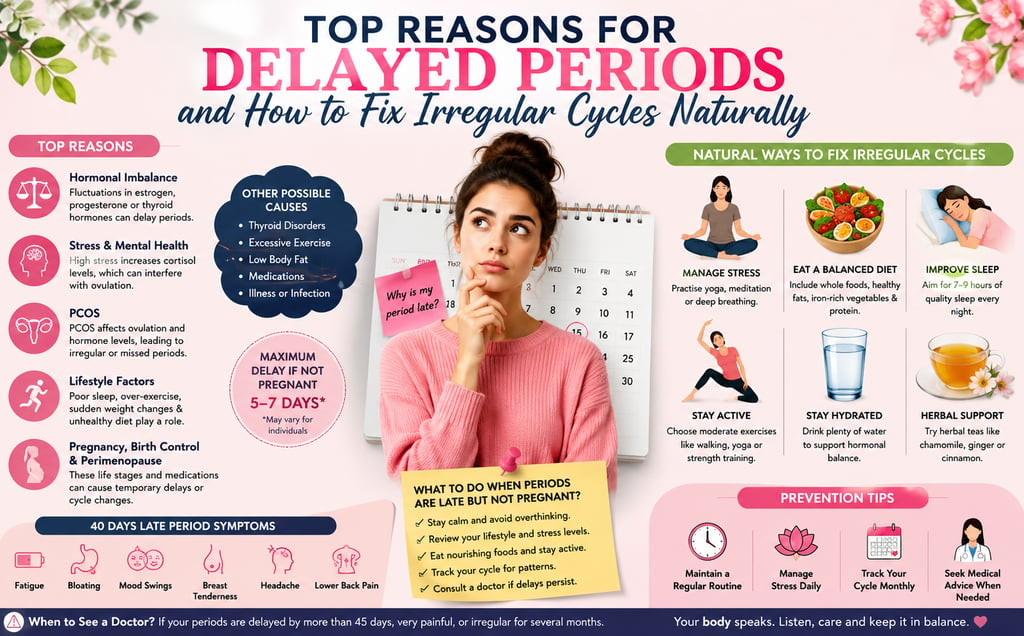
What are the reasons for delayed periods and How Exercise, Sleep, and Diet Affect Your Cycle?
The reasons for delayed periods are rarely explained with the clarity they deserve, yet they are deeply woven into everyday feminine health. Whether a sudden shift in sleep, a spike in stress, or something subtler like a hormonal imbalance, the body speaks in its own unhurried dialect.
This blog decodes that dialect honestly. Ahead, you will find every significant cause behind irregular periods, natural fixes rooted in science and tradition, and prevention strategies that genuinely hold.
Also Read: Imbalance Hormones Symptoms - How Will You Check It? - Every Step Disclosed
What Are the Reasons for Delayed Periods?
The menstrual cycle is, at its most poetic, a monthly monologue the body delivers on its own terms. When that monologue falls silent, the reasons for delayed periods deserve a thoughtful examination.
Irregular menstrual causes span a wide spectrum, and understanding them begins not with panic, but with perspective.
Common Causes Overview
The most frequently cited irregular periods causes include:
Hormonal imbalance - a fluctuation in oestrogen or progesterone that disrupts ovulation timing.
Pregnancy - the body redirects its entire hormonal architecture from the moment of implantation.
PCOS (Polycystic Ovary Syndrome) - excess androgens cause ovulation to become infrequent or absent.
Stress - cortisol, the body's alarm chemical, suppresses reproductive hormones when chronically elevated.
Lifestyle changes - sudden shifts in weight, exercise intensity, or erratic eating patterns
Two concerns many women silently carry:
Maximum delay in periods if not pregnant - a delay of up to 45 days may fall within a variable cycle range, but beyond that, clinical attention becomes worthwhile.
40 days late period symptoms - fatigue, breast tenderness, mood shifts, and bloating may accompany a very late cycle even without pregnancy.
Once the common causes are understood, the next step is examining what governs them all: the hormonal system.
Also Read: Breast Cancer Symptoms: How to Spot the Signs Early and Stay Safe
Hormonal Imbalance and Its Impact on Menstrual Cycles
Oestrogen and progesterone, the twin sovereigns of the female reproductive world, govern not only the menstrual cycle but also mood, metabolism, and bone density. When disrupted, the reasons for delayed periods become both biochemical and deeply personal.
A hormonal imbalance does not always announce itself dramatically. It may arrive as persistent fatigue or the quiet disappearance of a period. The reproductive axis operates as a finely calibrated instrument, and even the slightest dissonance can silence ovulation entirely.
Thyroid and Period Delays
Here is something most women are never told: the thyroid does not merely govern metabolism; it is deeply entangled with menstrual health. Hypothyroidism causes the body to conserve energy and delay ovulation.
Hyperthyroidism causes cycles to become erratic or vanish entirely. Both represent significant reasons for delayed periods that remain chronically underdiagnosed.
Hormone Disruption Triggers
Beyond the thyroid, several overlooked catalysts dismantle hormonal equilibrium:
Poor sleep - the body synthesises key reproductive hormones during deep sleep; chronic deprivation starves the system of its own raw material.
Sudden weight changes - shifting more than 10% of body weight within weeks sends distress signals to the hypothalamus, which withholds ovulation.
Stress hormones - persistently elevated cortisol suppresses gonadotropin-releasing hormone, halting the ovulation cascade before it begins.
Corrective practices worth adopting:
A fixed sleep window of seven to nine hours with consistent timings.
Balanced, nutrient-dense meals that avoid dramatic blood sugar spikes.
Ten minutes of daily breathwork to counteract cortisol's quiet dominance.
Hormonal disruption rarely stands alone - and PCOS is its most common companion.
Also Read: How Do HIV AIDS Symptoms Look Like And Why Do They Happen?
How Does PCOS Affect Periods?
PCOS is perhaps the most misunderstood hormonal condition of the modern era. It sits at the very centre of countless reasons for delayed periods across women in their twenties and thirties, yet is often diagnosed years after symptoms first surface. PCOS is not simply "cysts on the ovaries."
It is a systemic hormonal disorder in which insulin resistance, elevated androgens, and suppressed ovulation intersect, making it one of the most significant reasons for delayed periods that lifestyle change can address.
What Happens in PCOS?
Within a PCOS-affected cycle, follicles fail to rupture and release an egg. Without ovulation, there is no progesterone surge. Without progesterone, there is no menstruation. The cycle stalls.
This mechanism is precisely why PCOS consistently tops every clinical list of reasons for delayed periods.
Signs You Should Not Ignore
Women with PCOS often experience a constellation of signs beyond missed periods:
Acne persisting well beyond adolescence, concentrated along the jawline.
Gradual, unexplained weight gain, particularly around the abdomen.
Unwanted facial or body hair growth, driven by elevated androgens.
Practical measures that show genuine promise:
A low-glycaemic balanced diet that stabilises blood sugar and reduces insulin resistance.
Resistance-based exercise three to four times weekly to improve insulin sensitivity.
Tracking symptoms over three months before any gynaecological appointment.
PCOS is a medical condition, but daily life shapes it profoundly, which is why lifestyle deserves its own section.
Also Read: How to Get Period Fast at Home: Effective Tips Backed by Science & Tradition
Lifestyle Factors That Lead to Irregular Cycles
Not every reason for delayed periods resides in a laboratory result. Some of the most potent disruptors live inside ordinary daily life: morning routines, nightly habits, and choices made between meetings.
Role of Stress and Mental Health
A colleague once described skipping her period for three consecutive months during a particularly brutal project deadline season. Her diet had not changed. Her weight was stable. No medical condition was ever found.
The only variable was relentless, unmanaged stress. Her story is not unusual; it is, in fact, one of the most instructive illustrations of how the reasons for delayed periods can be entirely invisible on a blood panel yet devastatingly real inside the body.
Stress is not merely an emotional experience; it is a full-body physiological event. When the nervous system perceives prolonged threat, cortisol floods the bloodstream.
The hypothalamus then suppresses reproductive function, because from an evolutionary standpoint, the body refuses to invest in reproduction when survival feels uncertain.
This cortisol-reproduction tension is among the most frequently observed reasons for delayed periods in otherwise healthy women.
Over-Exercise or Lack of Activity
Exercise is a gift to the body, but only within measured application. Women who train intensively without adequate caloric support often experience hypothalamic amenorrhoea -- a hormonal shutdown driven by energy deficiency.
Conversely, a sedentary lifestyle generates insulin resistance, creating its own irregular periods causes. Balance here is not a compromise. It is the prescription.
Sleep Disruption
The circadian rhythm is a biological clock of extraordinary precision. Sleep deprivation disrupts melatonin, destabilises cortisol, and interferes with the pulsatile release of luteinising hormone - the very hormone that triggers ovulation.
What to do when periods are late but not pregnant:
Reduce screen exposure an hour before bedtime.
Maintain a consistent wake time even on weekends.
Introduce magnesium-rich foods - pumpkin seeds, dark leafy greens - in the evening
Lifestyle is where most natural corrections begin. Three specific life events, however, carry their own distinct reasons for delayed periods.
Also Read: What Is Women White Discharge? Meaning, Types & Health Insights
Pregnancy, Birth Control, and Perimenopause
Early Pregnancy Signs
Pregnancy remains the most familiar of all reasons for delayed periods. From the moment of implantation, the body produces human chorionic gonadotropin (hCG), preventing the uterine lining from shedding.
Accompanying signs include heightened sensitivity to scent, morning nausea, and breast tenderness.
Birth Control Effects
Birth control pills, hormonal patches, and certain intrauterine devices suppress natural ovulation. When birth control pills are discontinued, the body requires two to three months before its own rhythm reasserts itself.
This transitional silence is one of the most misunderstood reasons for delayed periods in women of reproductive age.
Perimenopause Changes
Perimenopause - the unhurried threshold before menstruation ceases - typically begins in the early to mid-forties. Oestrogen levels descend gradually, and ovulation grows irregular.
Perimenopause is one of the most natural of all reasons for delayed periods, and yet it catches most women entirely unprepared.
Diet is the next lever, and it is far more powerful than most women realise.
Also Read: How to Get Bigger Breast Naturally: Proven Methods, Diet, and Exercises
What Are the Diets That Help Prevent Irregular Periods?
A balanced diet rich in whole foods, healthy fats, and micronutrients creates the biochemical environment in which the reproductive system flourishes.
A depleted, inflammatory diet does the opposite -- sitting among the most correctable reasons for delayed periods that exist.
Foods That Regulate Hormones
A balanced diet designed for menstrual health prioritises:
Leafy greens such as spinach, kale, and methi - dense in iron and folate, replenishing what the cycle depletes.
Healthy fats from avocado, ghee, and raw nuts - precursors to steroid hormone synthesis.
Whole grains such as oats, quinoa, and brown rice - stabilising blood sugar and reducing insulin spikes that disrupt ovarian function.
Eight to ten glasses of water daily, supplemented by spearmint or ashwagandha tea, completes the hydration foundation every hormonal process depends upon.
Foods to Avoid
Certain dietary choices quietly accumulate as reasons for delayed periods:
Refined sugar spikes insulin, triggering androgen production and suppressing ovulation.
Processed foods laden with seed oils and preservatives generate systemic inflammation that disrupts hormonal signalling.
Nourishment sets the stage. Movement then amplifies everything the diet begins.
Also Read: Childbirth Normal Delivery: How to Increase Chances of Natural Birth Without C-Section
What Are the Exercises to Regularise Periods?
The right kind of exercise restores hormonal balance, improves pelvic circulation, reduces cortisol, and directly counters reasons for delayed periods rooted in lifestyle excess.
Best Workouts
Yoga - particularly restorative and yin styles - calms the nervous system, reduces stress, and stimulates endocrine function; poses such as Supta Baddha Konasana carry centuries of Ayurvedic credibility for reproductive vitality.
Walking - 30-45 minutes daily in natural light regulates cortisol and improves insulin sensitivity in a way gentle enough to sustain indefinitely.
Strength training - two to three sessions weekly improves body composition and ameliorates the insulin resistance associated with PCOS-related irregular periods.
What to Avoid
Excessively high-intensity training without adequate caloric support sends the body into conservation mode.
In that state, ovulation is the first luxury the body revokes - one of the most preventable reasons for delayed periods among physically active women.
Consistent movement and nourishment lay the groundwork. Prevention, however, requires one final layer of daily intention.
Also Read: White Discharge During Pregnancy: What’s Normal & What Could Be Dangerous
What Are the Prevention of Irregular Periods?
Prevention is the art of tending to the garden before the seasons turn harsh. Most reasons for delayed periods do not arrive without prior signal, and most can be forestalled with consistent habits observed daily.
Daily Habits That Matter
Sleep consistency - retiring and rising at the same hour daily synchronises the hormonal orchestra governing ovulation.
Stress management - woven permanently into morning ritual, afternoon pauses, and evening decompression.
A stable, nourishing relationship with food and exercise, neither excessive nor neglectful.
Monthly Tracking
Cycle tracking is among the most underutilised tools available to women. Applications that log cycle length, symptoms, and basal body temperature allow a woman to recognise her own deviations long before they demand attention.
Pattern recognition transforms the anxiety of a missed period into clear, actionable data.
When the Cycle Falls Silent Beyond 45 Days
A delay extending beyond 45 days - especially when accompanied by unusual pain, sudden hair loss, or pronounced mood shifts - deserves a gynaecological appointment without further postponement.
The reasons for delayed periods grow complicated only when left unexamined for too long.
Also Read: How to Get Period Fast at Home: Effective Tips Backed by Science & Tradition
Conclusion
The reasons for delayed periods are rarely mysterious once examined with patience. From hormonal imbalance and PCOS to the everyday weight of stress, disrupted sleep, and depleted nutrition, most cycles can be coaxed back toward their natural rhythm through intentional living. Honour the body's intelligence with wholesome food, restful nights, and measured movement.
FAQs
How much delay in periods is normal?
Ans: A variation of five to seven days either side of an expected date is generally within normal range. Cycles between 21 and 35 days are medically acceptable. Occasional minor delays caused by stress or travel are among the most common and least alarming reasons for delayed periods a woman will encounter.
Why is my period late but not pregnant?
Ans: Several lifestyle and hormonal factors step in here. The most prevalent reasons for delayed periods without pregnancy include elevated stress, disrupted sleep, significant weight shifts, PCOS, thyroid dysfunction, and the transitional effects of stopping birth control pills after prolonged use.
What can trigger a late period to come?
Ans: Relaxation is profoundly powerful. Reducing cortisol through rest, warm baths, and gentle yoga often allows a stalled cycle to resume. A nourishing balanced diet, adequate hydration, and pulling back from excessive exercise can gently encourage menstruation when irregular periods causes are rooted in lifestyle.
What is the main reason for delaying periods?
Ans: The most central factor is hormonal imbalance - specifically, the suppression of ovulation caused by disrupted oestrogen and progesterone signalling. Whether triggered by stress, PCOS, or thyroid irregularities, hormonal disruption remains the root of most reasons for delayed periods.
How to fix a delayed period?
Ans: Begin with lifestyle correction: restore consistent sleep, reduce stress, adopt a balanced diet, and engage in measured exercise. If the delay persists beyond 45 days or recurs frequently, a gynaecological review will identify the deeper reasons for delayed periods and guide a personalised path forward.
Neha Shukla is a writer and LinkedIn creator who demystifies wellness for modern lives. She writes about nutrition, mindfulness, and sustainable habits, grounded in research, infused with real-world wisdom. Her mission is to help you feel better without feeling overwhelmed.


About The Author

Contact
Don't Let Your Wellness Journey Feel Boring! Get connected with us today to know your health better.
Phone
hello@nehashuklaa@gmail.com
+91 92110 33284
© 2026. All rights reserved.